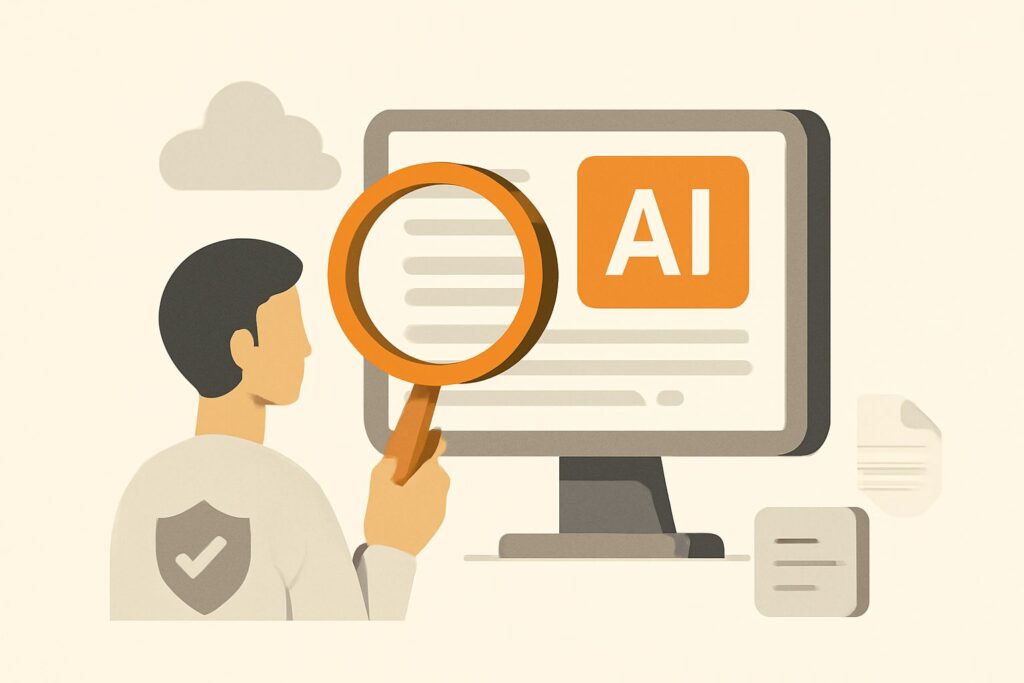
Before you trust any of the best AI content detectors to make a decision for you, understand what they actually are: probability estimators, not lie detectors. They guess how likely a passage was machine-generated based on statistical patterns, and independent testing consistently shows real-world accuracy well below the 99% figures vendors advertise. The most dangerous mistake isn’t picking the wrong tool — it’s treating any tool’s output as proof. This guide covers the strongest detectors honestly, including where each one earns its place and where all of them fall short.
It helps to know how these tools work before you trust one. An AI detector analyzes text for signals like low perplexity (how predictable each word is) and uniform sentence rhythm, patterns that machine writing tends to show more than human writing. That approach works reasonably well on raw, unedited AI output and gets much weaker on paraphrased, edited, or mixed human-AI text — exactly the kind most real workflows produce. The critical failure mode is false positives: genuine human writing, especially from non-native English speakers or people with a plain, consistent style, gets flagged as AI at meaningful rates, and the person wrongly accused pays the cost. Independent studies put real accuracy roughly in the 75–95% band depending on the sample, not the near-perfect scores on the marketing page. Use these tools as one signal, never as a verdict.
Originality.ai
Originality.ai is built for publishers, agencies, and content teams, and in multiple independent adversarial tests it lands among the most accurate paid detectors, including on paraphrased text where many tools collapse. It bundles plagiarism checking and team features alongside AI detection. It’s a paid tool aimed at professionals rather than casual users. Best for content teams and agencies that need to screen writers’ work at scale and want the strongest paid accuracy — while still treating results as evidence, not proof. Its edge on paraphrased text matters because that’s precisely where cheaper detectors give a confident-looking score that’s simply wrong, and a wrong score you trust is worse than no score at all.
GPTZero
GPTZero rose to prominence in education and remains one of the most widely trusted detectors, with strong performance on pure AI text and student-style writing across different models. It offers a free tier alongside paid plans and is designed to be approachable, with a highlighting view that shows which sentences it thinks are machine-written rather than just spitting out a single percentage. Like all detectors it can misfire on edited or non-native writing, so read the highlights with the same skepticism you’d give the score. Best for educators and individuals who want a well-known, accessible detector with a usable free option.
Copyleaks
Copyleaks pairs AI detection with a mature plagiarism-detection engine and multi-language support, and independent academic evaluation has ranked it among the more accurate tools for LLM-generated text. It’s positioned for enterprises, educational institutions, and businesses needing both plagiarism and AI checks in one platform. Best for organizations that need plagiarism and AI detection together, with language coverage beyond English.
Winston AI
Winston AI targets writers, publishers, and educators with a clean interface, AI detection, plagiarism checking, and readability scoring in one place. It positions itself around high claimed accuracy and workflow features like reports you can share. As always, verify claims against your own test samples rather than the marketing numbers. Best for content professionals who want detection plus plagiarism and reporting in a polished, purpose-built tool.
Turnitin
Turnitin is the incumbent in academic integrity, deeply embedded in universities and schools through its plagiarism platform, with AI-writing detection added to that ecosystem. Its reach and institutional integration are unmatched in education, though its AI detection — like everyone’s — has faced scrutiny over false positives on legitimate student work. Best for academic institutions already inside the Turnitin ecosystem, used with human judgment and an appeals process.
Sapling and other free checkers
Sapling offers an AI detector alongside its writing-assistant tools, and a range of free web checkers (including ones bundled with writing platforms) let you spot-check short passages at no cost. Free tools are fine for a quick gut-check but tend to be the least reliable and the most prone to false positives, so weight their output accordingly. Best for a fast, no-cost first look — never for a consequential decision on its own.
The honest other side: writing content that doesn’t need detecting
Detectors exist because so much unedited, low-value AI text got published. The durable answer for anyone producing content at scale isn’t to game a detector — it’s to produce work that’s genuinely good enough that the question stops mattering to your readers and to Google. This is where an AI-first SEO platform differs from a spray-and-pray generator. SEO Rocket’s AI article writer runs hard validation gates — a minimum word count, title and meta limits, at least five sections, and an automatic repair loop — and is built to slot into a human editorial process, not replace it, so drafts arrive structured and on-brief for a person to fact-check and finish. That’s the honest use of AI in content: quality-gated drafts that a human owns, rather than raw output pushed live and later flagged. SEO Rocket is not an AI detector and doesn’t pretend to be one; it’s the production-side counterpart, on a playbook proven across 1,000,000+ ranking pages. Best understood as the “write it well in the first place” approach that reduces why you’d be running a detector at all.
How to use a detector responsibly
Whatever tool you pick, the process matters more than the score. Never make a high-stakes decision — an accusation, a rejection, a payment dispute — on a single detector’s output.
- Cross-check with a second tool before drawing any conclusion.
- Weight false positives seriously, especially for non-native English writers.
- Treat scores as one signal alongside your own reading of the work.
- Keep a human in the loop for any decision with consequences.
The bottom line
The best AI content detectors in 2026 — Originality.ai, GPTZero, Copyleaks, Winston AI, Turnitin, and the free checkers — are useful signals, not verdicts, and every one of them carries a real false-positive risk that human writers pay for when the tool is trusted blindly. Pick the one that fits your context (professional content, education, or a quick spot-check), verify claims against your own samples, and always keep a person in the loop. And if your reason for detecting is a flood of thin AI content on your own site, the better fix is upstream: produce quality-gated, human-owned work — the kind SEO Rocket’s validation-gated writer is built to support — so detection becomes a formality rather than a firefight.