If you are weighing Ahrefs vs SEO Rocket, you are really comparing two different eras of SEO tooling. Ahrefs is the specialist instrument that a generation of SEOs learned the craft on — deep, precise, and built around the backlink graph. SEO Rocket is the AI-native workflow built for how the job runs now: you ask for what you need in plain language, get Ahrefs-grade data back, and draft the content in the same place. Neither is a toy, and the honest answer to which one wins depends entirely on what your week actually looks like.
This is not a takedown of Ahrefs. It is a genuine comparison of what each tool is best at, where the competitor is clearly stronger, and who should pick which. If you spend your days deep in link audits, you may finish this article and stay exactly where you are — and that is the right call.
What the comparison really comes down to
Most tool comparisons drown you in feature checklists. The decision is simpler than that. Ahrefs was designed as a reference library: an enormous, meticulously maintained database of backlinks, keywords, and rankings that you query through a dense interface. It assumes you already know what you are looking for and how to read it. That design is a strength for experts and a wall for everyone else.
SEO Rocket starts from the opposite premise. The data still has to be trustworthy, but the interface is a conversation, and the output is not just a report — it is often the finished article, the client dashboard, or the answer to “am I even showing up in ChatGPT.” So the real question in Ahrefs vs SEO Rocket is whether you want the deepest possible reference tool or the fastest path from question to published work.
Ahrefs vs SEO Rocket at a glance
Here is how the two stack up on the dimensions that decide most buying decisions. Read the notes below the table for the nuance, because a couple of these rows deserve more than a checkmark.
| Dimension | SEO Rocket | Ahrefs |
|---|---|---|
| Core interface | Chat-first, plain language | Dashboard-driven, dense |
| Backlink index depth | Solid, Ahrefs-grade feed | Industry-leading — larger, fresher |
| Keyword & rank data | Real, Ahrefs-grade data | Excellent, deep historical |
| AI content writing | Built in (Claude) | Not the focus |
| AI-search visibility | Built in (Brand Radar) | Limited |
| Site audit | Yes | Yes — very thorough |
| Agency client dashboards | Yes, read-only sharing | Via higher tiers |
| Learning curve | Low — you just ask | Steep |
| Rough entry price | Entry-friendly, low $ | Low hundreds / month |
Where Ahrefs is genuinely stronger
Start with the honest part, because it matters. Ahrefs runs one of the largest and freshest backlink indexes in the industry, and that lead is real. If your work is link-heavy — competitive backlink audits, disavow files, link-gap analysis across a dozen competitors, or link building at scale — Ahrefs sees more referring domains, updates them faster, and lets you slice that data more precisely than almost anything else on the market. That depth is expensive to build, and it shows.
The historical data is another edge. Ahrefs has been crawling and storing rankings and links for well over a decade, so when you need to see how a domain’s backlink profile or keyword footprint moved over three years, it simply has more history to show you. For forensic SEO — figuring out exactly when and why a competitor’s traffic changed — that archive is hard to beat. If either of these is the center of your job, keep Ahrefs and do not overthink it.
Where SEO Rocket makes its case
SEO Rocket’s argument is not “cheaper Ahrefs.” It is a different shape of tool. The chat-first interface means you ask for keyword research, a competitor gap, a backlink profile, or a rank-tracking update in plain language, and it runs the lookup on real, Ahrefs-grade data underneath. The data is not the differentiator; the workflow around it is. You are not hunting through tabs to assemble an answer — you describe the answer you want and get it.
Then the tool keeps going where a reference library stops. It drafts the article with Claude, using the same data you just pulled, so research and writing stop being two separate subscriptions and two separate afternoons. Its Brand Radar feature tracks whether your brand is being cited in ChatGPT, Perplexity, and Google’s AI Overviews — the search surface that traditional tools barely touch. And for consultants and agencies, the client dashboards mean you hand a client a live, read-only view instead of exporting spreadsheets every month.
Data quality: are you trading down?
This is the fear that stops most people from switching, and it is a fair one. The good news is that SEO Rocket runs on genuine Ahrefs-grade data for keywords, rankings, and domain metrics — Domain Rating, organic traffic estimates, top pages, referring domains, the core numbers you open a site explorer for. On day-to-day keyword and rank work, you are not trading down in any way you would notice.
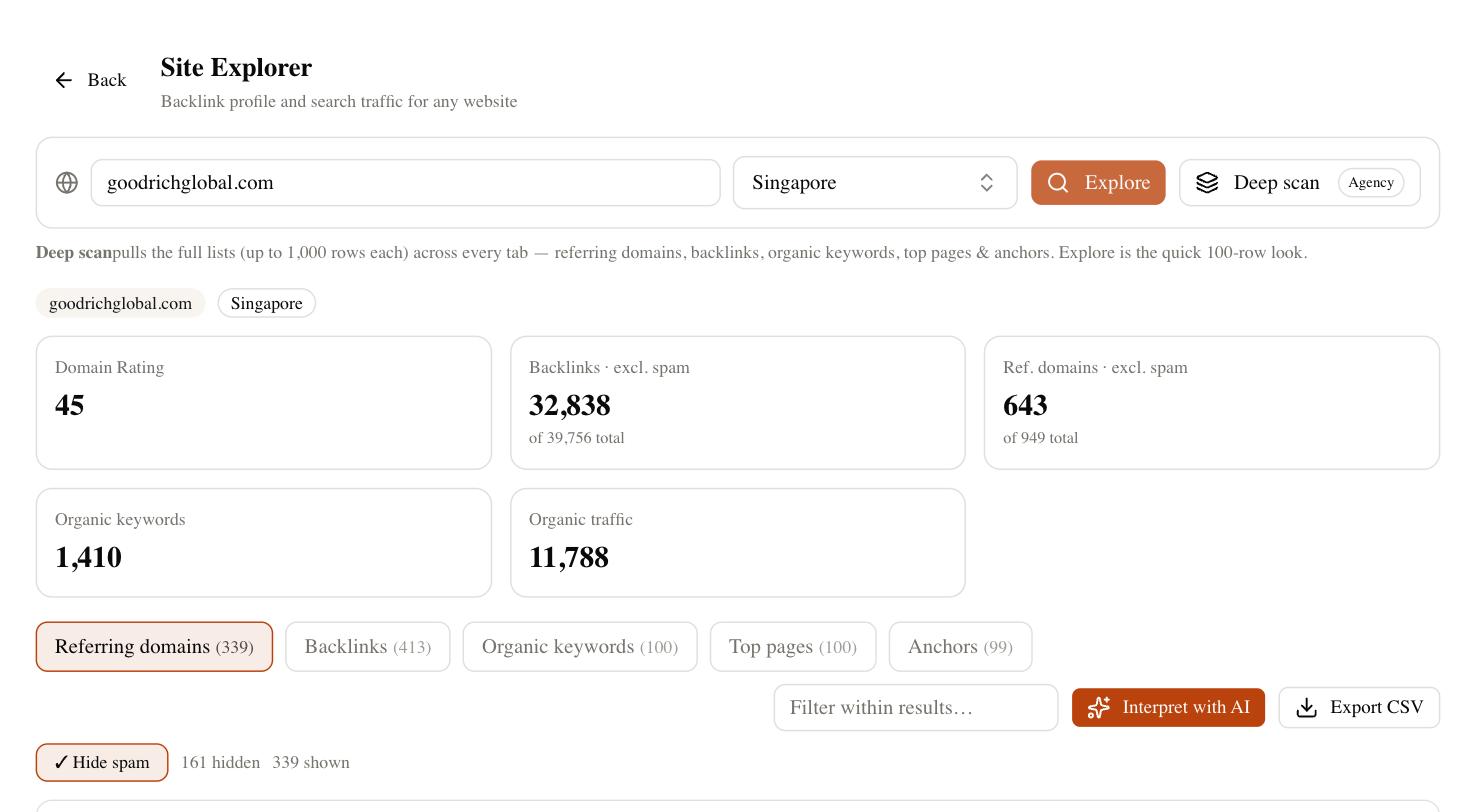
Where the honesty comes back in is backlink breadth. Ahrefs will surface more of the long tail of low-quality and freshly-discovered links, simply because its crawl is bigger. For most SEOs that difference is invisible — you care about the strong referring domains, and both tools show those. For a dedicated link builder, that extra tail is the job. Treat third-party metrics from either tool as estimates, not gospel; Domain Rating and traffic numbers are directional, and no tool’s figures are precise to the decimal.
Pricing and total cost of ownership
Headline price is only part of the story, but it is where the gap is widest. Ahrefs entry plans run into the low hundreds a month, credits burn quickly on a busy account, and adding seats or projects pushes the bill up fast. SEO Rocket’s entry pricing is a fraction of that — but the bigger saving is consolidation.
Think about the real stack most people run today: a backlink-and-keyword tool, plus a separate AI writer, plus something to check AI-search visibility. SEO Rocket folds those three into one subscription. So the fair comparison is not “SEO Rocket price versus Ahrefs price” — it is one bill versus three. If your reason for shopping is the invoice or the tool sprawl, that math is the whole argument.
Which one should you choose?
Match the tool to your actual constraint, not to the longer feature page. Choose Ahrefs if backlinks are the core of your work, if you need the deepest link index and the longest history, or if you are a large in-house team that already knows the interface cold and has the budget for it. There is no shame in staying with the specialist when the specialist is what your job demands.
Choose SEO Rocket if you are a solo SEO, consultant, or agency who wants one connected workflow — real data, AI writing, and AI-search visibility in the same place — without paying enterprise-backlink prices for a mid-tier set of tasks. A quick test: write down the three things you actually did in your SEO tool last week. If the list is some mix of checking what you rank for, seeing what a competitor is doing, and producing content, an AI-native tool covers that faster and cheaper. If your week was three hours deep in link audits, keep the specialist. Whichever you pick, run your own site and two competitors through it for a full week before you judge it — the one that answers your real questions fastest is the right tool for you.