If you write content for a living, you have probably tried Frase — and that is the right place to start this comparison. Frase vs SEO Rocket is really a question about where your work actually lives: inside a document, optimizing one page against the SERP, or across a whole account where research, writing, and tracking are one connected loop. Frase built its name on the first job and does it well. This piece is an honest look at where each tool wins, because pretending Frase is weak would waste your time and mine.
So this Frase vs SEO Rocket breakdown leads with the competitor on purpose. Frase has real strengths that SEO Rocket does not try to copy, and if content optimization scoring is the one thing you need, you should probably keep using it. The rest of the article explains when that is true, and when an AI-native workflow with real ranking and backlink data pulls ahead.
What Frase is genuinely good at
Frase is a content optimization and brief-building tool, and it is one of the cleaner ones. Point it at a keyword and it pulls the pages currently ranking, extracts their headings and questions, and hands you a structured brief in a minute or two. That SERP-driven outline is a real time-saver when you are briefing writers or starting from a blank page, and the workflow is tight enough that a content team can live in it all day.
The optimization score is the other draw. As you draft, Frase compares your text against the terms and topics the ranking pages cover, and nudges you toward the gaps. It is not a guarantee of rankings — no on-page score is — but it gives writers a concrete target instead of guessing, and it keeps thin drafts from shipping. For a content-first team whose bottleneck is producing and optimizing articles at volume, Frase earns its place.
Where Frase runs out of road
Frase’s boundary is the same as its focus. It is a page-level content tool, not a full SEO platform. It does not carry an Ahrefs-scale backlink index, its keyword and traffic data is thinner than a dedicated research tool, and rank tracking is limited compared with a tool built around it. When you need to know why a competitor outranks you — their links, their overall authority, the keywords driving their traffic — Frase points you elsewhere.
The newer gap is AI search. Buyers increasingly ask ChatGPT, Perplexity, and Google’s AI Overviews instead of typing a query and scrolling, and a page that scores perfectly in a content editor can still be invisible in an AI answer. Frase optimizes the document; it does not tell you whether you are being cited in the answers people now read instead of clicking. That is not a knock on Frase — it is a different job — but it is a job that matters more every quarter.
What SEO Rocket does differently
SEO Rocket is built chat-first. Instead of moving between a brief builder, a keyword tool, and a rank tracker, you ask for what you need in plain language and it runs the lookup on real, Ahrefs-grade data underneath — keyword research, competitor gaps, backlink profiles, rank tracking. The same conversation then drafts the article and checks whether your brand shows up in AI answers. The pitch is not that any single feature beats a specialist; it is that the whole loop happens in one place without exporting between tools.
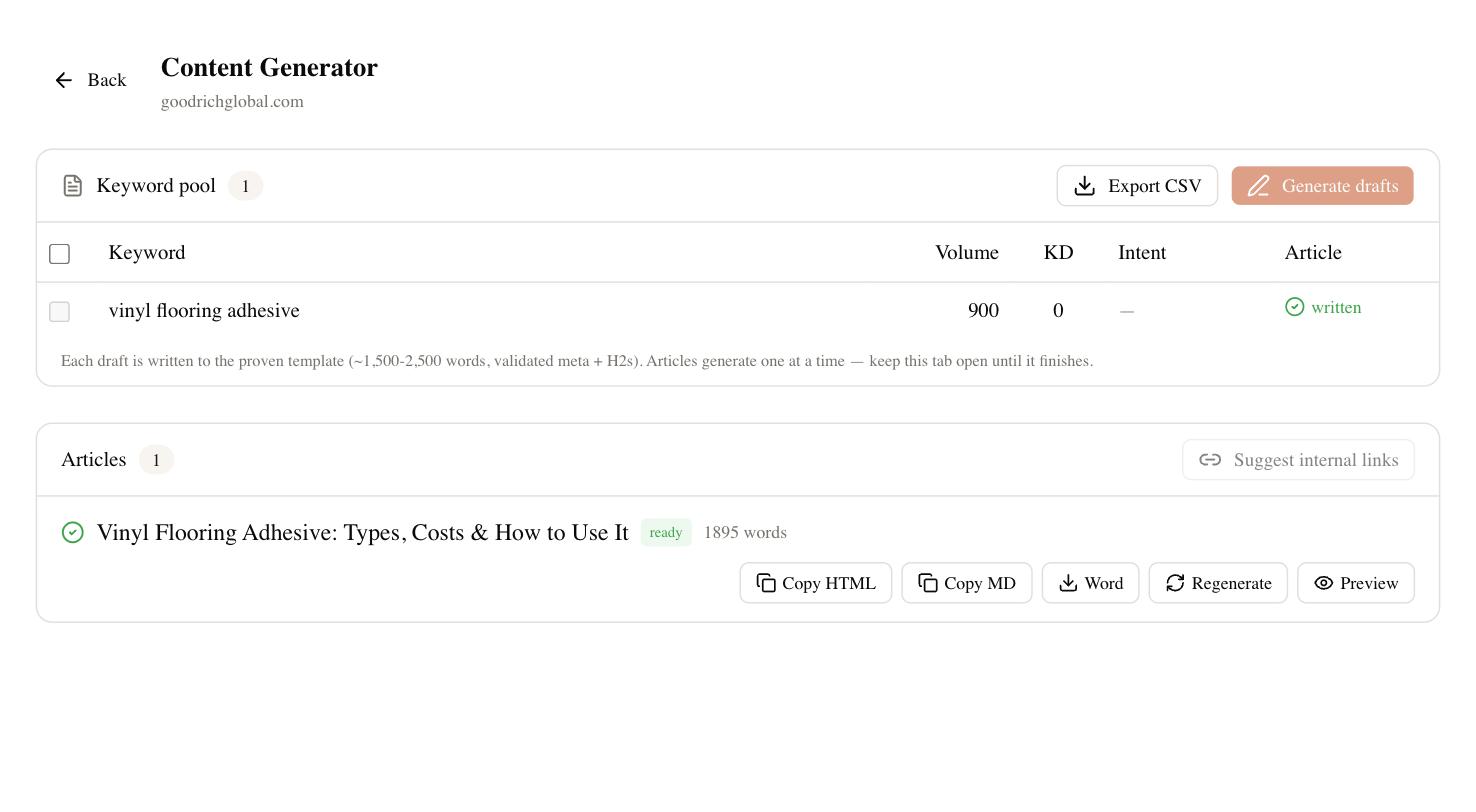
The content writing is powered by Claude, so the drafts read like a person wrote them rather than a template filled in blanks. But the part that separates SEO Rocket from a content optimizer is what surrounds the draft. Before you write, you can see the real keyword difficulty and the competitor’s backlink gap. After you publish, you can track the ranking and watch whether the page gets picked up in AI Overviews — all without leaving the same window. For a solo SEO or an agency, that consolidation is the point.
Frase vs SEO Rocket, side by side
Here is the honest split. Read across the row that matches your actual work, not the longest feature list.
| Capability | Frase | SEO Rocket |
|---|---|---|
| SERP-based content briefs | Strong — a core strength | Yes, generated in chat |
| On-page optimization score | Strong, mature scoring | Guidance in draft, less granular scoring |
| AI article writing | Yes, built in | Yes — powered by Claude |
| Keyword & backlink data | Limited, page-focused | Ahrefs-grade index |
| Rank tracking | Basic | Built-in, ongoing |
| AI-search visibility (Brand Radar) | Not covered | Tracks ChatGPT, Perplexity, AI Overviews |
| Competitor gap analysis | Content-level only | Keyword, content and backlink gaps |
| Client dashboards | Not the focus | Read-only client reporting |
| Interface | Document editor | Chat-first workflow |
| Rough price band | Low–mid $ | Entry-friendly $ |
Pricing and what you actually pay for
Both tools sit in reach of a freelancer, so this is less about the headline number and more about what the number replaces. Frase’s plans run in the low-to-mid range per month, and for a pure content workflow that is fair value — you are paying for briefs and optimization, and you get them. The catch is what is not included: if you also need real keyword research, backlink data, and rank tracking, you are buying a second subscription, often a pricey one, and stitching the two together by hand.
SEO Rocket’s case is that one entry-friendly plan covers the research, the writing, the tracking, and the AI-visibility piece together. That matters most if your current stack is a content optimizer plus a separate data tool plus a separate AI-search tracker. Fold three logins into one and the saving is real, both in money and in the time you lose exporting a keyword list from one tool to paste into another. If your stack is only Frase and you have no plans to add research tooling, that consolidation argument does not apply to you — and you should weigh it honestly.
Which one should you choose
Match the tool to your real constraint. If your job is producing and optimizing a high volume of articles, and your research and tracking already live in a separate platform you are happy with, Frase is a strong, focused choice — its briefs and optimization score are among the best at that specific task, and there is no reason to switch just for the sake of it. Keep the tool that does your main job well.
SEO Rocket is the better fit when the friction is tool-sprawl rather than writing alone. If you are a consultant or a small agency running keyword research, competitor analysis, content, rank tracking, and client reporting — and paying for three or four tools to do it — an AI-native workflow that answers all of those in one chat window will save you more than a marginally better optimization score ever could. The AI-search visibility tracking is the tiebreaker for anyone whose buyers have started asking chatbots instead of Google.
The honest bottom line
This is not a case where one tool is simply better. Frase is a specialist that does content optimization cleanly and affordably, and for a content-only team that specialization is a feature, not a limitation. If that describes you, the comparison ends there and you are already using the right tool.
The wider your job gets, the more the balance tips. Once you need Ahrefs-grade data, ongoing rank tracking, competitor backlink gaps, client dashboards, and a read on whether AI answers cite you — all beside the writing — running a content optimizer plus a data suite starts to feel like two half-workflows taped together. That is the gap SEO Rocket is built to close, in one chat-first tool. Try each on your own site and two competitors for a week; the one that answers your real questions fastest, with the fewest tabs open, is the right pick for how you actually work.