If you’re weighing Byword vs SEO Rocket, you’re really choosing between two different jobs. Byword is a content machine built to publish AI articles at scale, and the Byword vs SEO Rocket question usually comes down to whether raw article volume is your bottleneck or whether you need the research, tracking, and AI-search visibility that surround the writing.
Both are good at what they do. This comparison is written to help you pick the right one, not to pretend one tool wins every use case. Where Byword is the better answer, you’ll read that plainly.
What Byword actually is
Byword is an AI article writer built for SEO at scale. Its whole design points at one outcome: produce a lot of publishable long-form content, fast. You feed it keywords or titles — often a spreadsheet of hundreds of rows — and it returns full articles complete with headings, an intro, an FAQ block, and images. For programmatic SEO, where you’re generating a page for every “best X in Y” permutation, that batch workflow is the entire point.
The output quality is a genuine strength. Byword articles read more like a competent human draft than the flat, obviously-generated text early AI writers produced, and the built-in publishing pipeline pushes finished pieces straight to WordPress, Webflow, Ghost, and similar platforms. If your plan is to stand up a content site and fill it with a few thousand URLs this quarter, Byword is squarely aimed at you.
What SEO Rocket actually is
SEO Rocket is a chat-first AI SEO tool that folds four jobs into one place: Ahrefs-grade keyword and backlink data, AI content writing with Claude, AI-search visibility through Brand Radar, and rank tracking. Instead of a batch queue, you work in a conversation — you ask for keyword gaps against a competitor, then ask it to draft the article that fills one, then check whether you’re being cited in AI answers.
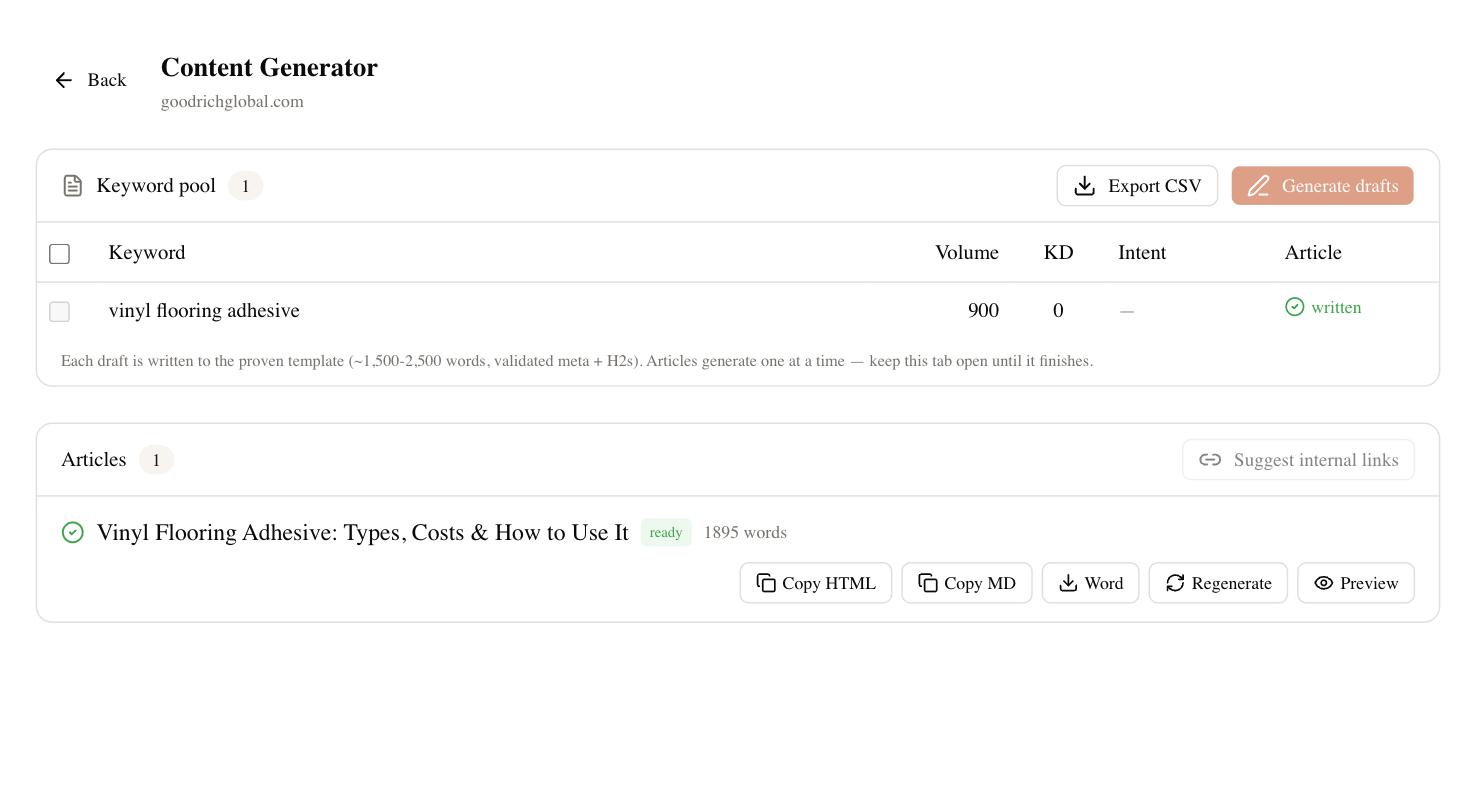
The writing isn’t detached from the data. Because the same system holds your keyword research, your competitor profiles, and your ranking history, a draft can be grounded in what you actually rank for and what the page-one competitors are doing, rather than spun from a keyword in isolation. The trade-off is that SEO Rocket is built for considered, connected work — not for firing off a thousand pages before lunch.
Byword vs SEO Rocket at a glance
Here’s the side-by-side. Read the notes underneath before you decide — the summary flattens some real nuance.
| Byword | SEO Rocket | |
|---|---|---|
| Core job | Bulk AI article production | All-in-one AI SEO workflow |
| Bulk / programmatic output | Yes — CSV batches of hundreds | One considered draft at a time |
| Keyword & backlink data | No native SEO dataset | Ahrefs-grade data built in |
| AI-search visibility | No | Yes — Brand Radar |
| Rank tracking | No | Yes |
| One-click publishing | Yes — WordPress, Webflow, Ghost | Export-based |
| Interface | Batch dashboard | Chat-first |
| Rough price band | Low hundreds / mo | Entry-friendly |
Where Byword is genuinely stronger
Volume is Byword’s clear win. If you need 500 city-and-service landing pages or a comparison article for every product pairing in a catalog, no chat-first tool is going to match a purpose-built batch generator. You upload the sheet, tune the template once, and let it run. SEO Rocket, by design, wants you in the loop on each piece — which is the wrong shape for pure scale.
The publishing pipeline is the second real advantage. Byword’s direct integrations mean a finished article can go from generated to live without a copy-paste step, which matters a lot when you’re moving thousands of URLs. Templated consistency is a third: when every page in a batch needs the same structure — intro, sections, FAQ, image — a generator that enforces that shape across hundreds of rows saves hours of manual formatting. If your bottleneck is the sheer mechanical throughput of writing and shipping content, Byword is the honest recommendation, and you shouldn’t talk yourself out of it.
Where SEO Rocket pulls ahead
SEO Rocket’s edge is everything that surrounds the writing. Byword produces articles, but it doesn’t tell you which keywords are worth targeting, whether a competitor already owns the topic, where you currently rank, or whether ChatGPT and Perplexity are citing you. You’d need a separate stack — a data tool, a rank tracker, an AI-visibility monitor — bolted around it. SEO Rocket puts those in the same conversation as the draft.
That matters more each quarter, because search is splitting. A growing share of buyers now ask an AI assistant instead of typing into Google, and a page that ranks first can still be absent from the AI answer. Brand Radar tracks whether you’re mentioned across those surfaces, so you’re optimizing for the search that’s actually happening. Byword, focused on production, doesn’t attempt this — and neither does most of the tooling built for the last era of SEO.
The other quiet advantage is grounding. Because a SEO Rocket draft can draw on your real ranking data and live competitor profiles, it’s aimed at content that has a reason to exist, not just content that fills a URL. You can ask why a page slipped, see the keywords a rival gained, and commission a rewrite in the same thread — a loop that a standalone writer simply can’t close on its own. For a small team or a consultant who lives and dies by whether pages actually rank, that connection between data and drafting is the whole game.
Pricing and what you really pay for
On sticker price, both sit in a reasonable range for independents and small teams — Byword’s entry plans land in the low hundreds a month, and SEO Rocket’s entry tier is deliberately approachable. But the number on the pricing page isn’t the real cost. With Byword, you’re paying for content generation alone; the keyword data, rank tracking, and AI-visibility monitoring you still need come from other subscriptions. Add those up and the true stack cost climbs.
SEO Rocket’s pitch is consolidation: one subscription covers the research, the writing, and the tracking, so the comparison isn’t tool-against-tool but stack-against-tool. If you already own strong data and tracking tools and only lack a volume writer, that consolidation is wasted on you and Byword is cheaper. If you’re assembling the stack from scratch, one bill usually wins.
Which one should you choose
Match the tool to your actual constraint. Choose Byword if your work is high-volume or programmatic content — you have the keywords, you have the publishing targets, and your only real bottleneck is generating and shipping articles fast. It’s built precisely for that, and it does it well.
Choose SEO Rocket if writing is only one part of your job and you’re tired of paying for a separate tool for every task. When you want Ahrefs-grade research, AI drafting, rank tracking, and AI-search visibility answered in the same chat — and you value one grounded, well-aimed article over a hundred generic ones — SEO Rocket is the stronger fit. And if you’re honestly torn, run one real project through each for a full ranking cycle before you commit; positions jitter a few spots day to day, so give either tool a couple of weeks before you judge the results.