
Most people land on a wordtune review after typing a sentence three times and still hating it. That is exactly the itch Wordtune was built to scratch — it takes a clumsy line and hands you a handful of cleaner ways to say the same thing. This wordtune review covers what the tool genuinely does well, where it quietly falls short, roughly what it costs, and the kind of writer it actually suits, so you can decide before you hand over a card.
Wordtune is made by AI21 Labs, and it has always been a rewriting-first product rather than a content factory. Keep that framing in mind, because it explains most of its strengths and every one of its limits.
What Wordtune actually is
At its core Wordtune is a browser extension and web editor that rephrases what you have already written. You highlight a sentence, and it offers several rewrites — some tighter, some more formal, some more casual — while keeping your meaning intact. Around that central trick it has grown a wider toolkit: a tone switch between formal and casual, grammar and spelling cleanup, a synonym helper, a “continue writing” generator, and a summarizer that condenses articles, web pages, and even YouTube videos into a few lines.
It works where you already write — Gmail, Google Docs, LinkedIn, most text boxes on the web — which is a big part of the appeal. You are not copying text into a separate app and back. The suggestions appear inline, and you pick the one that sounds like you.
What Wordtune does well
The rephrasing is the reason to use it, and it is legitimately good. Where a plain grammar checker flags an error, Wordtune offers you a genuinely different sentence — often three or four — and lets you choose. For anyone who freezes on phrasing, that is a real unlock. Non-native English writers get the most out of it here; it smooths idiom and rhythm in a way spellcheck never will, without flattening the message.
The summarizer is the other standout. Paste a long report or drop in a URL and you get a usable digest in seconds, which is handy for research, inbox triage, or getting the gist of a dense page before you commit to reading it. The tone control is quietly useful too — turning a blunt Slack message into a client-safe email is a two-click job.
Because everything lives in the browser, the friction is close to zero. You do not open a dashboard or start a project. You write as normal, and the help shows up when you want it.
Where Wordtune falls short
The honest limits start the moment you ask it to do more than polish. Wordtune is not an SEO tool, and it does not pretend to be one — there is no keyword research, no search-volume data, no SERP analysis, and nothing that tells you what a page needs to rank. If your goal is content that gets found on Google, Wordtune helps the sentences read well but has no opinion on whether the article should exist or what it should cover.
Long-form generation is the second soft spot. The “continue writing” feature is fine for nudging past a stuck paragraph, but it is not built to draft a structured 1,500-word article with a title, headings, and a meta description. Dedicated writing tools do that job better because it is the job they were designed for. Lean on Wordtune too hard across a whole piece and the prose can drift toward a smooth, slightly generic middle — the sameness a lot of AI rewriting introduces when you accept every suggestion.
The free plan is also tight. It exists, and it is genuinely useful for light users, but the daily rewrite and generation caps come up fast once you write for a living, which pushes most serious users onto a paid plan.
Wordtune pricing, roughly
Wordtune keeps a free tier that needs no credit card, with a limited number of rewrites and AI actions per day. Paid plans move you into unlimited or near-unlimited rewrites plus the fuller toolkit, and they generally sit in the roughly $10–$30 a month band depending on the tier and whether you pay monthly or annually. That is affordable next to a full marketing suite, and fair for what the tool does. Just price it against the job: it is a writing companion, not a content or SEO platform, so judge the cost on how much cleaner your everyday writing gets, not on rankings it was never meant to move.
Wordtune versus an AI SEO tool
This is where a lot of buyers get confused, because Wordtune sits next to tools that look similar on the surface but solve a different problem. If you are choosing between “help me write this better” and “help me write something that ranks,” those are two different purchases. Here is the honest split.
| Job | Wordtune | SEO Rocket |
|---|---|---|
| Rephrase a clumsy sentence | Excellent — its core strength | Not the focus |
| Fix grammar and tone inline | Yes, everywhere you write | Handled inside drafting |
| Keyword research & search data | None | Yes — Ahrefs-grade data |
| Draft a full SEO article | Weak — not designed for it | Yes — structured, on-brief |
| AI-search visibility tracking | None | Yes — Brand Radar |
| Rough price band | Low $ / writer-friendly | Low $ / entry-friendly |
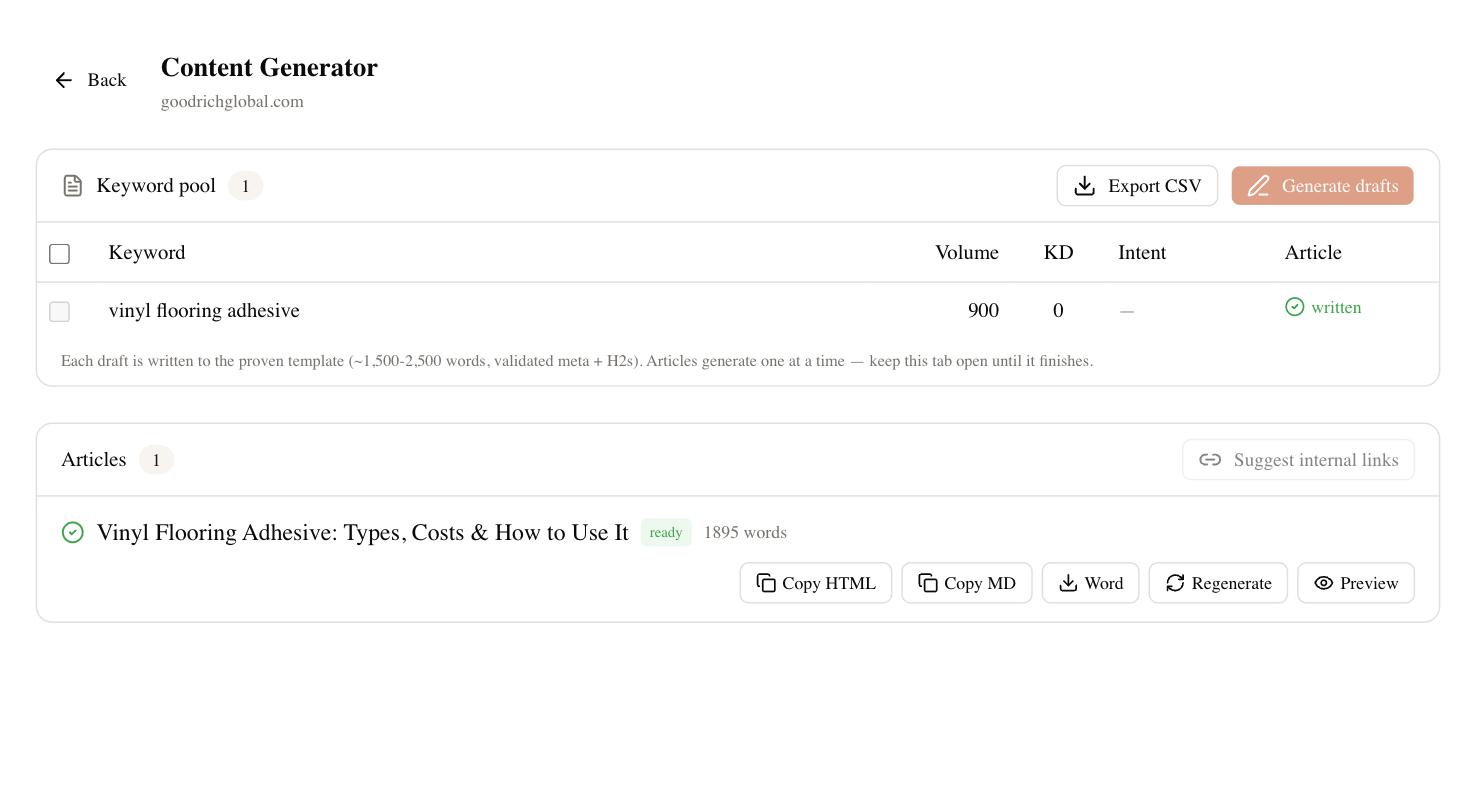
SEO Rocket is worth naming here because it answers the part Wordtune leaves open. It is a chat-first, AI-native SEO tool: you ask in plain language for keyword research or a competitor gap, it runs the lookup on real search data, and the same tool drafts the article — title, meta, and heading structure included — then tracks whether your brand shows up in AI answers like ChatGPT and Google’s AI Overviews.
To be fair to Wordtune, that is a different tool for a different day. If all you need is to write clearer emails and cleaner paragraphs, an SEO platform is overkill and Wordtune is the lighter, better fit. The two are complements as often as they are rivals — polish with one, rank with the other.
Who Wordtune is for
Wordtune suits people whose bottleneck is phrasing, not strategy. Students, professionals drowning in email, social and community managers, and especially non-native English writers all get daily value from the rewrite and tone tools. If you write a lot of short-form copy and just want it to read better with less staring at the cursor, it earns its keep.
It is the wrong tool if your real job is producing content that ranks and gets cited. There is no keyword data, no SERP insight, and no AI-visibility tracking, so you would still need a second subscription for the actual SEO work. For that side, an AI-native tool built for search is the honest recommendation.
The verdict
Wordtune is a genuinely good rewriting assistant that knows what it is. The paraphrasing is its best-in-class feature, the summarizer is a real time-saver, and the browser-everywhere design keeps friction low. The catch is scope: it makes your writing better, but it does nothing to decide what to write or whether anyone will find it. Buy it to sharpen your prose, keep your expectations pinned to that, and it is easy to recommend. If your problem is rankings rather than wording, put your money toward a tool built for search instead — and give either one a couple of weeks of real work before you judge it.