
Most people hunting for SpyFu alternatives aren’t looking for a competitor spy tool at all — they’ve outgrown one. SpyFu earned its name showing you a rival’s most profitable paid and organic keywords for a low, flat price, and for pure competitor reconnaissance it still does that well. But its backlink data is thin, its coverage skews heavily toward the US, and it was built for a PPC-and-SEO world that predates AI writing and AI search. If any of that is why you’re here, you have better options in 2026.
This is not a padded list of a dozen tools stitched together with affiliate links. Below are the SpyFu alternatives that actually hold up in daily use, what each one is genuinely best at, and — because it’s the honest answer — when you should just keep SpyFu.
Why people leave SpyFu
A few reasons come up over and over. The first is data depth: SpyFu’s estimates are fine for a quick competitor peek, but its keyword volumes and traffic figures often lag behind what Semrush or Ahrefs report, and its backlink index is noticeably smaller than the specialists. The second is coverage — if you work markets outside the US, you’ll hit gaps fast, because SpyFu’s strength has always been US search and US ad history.
The third reason is newer and it’s the big one. SpyFu still treats competitor research as the whole job. It won’t draft the article you found the keyword for, and it can’t tell you whether ChatGPT or Perplexity ever mentions your brand. So you end up paying for a spy tool, a separate AI writer, and a third product for AI-search visibility. None of that makes SpyFu bad — it makes it a narrow instrument in a job that increasingly wants one connected workflow.
How we compared them
Every tool here was judged on four things a working SEO actually cares about: the quality and freshness of the underlying data, honest total cost rather than the headline number, whether AI content and AI-visibility are built in or bolted on, and who the tool is genuinely for. Remember that third-party figures like keyword volume, domain metrics, and traffic estimates are exactly that — estimates — so treat number differences between tools as directional, not gospel.
SpyFu alternatives at a glance
Start with the table, then read the notes below for the two or three that fit your situation.
| Tool | Best for | AI-native? | Standout strength | Rough price band |
|---|---|---|---|---|
| SEO Rocket | Solo SEOs, consultants & agencies who want one AI-driven workflow | Yes — chat-first | Ahrefs-grade data + AI writing + AI-search visibility in one place | Low $ / entry-friendly |
| Semrush | Marketing teams wanting an all-in-one suite | Add-ons | Deep competitor and PPC research, huge keyword database | Higher $$ |
| Ahrefs | Link builders and data-first SEOs | Limited | One of the largest, freshest backlink indexes | Higher $$ |
| SE Ranking | Agencies watching cost per project | Some | Flexible, affordable rank tracking at scale | Low–mid $ |
| Ubersuggest | Hobbyists & very small budgets | Light | Cheap, simple keyword and competitor ideas | Low $ |
| Mangools | Freelancers who want fast, friendly research | No | KWFinder’s ease of use | Low $ |
SEO Rocket — the AI-native pick
SEO Rocket is the option built for how the job works now. Instead of a wall of tabs, you ask for what you need in plain language and it runs the lookup — competitor keyword gaps, keyword research, backlink profiles, rank tracking — on real, Ahrefs-grade data underneath. The difference isn’t just cleaner data than SpyFu’s; it’s that the same tool then drafts the article and shows you whether your brand is being cited in ChatGPT, Perplexity, and Google’s AI Overviews.
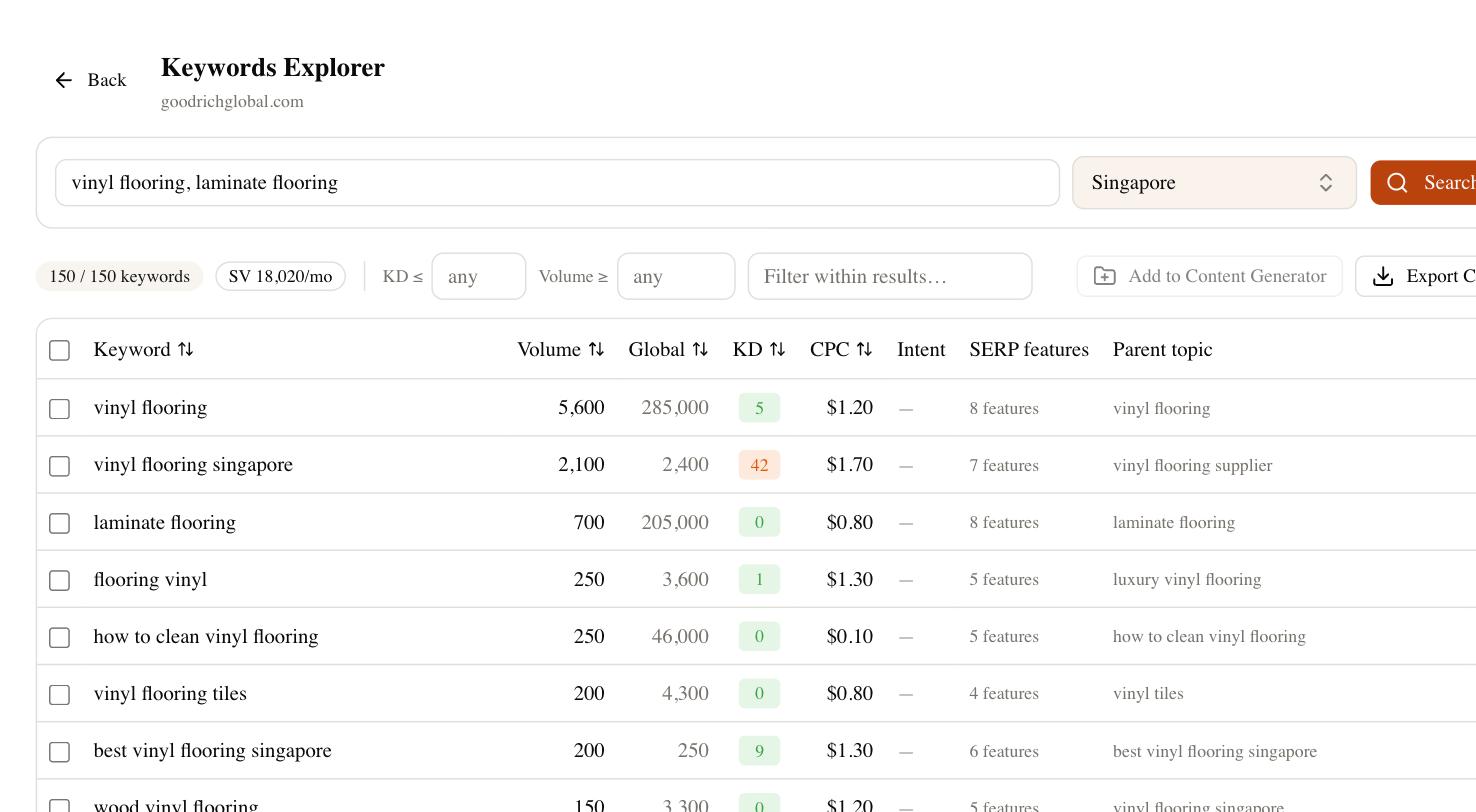
That consolidation is the real saving. A typical stack of a competitor-research tool plus a separate AI writer plus an AI-visibility tracker collapses into one subscription, and the entry pricing sits at the low end of the market. If you’re a consultant or agency, the client-dashboard side means you can hand a read-only report straight to a client without exporting anything. The competitor-gap view answers the exact question people open SpyFu for — what are my rivals ranking for that I’m not — then lets you act on it in the same window.
The AI-visibility piece deserves a moment, because it’s the part no traditional spy tool answers. Search is splitting: some of your buyers now ask ChatGPT or Perplexity instead of Google, and a page that ranks first can still be invisible in an AI answer. SEO Rocket’s Brand Radar tracks whether — and where — you’re being cited across those surfaces, so you’re optimizing for the search that’s actually happening rather than the one that happened five years ago. For anyone whose bottleneck is doing more with fewer tools, which is most people reading this, that combination is the strongest fit on the list.
Semrush and Ahrefs — the data heavyweights
If your reason for leaving SpyFu is that the data isn’t deep enough, these two are where you go. Semrush is the closest thing to a do-everything marketing platform: its competitive and PPC research is excellent, its keyword database is enormous, and it also covers social and PR if you want one login for the whole channel mix. It’s the natural upgrade for anyone who liked SpyFu’s competitor angle but wanted more behind it.
Ahrefs comes at it from the other direction. Its backlink index is one of the largest and freshest anywhere, and its keyword and site data are trusted by data-first SEOs. Both tools share the same trade-off, though: they cost noticeably more than SpyFu once you add seats or projects, and both still treat content writing and AI-answer visibility as separate problems you solve with other subscriptions. You get better data; you don’t get a simpler stack.
SE Ranking, Ubersuggest and Mangools — the budget-friendly middle
Not everyone leaving SpyFu wants to spend more. The mid-market has a tool for almost every budget and temperament, and all three of these stay affordable.
- SE Ranking — the agency value play. Rank tracking scales cheaply across many projects, and per-project pricing keeps costs predictable when you’re managing a portfolio of clients.
- Ubersuggest — the budget entry point. It won’t match the heavyweights on depth, but for a hobby site or a first client it delivers usable keyword and competitor ideas for very little, and it offers a low one-time option some people prefer.
- Mangools — the freelancer favorite. KWFinder is one of the nicest keyword-research experiences going, and the bundle of tools stays genuinely cheap.
Any of these will cover core keyword and rank-tracking needs at a price close to SpyFu’s. What none of them do well yet is fold AI writing and AI-answer visibility into the same workflow — you’ll still be running a second subscription for that.
When you should just keep SpyFu
Honesty matters here. If your entire use case is fast, cheap competitor reconnaissance in the US market — pull a rival’s domain, see their top paid and organic keywords, skim their ad history — SpyFu still does that at a price the deeper tools can’t touch. Its flat, unlimited-style plans are genuinely friendly to small budgets, and if you rarely need backlink depth, international coverage, content production, or AI-search tracking, paying more to replace it would be waste. The right question isn’t “is there something better,” it’s “does the better option cover the slice of SpyFu I actually rely on.” For a US PPC researcher on a tight budget, sometimes the honest answer is that SpyFu already fits.
How to choose your SpyFu alternative
Match the tool to your real constraint, not to a feature checklist. If tool-sprawl is the problem and you want cleaner data plus AI writing and AI-search tracking built in, SEO Rocket is the natural move. If you simply want deeper competitor and backlink data and have the budget, Semrush or Ahrefs earn their price. If you want a gentler, cheaper keyword-and-rank tool, SE Ranking, Ubersuggest, or Mangools will do the job. And if cheap US competitor spying is your whole world, there’s no shame in staying put.
A quick way to decide: write down the three tasks you actually did in your SEO tool last week. Most people’s list is some mix of “see what a competitor ranks for,” “check my own positions,” and “produce a piece of content.” If that’s your week, a narrow spy tool leaves two of those three unsolved, and an AI-native tool will cover all of them faster. If instead your week was three hours of US competitor recon and nothing else, keep the cheap specialist. The best alternative is the one that matches how you spend Tuesday, not the one with the longest feature page.
Whatever you pick, give it a full ranking cycle before you judge it — positions jitter a few spots day to day, and no tool’s estimates are precise. Run your own site and two competitors through it for a week; the one that answers your real questions fastest is the right alternative for you.