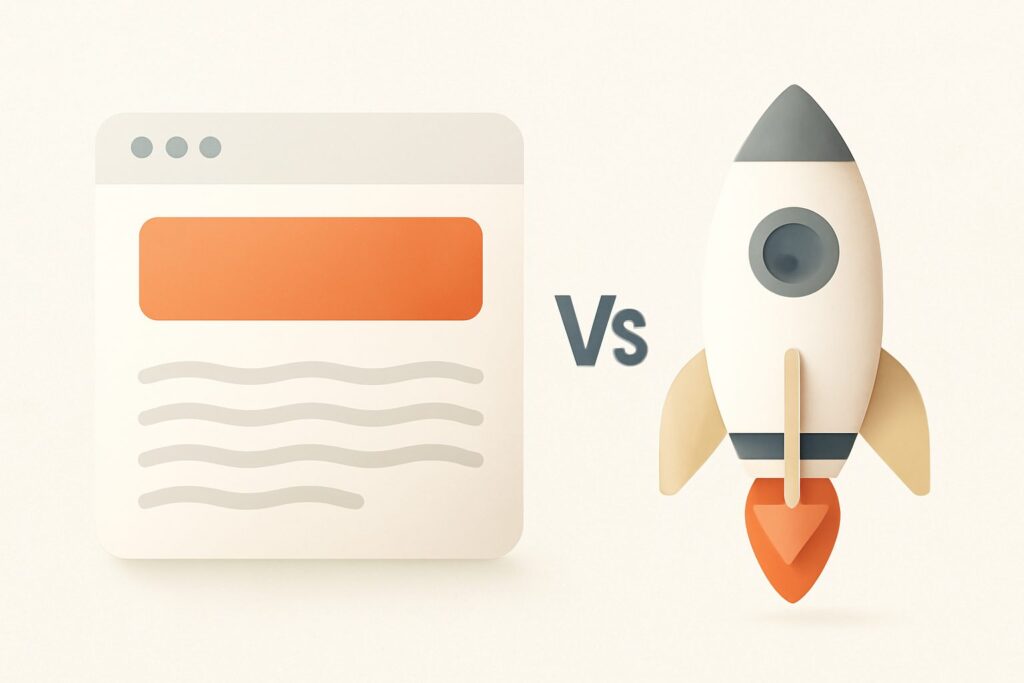
If you’re weighing Copy.ai vs SEO Rocket, the first thing to know is that they aren’t really the same kind of tool. Copy.ai vs SEO Rocket looks like a copywriting bake-off on the surface, but Copy.ai has spent the last couple of years walking away from being a copywriting app, while SEO Rocket was built from the ground up for one job: organic search. Pick the wrong one and you’ll pay for a workflow you never use.
This is a competitor-first comparison. We’ll start with what Copy.ai genuinely does well today, be honest about where it beats SEO Rocket, and only then make SEO Rocket’s case. By the end you’ll know which fits your actual week — not which has the longer feature page.
What Copy.ai actually is now
Copy.ai launched around 2020 as one of the first mainstream AI copywriting tools — templates for blog intros, product descriptions, ad copy, cold emails, and social posts. It got popular fast because it made a blank page less terrifying. But since roughly 2023 the company has deliberately repositioned itself as a “GTM AI Platform,” short for go-to-market. That’s not marketing fluff; it’s a real pivot.
Today Copy.ai is aimed at revenue teams. Its centerpiece is Workflows and agents that automate go-to-market tasks: enriching leads, researching accounts, drafting personalized sales outreach at scale, summarizing calls, translating content, and pushing all of it through your CRM and sales stack. Copywriting is still in the box, but it’s now one feature inside a broader automation platform for sales and marketing operations. If you came looking for a pure AI writer, that shift matters.
What SEO Rocket is
SEO Rocket is a chat-first AI SEO tool. You ask for what you need in plain language and it runs the work on real, Ahrefs-grade data underneath — keyword research, competitor content gaps, backlink profiles, and rank tracking. The same chat then drafts the article, grounded in that data, and its Brand Radar feature tracks whether you’re being cited in AI search surfaces like ChatGPT, Perplexity, and Google’s AI Overviews.
The point is consolidation for a single goal. Instead of a keyword tool, a separate AI writer, and a third AI-visibility tracker, you get one workflow built around organic growth. Copy.ai spreads across the whole go-to-market motion; SEO Rocket goes deep on search. That focus is the trade-off in a sentence: less surface area, more depth on the one thing an SEO does all day.
Copy.ai vs SEO Rocket at a glance
Here’s the honest side-by-side. Read the notes below it before you decide, because the summary hides some real trade-offs.
| Dimension | Copy.ai | SEO Rocket |
|---|---|---|
| Core purpose | Go-to-market automation + copywriting | SEO: data, content, rank tracking in one |
| Best for | Sales & marketing ops teams | Solo SEOs, consultants & agencies |
| SEO keyword & SERP data | No native SEO data | Yes — Ahrefs-grade |
| Backlink & rank tracking | No | Yes |
| AI content writing | Yes — broad formats | Yes — SEO-grounded, Claude |
| AI-search visibility | No | Yes — Brand Radar |
| GTM / sales workflow automation | Yes — its main strength | No |
| Interface | Workflow builder + templates | Chat-first |
| Rough price band | Free tier; low $ self-serve; custom $$$ for GTM | Low $ / entry-friendly |
Where Copy.ai is genuinely stronger
Be clear-eyed here: for a lot of teams, Copy.ai is the better buy. If your bottleneck is go-to-market volume — thousands of personalized sales emails, lead enrichment, account research feeding a CRM — SEO Rocket doesn’t do any of that, and Copy.ai does it well. Its workflow automation and agent framework are the whole reason to buy it, and they’re mature.
It also wins on breadth of copy. Copy.ai will happily produce ad variations, LinkedIn posts, product descriptions, cold-outreach sequences, and email nurture flows across dozens of formats, and its brand-voice controls keep that output consistent across a team. SEO Rocket writes for search; it isn’t trying to be your ad-copy or sales-email machine. If your week is mostly non-SEO marketing and revenue work, Copy.ai fits the shape of that job far better, and pretending otherwise would waste your money. The mistake is buying an SEO tool for a job that isn’t SEO.
Where SEO Rocket wins
The gap opens the moment the job is actually search. Copy.ai can write a blog post, but it writes from a prompt, not from data. It doesn’t know your keyword’s search volume, which competitor pages already rank, what the content gap is, or where you sit in the SERP. SEO Rocket does, because that data is the substrate the draft is built on — you’re not guessing at a topic, you’re answering the demand the numbers show.
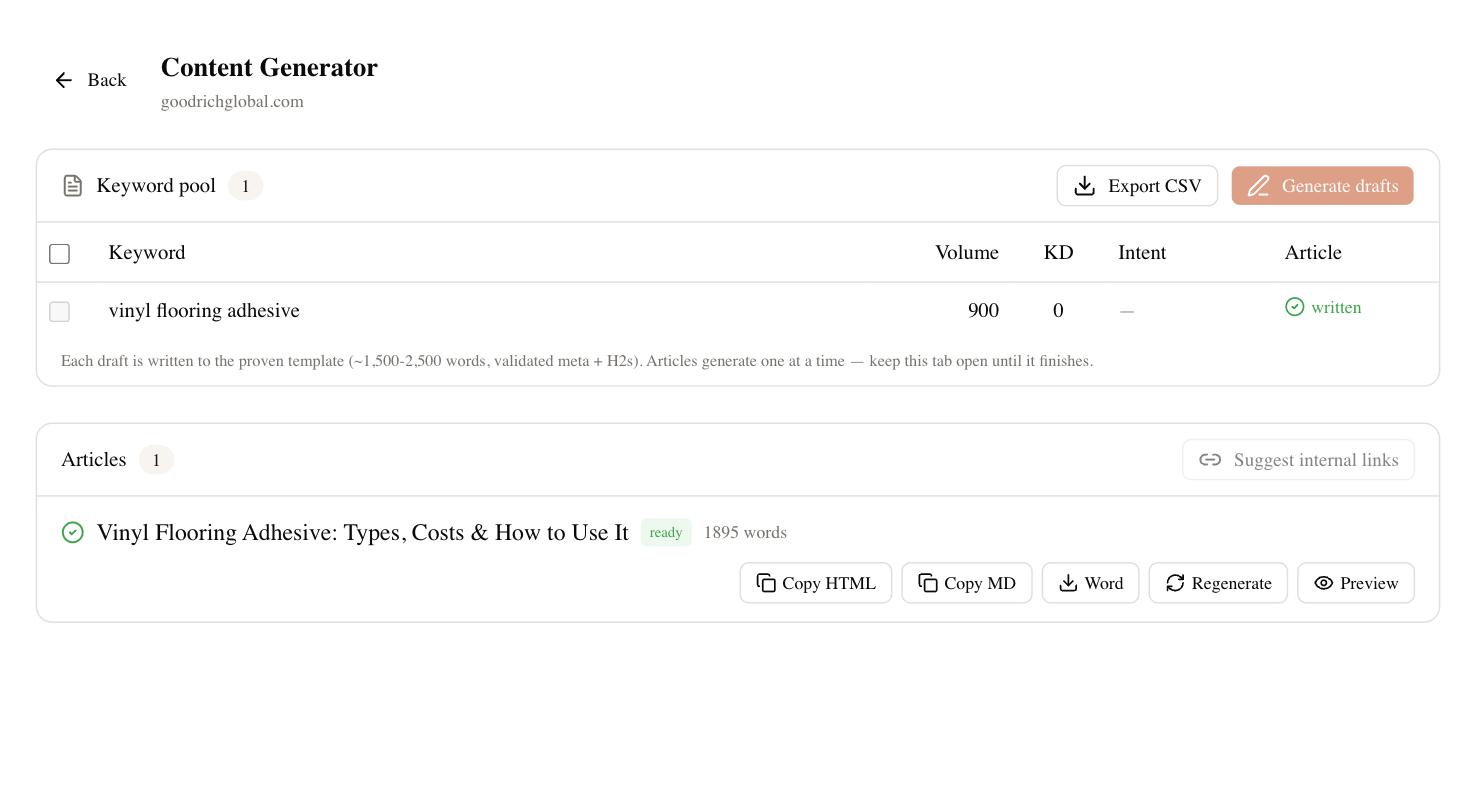
Then there’s everything after the draft. SEO Rocket tracks your rankings over time and watches your backlink profile — table stakes for SEO that a GTM platform simply doesn’t include. And Brand Radar answers the question no copywriting tool can: is ChatGPT or Perplexity actually citing your brand? Search is splitting, and a page that ranks first on Google can still be invisible in an AI answer. Optimizing for that shift is native here, bolted on nowhere in Copy.ai.
The last edge is workflow. Because SEO Rocket is chat-first and single-purpose, you go from “what should I write about” to a data-backed draft to a tracked ranking without switching tools or exporting anything. For a consultant or small agency, that consolidation is the saving — one subscription instead of a keyword tool, a writer, and a visibility tracker stacked together.
Pricing, honestly
Neither company loves publishing simple numbers, so treat these as bands, not quotes. Copy.ai has historically offered a free tier and low-cost self-serve plans in the tens of dollars per month for the writing side — genuinely accessible if all you want is copy. The GTM platform, with workflows and seats and integrations, moves into custom, higher-tier pricing that’s aimed at teams, and that’s where the real cost lives.
SEO Rocket sits at the entry-friendly, low end for what it bundles, precisely because it replaces two or three separate SEO subscriptions with one. The fair way to compare isn’t sticker price — it’s cost per job you actually do. If your job is SEO, paying for Copy.ai’s GTM tier to get writing you’d still have to pair with a real SEO stack rarely pencils out.
Which one should you choose?
Match the tool to your real constraint. If you run sales and marketing operations and your pain is go-to-market volume — outreach, enrichment, multi-format copy, workflow automation across a revenue team — Copy.ai is the honest recommendation, and SEO Rocket won’t replace it. Buy Copy.ai without guilt if that’s your week.
If your job is organic search — ranking pages, tracking positions, producing content that’s grounded in keyword and competitor data, and staying visible as buyers move to AI answers — SEO Rocket is built for exactly that, and Copy.ai isn’t. A quick test: write down the three tasks you did last week. If they’re “find a keyword,” “check a competitor,” and “publish a post that ranks,” you want the SEO tool. If they’re “enrich a lead list,” “personalize 500 emails,” and “brief the sales team,” you want the GTM platform. The best choice is the one that matches how you actually spend Tuesday.