SEO for TikTok is a real discipline, but almost none of it looks like the SEO you know from Google. There are no page titles to write, no meta descriptions to tune, no URLs to shape, no redirects, no structured data, and no page-speed score to chase. When people say they want SEO for TikTok, what they actually need is to be found in two places: TikTok’s own in-app search, and the growing number of TikTok videos that now appear in Google’s results. Both reward the same handful of signals, and none of them are the technical levers you’re used to pulling.
This guide is specific to the app — its real settings and its real limits. If you came expecting canonical tags and sitemaps, the honest news is that TikTok doesn’t give you any of them. What it gives you instead is a search engine that reads what you say, what you show on screen, and how people respond. Learn those three and you can rank inside the app without touching a single line of markup.
What “SEO” even means on TikTok
TikTok search is a genuine query engine. Users type things like “best budget espresso machine” or “how to fix a leaking tap” straight into the search bar, and TikTok returns videos ranked by relevance and performance. On top of that, Google now surfaces TikTok clips in its own search results and video carousels, so a single video can earn traffic from two different engines at once. Your job is to make each video legible to both — clear about what it covers, and engaging enough to keep watchers watching.
There’s a second reason to care. A growing share of younger users open TikTok before they open Google when they want a recommendation or a how-to. That shifts TikTok from an entertainment feed to a discovery engine, and it means a well-optimized video can quietly become an evergreen asset that keeps pulling searchers in long after the trend that inspired it has faded. Unlike a fleeting viral hit, a search-optimized video earns views on a schedule you don’t control but can absolutely feed.
What you can’t control (the honest limits)
Start by accepting what isn’t yours to touch. Every classic technical-SEO lever is either automated or absent. You don’t set the URL, you can’t edit a title tag, and there is no way to add schema or 301 a dead video to a new one. Pretending otherwise wastes time. Here’s the reality, side by side.
| Classic SEO lever | On TikTok? | What you get instead |
|---|---|---|
| URL / slug | No control | Auto-generated numeric video ID |
| Title & meta tags | None | The caption and on-screen text |
| Structured data / schema | Not available | Hashtags and topic signals |
| Redirects (301/302) | None | Repost or pin a newer video |
| Page speed / Core Web Vitals | Not applicable | Video load is TikTok’s job |
| JavaScript rendering / crawl budget | Not applicable | TikTok indexes audio, text, caption |
| Alt text on images | None | Spoken words and text overlays |
The takeaway isn’t that TikTok is worse at SEO — it’s that the ranking surface moved. Relevance is read from the content itself, not from tags wrapped around it.
The signals TikTok actually reads
TikTok understands your video through several inputs, and it stacks them. It transcribes your audio, so the words you say out loud become searchable text. It runs optical character recognition on your on-screen captions and text overlays, so a keyword typed across the screen counts too. It reads your written caption and your hashtags. And it weighs all of that against performance signals — watch time, completion rate, rewatches, saves, shares, and comments. A video that says the keyword, shows the keyword, and holds attention will out-rank a prettier clip that does none of those things.
This is why a vague caption fails. If your video never names the thing it’s about — in speech, on screen, or in text — TikTok has to guess, and it usually guesses wrong. It’s also why the first few seconds carry so much weight: they set the transcript, they set the hook, and they set the drop-off point that tells the algorithm whether to keep pushing your video into search results and the For You feed. Treat those opening seconds as the closest thing TikTok has to a title tag.
The highest-leverage moves that work
A few habits do most of the heavy lifting. None of them are technical, and all of them are repeatable.
- Say the keyword out loud in the first three seconds. The transcript is a ranking input and the hook decides watch time — this move helps both at once.
- Put the keyword on screen as text. A plain overlay of your target phrase feeds OCR and doubles as a hook for silent viewers.
- Write a caption that reads like a sentence, not a hashtag dump. Include the phrase naturally, then two or three tightly relevant hashtags — not twenty.
- Use TikTok’s own Search Insights. Inside Creator tools, the search feature shows real queries people type. Build videos around those exact phrases instead of guessing.
- Stay on one niche. Consistent topics train the algorithm on who to show you to, which lifts every future video’s search relevance.
Mistakes people make with TikTok SEO
The most common error is treating TikTok like a Google page and stuffing the caption with every keyword and thirty hashtags. TikTok reads that as noise, and it does nothing for watch time — the signal that actually matters. The second mistake is silence: posting a beautiful clip with no spoken words and no on-screen text, then wondering why it never surfaces in search. The third is inconsistency — jumping between unrelated topics so the algorithm never learns what you’re the answer to. Finally, many creators ignore the caption entirely, leaving a single emoji where a searchable sentence should be. Each of these throws away free relevance.
One more trap is worth naming: chasing trending sounds that have nothing to do with your topic. A trending audio can lift a single video’s reach for a day, but it confuses the topic signal and rarely helps you rank for a search term anyone types on purpose. If the goal is discovery rather than a one-day spike, pick relevance over the trend every time.
Where web SEO tools fit the TikTok side
Here’s the honest boundary: SEO Rocket is a web SEO tool, and it doesn’t run inside TikTok or read TikTok’s private engagement data. What it does well is the demand research that feeds your TikTok topics and the Google-facing half of the equation. Because TikTok videos increasingly rank in Google, the phrases with real search volume there are often the same phrases worth saying on camera.
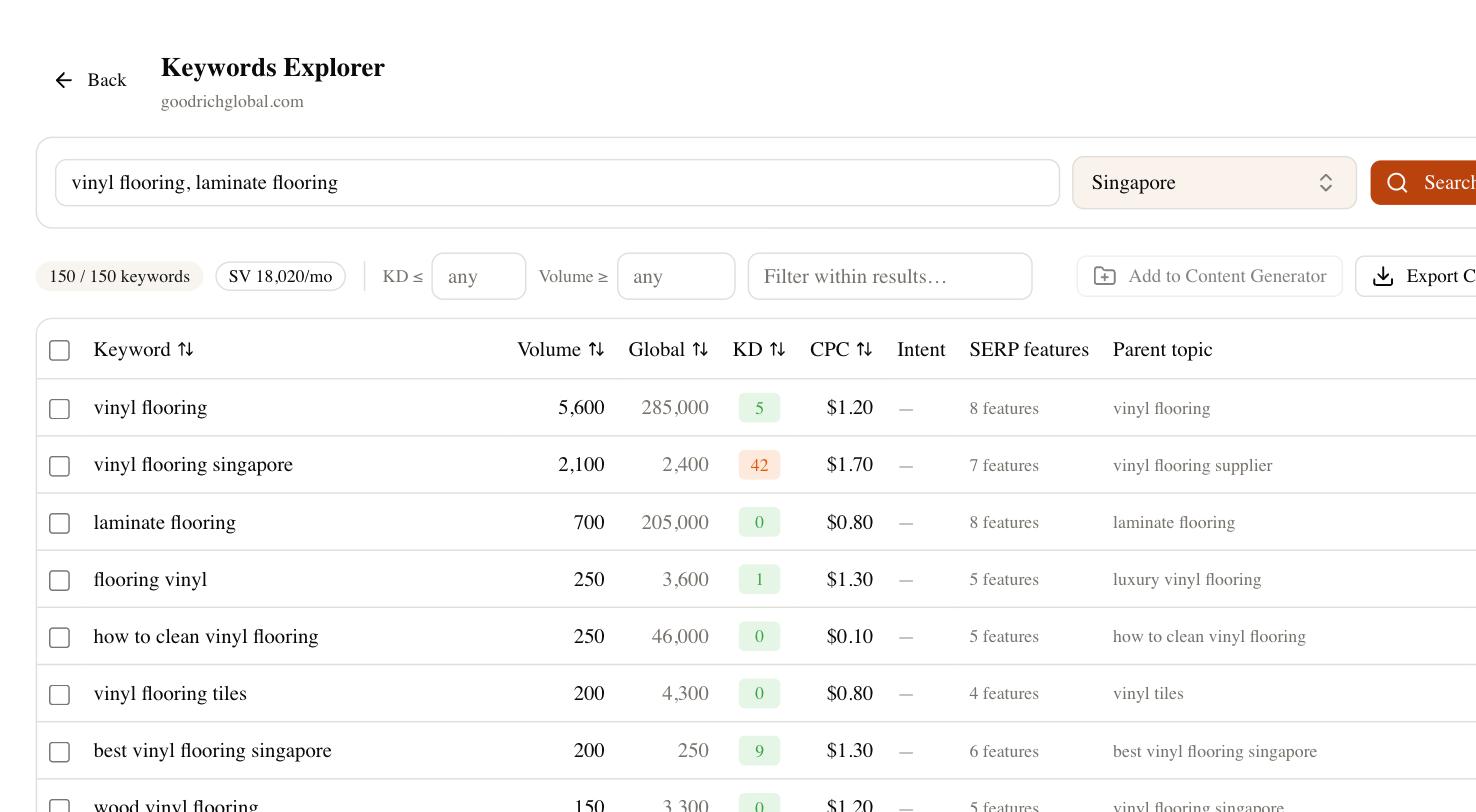
Use Keywords Explorer to find the questions your audience actually searches, then script videos around the ones with steady volume — the same keyword can earn you a Google video result and an in-app search rank. The keyword-difficulty and volume columns help you pick topics that are worth the shoot, so you spend production time on phrases people genuinely look for rather than clever titles nobody types.
Brand Radar tells you whether AI answer engines like ChatGPT and Perplexity are citing your brand, which is the next frontier of discovery beyond both TikTok and Google. Rank tracking confirms when a TikTok video breaks into Google’s results for a term you targeted, so you can see the payoff instead of guessing at it. Pair that outside research with TikTok’s own Search Insights, and you’re optimizing for real demand from both engines instead of hunches — one deciding what to film, the other confirming it landed.
A quick TikTok SEO checklist
Run every video through this before you post. It takes thirty seconds and covers the signals TikTok can actually read.
- Keyword spoken aloud within the first three seconds.
- Keyword shown as on-screen text.
- Caption written as a natural sentence containing the phrase.
- Two to four tightly relevant hashtags — no dumps.
- A hook strong enough to protect completion rate.
- Topic consistent with your recent videos.
- Phrase validated against TikTok Search Insights and real web demand.
Do those seven things and you’ve done the version of technical SEO that TikTok allows. You can’t edit a URL or add schema, but you can make every video unmistakably clear about what it answers — and on this platform, clarity plus watch time is the whole game.