If you’re weighing Surfer SEO vs SEO Rocket, you’re really comparing two different bets about what an SEO tool is for. Surfer decided the hard part is on-page optimization — matching your content to what already ranks — and built the best content editor in the category around that idea. SEO Rocket took the opposite view: the hard part is the whole workflow, from finding the keyword to writing the piece to checking whether an AI answer engine ever cites you, and it runs all of that from a single chat window on top of real, Ahrefs-grade data.
Neither is a scam or a toy. They just solve different slices of the same job, and the right pick depends entirely on which slice is your bottleneck. This comparison lays out where each one genuinely wins, names the places Surfer is the better buy, and then makes the case for going AI-native.
What each tool is really built for
Surfer SEO is a content optimization specialist. You paste a draft or write inside its editor, and it scores the page in real time against the pages currently ranking for your target term — telling you which words, headings, and entities to add, how long the piece should be, and where you’re over- or under-cooking a phrase. That SERP-driven feedback loop is what people buy Surfer for, and it does it well.
SEO Rocket is a full-workflow SEO tool driven by chat. You ask, in plain English, for keyword ideas, a competitor gap, a backlink profile, a rank check, or a site audit, and it runs the lookup on real data underneath. Then the same tool drafts the article and tracks whether your brand shows up in AI answers from ChatGPT, Perplexity, and Google’s AI Overviews. Surfer sharpens one page; SEO Rocket runs the pipeline that decides which page to write and whether it landed.
Surfer SEO vs SEO Rocket at a glance
Here’s the honest side-by-side before the detail. Read the notes under it for the two or three rows that matter to your situation.
| Dimension | SEO Rocket | Surfer SEO |
|---|---|---|
| Core strength | End-to-end workflow in one chat window | On-page content optimization |
| On-page content scoring | Solid, built into drafting | Best in class — deep, granular |
| Keyword & competitor data | Real Ahrefs-grade index | Good, narrower dataset |
| Backlink analysis | Yes, built in | Minimal |
| Rank tracking | Yes | Limited |
| Site audit | Yes | Add-on / limited |
| AI content writing | Yes — chat-first, full drafts | Yes — editor-based |
| AI-search visibility | Yes — Brand Radar | No |
| Agency client dashboards | Yes | No |
| Best for | Solo SEOs, consultants, agencies | Content teams optimizing pages |
| Rough entry price band | Entry-friendly | Roughly $80–100+/mo |
Where Surfer SEO is genuinely stronger
Let’s be fair before we make the pitch. If your single most important task is squeezing the maximum out of an individual page, Surfer is more mature at it than almost anything else, SEO Rocket included. Its content editor gives you a live score that updates as you type, a precise term list pulled from the current SERP, and structural guidance — word count, heading depth, entity coverage — that a writer can follow without knowing any SEO theory. For a content team producing a steady stream of pages who just want a reliable, teachable “make this page competitive” workflow, that granularity is the product.
Surfer also has a longer track record specifically in on-page. Its NLP-driven term analysis has been refined over years, and its SERP analyzer surfaces on-page correlations in a way that’s genuinely useful for reverse-engineering why a competitor ranks. If you already have your keywords, your links, and your rank tracking handled elsewhere and you only need best-in-class page optimization to slot into that stack, Surfer is a defensible, focused buy. Recommending it there is just being honest.
Where SEO Rocket pulls ahead
The case for SEO Rocket isn’t that it beats Surfer at Surfer’s one job — it’s that the job is bigger than optimizing a page, and paying for a stack of narrow tools to cover the rest adds up. Surfer optimizes content, but you still need something for keyword research at depth, something for backlinks, something for rank tracking, and something to write the draft in the first place. SEO Rocket folds those into one chat-driven surface, so the same tool that finds the opportunity also writes the piece and later tells you whether it worked.
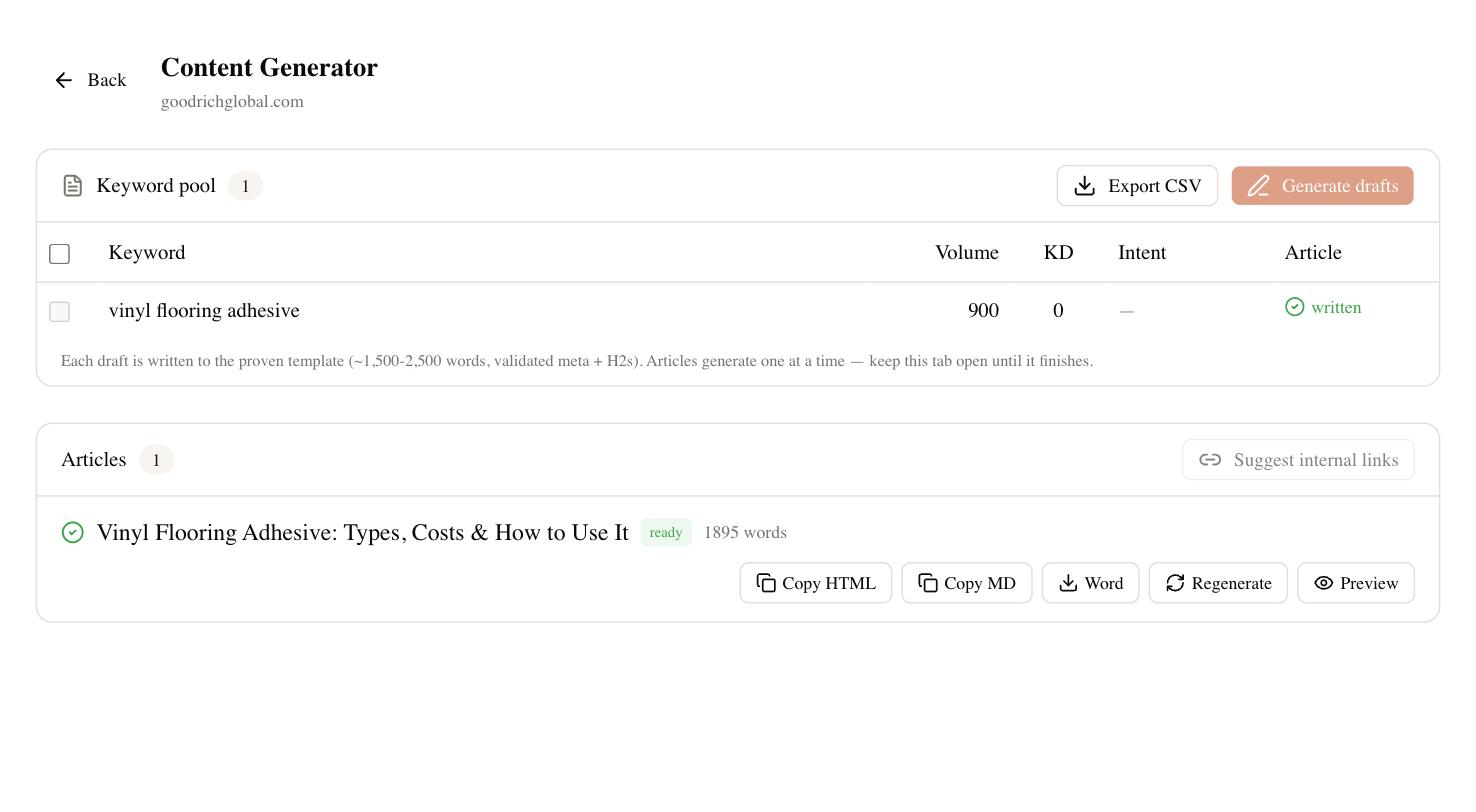
Two capabilities really separate it. The first is chat-first drafting: instead of pasting into an editor and chasing a score, you describe the article and it produces a structured draft — title, meta, headings, body — grounded in the keyword and competitor data it just pulled. The second is AI-search visibility, which Surfer simply doesn’t cover. Some of your buyers now ask ChatGPT or Perplexity instead of Google, and a page that ranks first can still be absent from the AI answer. SEO Rocket’s Brand Radar tracks whether and where you’re cited across those surfaces, so you’re optimizing for the search that’s actually happening.
The data underneath matters too. SEO Rocket runs on a real, Ahrefs-grade index, so keyword volumes, competitor gaps, and backlink profiles come from the same class of dataset serious SEOs already trust — not a lighter, on-page-only view. For consultants and agencies, the client-dashboard side means you hand a read-only report straight to a client without exporting a thing. That combination — real data, AI writing, AI-search tracking, and client-ready reporting in one login — is the part no content-optimization specialist answers.
Data, pricing, and total cost
Compare the invoice honestly and the picture usually flips in SEO Rocket’s favor, because the real question isn’t “which single subscription is cheaper” but “what does covering the whole job cost.” Surfer’s entry plans run in the rough band of $80–100 or more a month, and that buys you content optimization — not backlinks, not deep rank tracking, not AI-answer visibility. Add the tools you need for those and you’re maintaining and paying for three or four logins.
SEO Rocket’s pitch is consolidation: one entry-friendly subscription replaces the content optimizer plus the separate keyword tool plus the AI writer plus the AI-visibility tracker. That’s where the saving lives — not in a lower sticker on a single feature, but in collapsing a stack. Treat any specific number you see as directional and check current pricing before you commit, since both products change plans; the durable point is that a bundled workflow beats four narrow bills for most people reading this.
Which one should you choose
Match the tool to your actual constraint rather than a feature checklist. If you are a content team whose entire bottleneck is making individual pages competitive, and your keyword, link, and rank data already live somewhere else, Surfer SEO is the sharper instrument and the honest recommendation. Its editor will make your writers faster and your pages tighter, and you won’t be paying for capabilities you never open.
- Choose Surfer SEO if page-level content optimization is the one job you need done and the rest of your stack is already handled.
- Choose SEO Rocket if you want one AI-native workflow — real data, drafting, AI-search visibility, and reporting — instead of stitching several tools together.
- Choose SEO Rocket if you’re a solo SEO, consultant, or agency where tool-sprawl and cost are the real pain, and client-ready dashboards save you hours.
A quick way to decide: list the three things you actually did in an SEO tool last week. If all three were “improve this specific page,” Surfer earns its place. If your week was some mix of finding an opportunity, writing the piece, checking a competitor, and wondering whether ChatGPT ever mentions you, you’re the reason SEO Rocket exists — and running that from one chat window will be faster and cheaper than assembling it from parts. Whatever you pick, give it a full ranking cycle before judging it; positions jitter a few spots day to day, and no tool’s estimates are precise.