If you are weighing Outranking vs SEO Rocket, you are almost certainly deciding between two different ideas of what an AI SEO tool should be. Outranking built its name on content — turning a target keyword into a SERP-informed brief and a scored draft — while SEO Rocket is a chat-first workspace that folds writing, ranking data, and AI-search visibility into one place. This piece puts Outranking vs SEO Rocket side by side, tells you plainly where Outranking is the stronger buy, and then makes the case for the AI-native alternative.
Neither tool is a toy, and neither is trying to be the other. The honest answer to which one you should pay for depends less on a feature grid than on what your week actually looks like. So we will start with what Outranking does genuinely well, because for a real slice of readers it is the right call.
Where Outranking is genuinely stronger
Outranking is a content optimization tool first, and it shows in the parts that matter to a writer. Its editor scores your draft in real time against the pages already ranking, nudging you on terms, headings, and depth as you type. If your job is to sit inside a document and grind a piece from outline to publish-ready, that live feedback loop is tight and satisfying in a way general tools rarely match.
The brief workflow is the other strong suit. Point it at a keyword and it pulls the SERP apart — competing headings, questions people ask, entities worth covering — and hands you a structured brief a freelancer can follow without much hand-holding. Content teams that assign work to a bench of writers get real leverage from that consistency, plus the Google Docs and WordPress paths that get a finished draft out the door. If you produce a high volume of articles and your bottleneck is the writing pipeline itself, Outranking earns its place.
Give the rival its due beyond the headline features, too. The scoring model has been tuned over years specifically for on-page relevance, so a writer who lives inside that editor tends to trust its guidance rather than second-guess it. For a dedicated content shop, that trust is worth more than a longer feature list, and it is a reason to think twice before switching away.
What SEO Rocket does differently
SEO Rocket starts from a different premise: that the wall of tabs is the problem. Instead of opening a dashboard and clicking through reports, you ask for what you need in plain language and it runs the lookup. “Show me where dgfloors.com ranks in Singapore,” “find the keywords my competitor covers that I don’t,” “audit this URL” — the chat runs it and hands back a card, then drafts the article off the back of the same session.
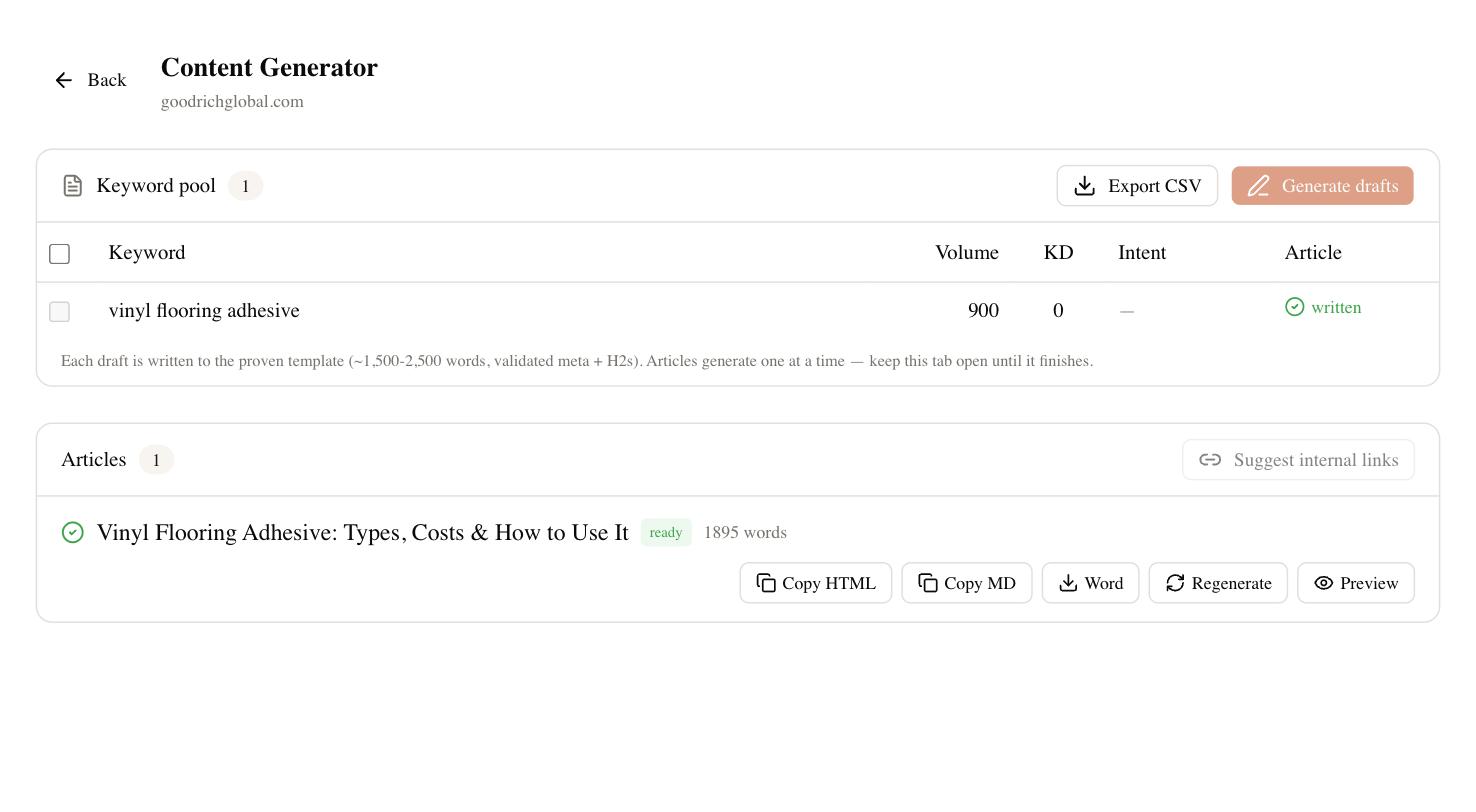
Underneath the chat sits real, Ahrefs-grade data — the same class of keyword, backlink, and rank information you would open a traditional research suite for. That matters because a content-only tool tells you how to write a page but not whether the topic is worth the effort, who already owns it, or whether you are climbing after you publish. SEO Rocket answers those questions and the writing question in one workflow, which is the thing a stack of point tools never quite does.
The AI-search visibility gap
Here is the piece neither a classic research suite nor a content optimizer really addresses. Search is splitting. A growing share of your buyers now ask ChatGPT, Perplexity, or Google’s AI Overviews instead of scrolling ten blue links, and a page that ranks first can still go completely uncited in the answer they actually read. Optimizing a document to out-score page-one competitors does nothing to tell you whether the AI engines are mentioning your brand at all.
SEO Rocket’s Brand Radar tracks exactly that — whether and where you are being cited across AI answer surfaces — so you are optimizing for the search happening now rather than the one that happened five years ago. Outranking will make your on-page content stronger; it will not tell you if an AI assistant recommends your competitor over you when a customer asks. For a brand that suspects its buyers have already moved to AI search, that blind spot is the whole argument.
Outranking vs SEO Rocket at a glance
Read the table for the shape of the decision, then the use-case notes below for the deciding detail.
| Factor | Outranking | SEO Rocket |
|---|---|---|
| Core focus | Content optimization & briefs | Chat-first, full SEO workflow |
| Interface | Document editor with scoring | Conversational chat + cards |
| AI writing | Yes — strong, in-editor | Yes — from the same chat |
| Ahrefs-grade research data | Limited | Yes — built in |
| Rank tracking & site audit | Basic | Yes |
| AI-search visibility | No | Yes — Brand Radar |
| Client dashboards | No | Yes |
| Rough price band | Mid $$ | Low $ / entry-friendly |
Cost and the tool-sprawl question
On sticker price the two land in a similar mid-tier neighborhood, though SEO Rocket’s entry tier is friendlier for a solo operator getting started. The real number is not the sticker, though — it is the total stack. Run Outranking and you still need a research suite for keyword and backlink data, a rank tracker, and something to watch AI-search mentions, which is three more subscriptions and three more logins.
SEO Rocket’s pitch is that the consolidation is the saving. When keyword research, competitor gaps, rank tracking, site audits, AI writing, and AI-visibility all live behind one chat, the second and third invoices disappear. If you are a consultant or a small agency, the read-only client dashboards mean you can hand a client a live report without exporting a thing — a workflow Outranking simply does not cover.
Be honest about the flip side, though. Consolidation only pays off if you use most of what is bundled; a solo writer who never touches backlink data or rank tracking is paying for reach they do not need, and Outranking’s narrower focus can be the cheaper fit for that person. The stack math favors SEO Rocket when your work is broad, and Outranking when it is deep in one lane.
Which one should you pick
Match the tool to your real constraint. If you run a content operation with writers to feed and your single bottleneck is producing optimized drafts at volume, Outranking is the honest recommendation — its in-editor scoring and brief automation are purpose-built for that, and you will feel the difference every day. Do not switch away from something that fits your workflow just because a rival does more on paper.
But if your week is a scattered mix — checking what you rank for, seeing what a competitor is doing, drafting a piece, and increasingly wondering whether ChatGPT ever mentions you — then you are the reader SEO Rocket was built for. One AI-native workspace covers all of it, on real data, without the tab-switching or the extra invoices. A quick test: write down the three SEO tasks you actually did last week. If they all live inside a document, keep the content specialist. If they sprawl across research, tracking, writing, and AI visibility, the chat-first tool will do the whole job faster.