If you’re weighing SE Ranking vs SEO Rocket, you’re comparing two tools built in different eras for slightly different jobs. SE Ranking is a mature, well-priced SEO suite that agencies have trusted for years; SEO Rocket is an AI-native workspace where you run the same lookups by asking in plain language, and the tool drafts the content too. Both are genuinely good. Which one is right depends less on a feature grid and more on how you actually spend your working week.
This comparison is honest about where each tool wins. SE Ranking has strengths SEO Rocket doesn’t try to match, and there are teams who should pick it without a second thought. But if your real bottleneck is producing content and staying visible in AI search — not just watching positions move — the math changes. Here’s the full picture, dimension by dimension, so you can decide on evidence rather than marketing.
Where SE Ranking is genuinely stronger
Start with the honest part, because it matters more than any pitch. SE Ranking has spent well over a decade refining a broad SEO toolkit, and that maturity shows. Its rank tracking is deep and configurable — daily updates, granular location and device targeting, and reporting that scales across a large portfolio of clients without the cost spiraling. If you run twenty client sites and need predictable, per-project pricing, that discipline is hard to beat.
The bigger point in SE Ranking’s favor is backlink data. A veteran suite like this has invested years into its link index, and depth of link data — historical referring domains, lost-and-found tracking, disavow workflows — is exactly the kind of thing a newer AI-first tool takes time to match. If competitive link audits and large-scale link building are the core of your job, that index depth is a real reason to lean toward the incumbent. SEO Rocket runs on strong, Ahrefs-grade data underneath, but a pure backlink specialist should weigh this dimension heavily and honestly.
SE Ranking vs SEO Rocket at a glance
Skim the table, then read the sections that apply to you. Treat the price bands as directional — both vendors change plans, and your real cost depends on seats, projects, and tracked keywords.
| Dimension | SEO Rocket | SE Ranking |
|---|---|---|
| Core interface | Chat-first — ask in plain language | Traditional dashboards and modules |
| Underlying data | Real, Ahrefs-grade keyword & competitor data | Its own large keyword and rank database |
| Backlink index depth | Solid, still maturing | Deep, long-established |
| AI content writing | Built in — drafts full articles | Add-on content tools |
| AI-search visibility (Brand Radar) | Yes — tracks ChatGPT, Perplexity, AI Overviews | Limited |
| Rank tracking | Yes, with position deltas over time | Deep, highly configurable |
| Agency client dashboards | Yes — read-only client views | Yes — mature white-label reports |
| Best for | AI-driven content & visibility workflows | Cost-conscious rank tracking at scale |
| Rough price band | Entry-friendly | Low–mid $ |
The AI-native case for SEO Rocket
Here’s what SEO Rocket does that a traditional suite doesn’t. Instead of clicking through modules, you ask for what you need — “show me the keyword gaps between my site and these two competitors,” “draft an article targeting this term,” “am I being cited in AI answers” — and it runs the work on real data underneath. The interface isn’t a gimmick; it collapses the tab-hopping that eats an SEO’s afternoon into one conversation, and it lowers the learning curve to roughly zero.
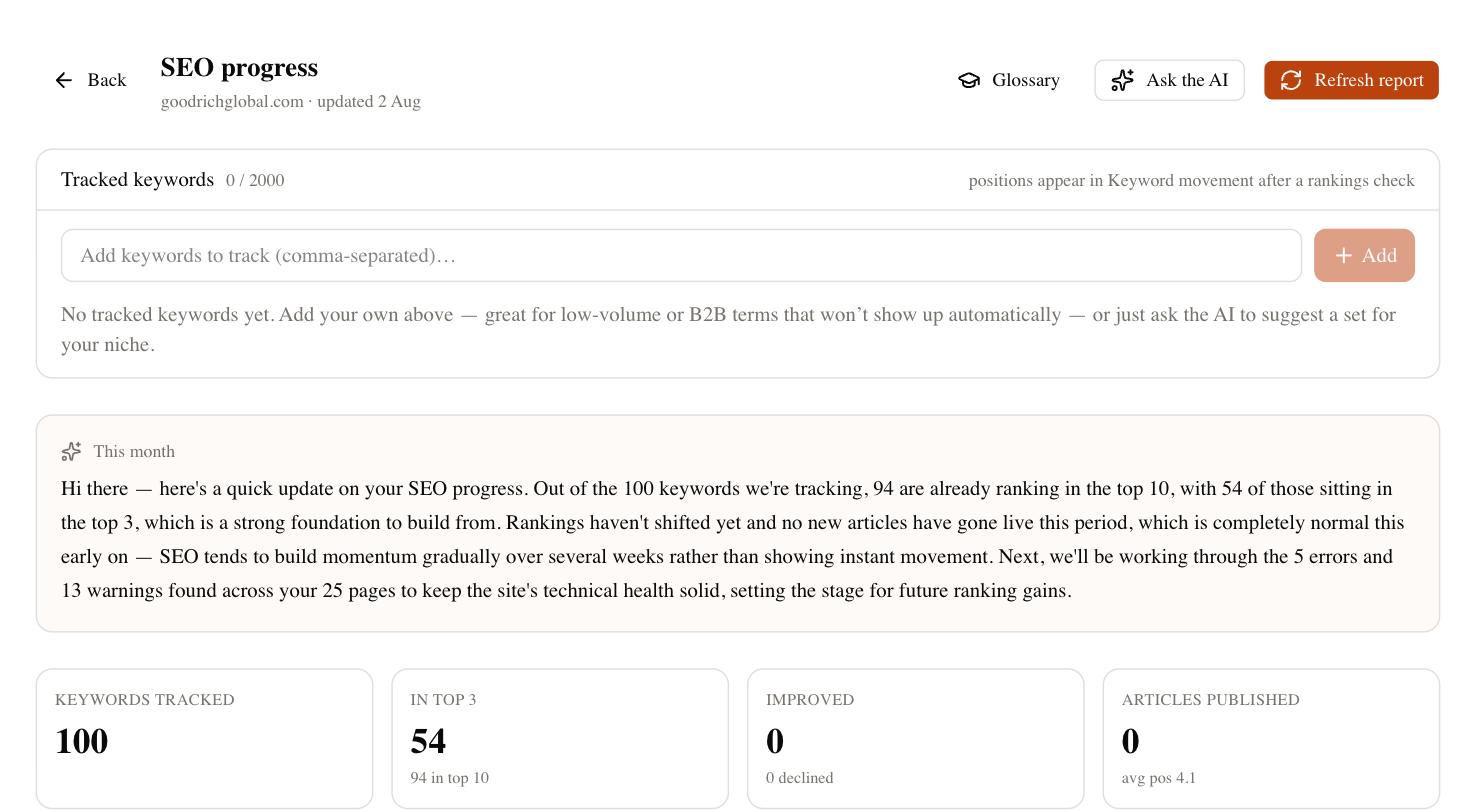
Two capabilities carry the argument. The first is AI content writing built into the same tool that does your research — you go from keyword gap to a drafted article without exporting anything or paying for a separate writer. The second is AI-search visibility, which SEO Rocket calls Brand Radar. Search is fragmenting: some of your buyers now ask ChatGPT or Perplexity instead of Google, and a page ranking first can still be invisible in an AI Overview. SEO Rocket tracks whether and where you’re being cited across those surfaces, which is the question most traditional tools simply don’t answer yet.
That consolidation is the practical win. A common stack of a rank tracker plus a separate AI writer plus an AI-visibility tool collapses into one subscription. For a solo consultant or a small agency, fewer logins and fewer invoices matters as much as any single feature — and the entry pricing is designed to sit at the friendly end rather than climb the moment you add a project.
Data quality and how to judge it
Neither tool’s numbers are gospel, and you should treat every third-party metric as an estimate. Domain ratings, traffic figures, and keyword volumes are modeled, not measured, so expect the two tools to disagree by a margin — that’s normal, not a defect. What matters is consistency over time and whether the data answers your real question.
SEO Rocket’s differentiator is that its keyword and competitor data is Ahrefs-grade rather than a lighter, cheaper feed — so the research you do in chat rests on a serious foundation. SE Ranking counters with the maturity of its own database and, as noted, a deeper backlink index. The honest read: for keyword research, competitor gaps, and rank tracking, both give you data you can act on. For heavy link analysis, the incumbent still has the edge. A practical test cuts through the debate — pull the same domain into both tools, look at the top pages and referring domains, and see which set of numbers matches what you already know about that site. Whichever tool tells you fewer surprising things is usually the one modeling your niche more accurately, and that answer shifts by industry more than either vendor likes to admit.
Pricing and total cost
Look past the headline number to your real bill. SE Ranking’s appeal has always been value — flexible, per-project pricing that stays affordable when you’re managing many client sites, which is why cost-watching agencies gravitate to it. If rank tracking at scale is the whole job, it’s tough to beat on price per project.
SEO Rocket’s cost story is different: the saving comes from consolidation, not just a low sticker. If you’d otherwise buy a research tool, an AI writing tool, and an AI-visibility tracker separately, folding all three into one entry-friendly subscription usually lands cheaper than the sum — and far cheaper than adding those capabilities on top of a traditional suite. Run your own numbers with the tools you’d actually pay for, not the marketing tiers.
Who each tool suits
Match the tool to your real constraint, not to a feature list.
- Choose SE Ranking if your work is rank tracking across many clients, your budget is tight per project, or deep backlink analysis and mature white-label reporting are non-negotiable.
- Choose SEO Rocket if content production and AI-search visibility are your bottleneck, you want research and writing in one chat-driven workflow, and you’re tired of paying for three tools that don’t talk to each other.
- Run both briefly if you’re unsure — a week each on your own site and two competitors will tell you more than any comparison page.
The verdict
There’s no universal winner in SE Ranking vs SEO Rocket, and anyone claiming otherwise is selling something. Write down the three tasks you actually did in your SEO tool last week. If they were “check what I rank for,” “audit a competitor’s links,” and “export a client report,” SE Ranking is a proven, economical home for that work. If instead your week was “find keyword gaps,” “produce a piece of content,” and “figure out why AI answers ignore my brand,” you’re describing exactly what SEO Rocket was built to do — and you’ll do it faster in one place. Pick the tool that matches how you spend Tuesday, give it a full ranking cycle before you judge it, and remember that positions jitter a few spots day to day no matter which one you’re staring at.