The reason you’re hunting for the best ai visibility tracking tools is simple: a growing slice of your buyers now ask ChatGPT, Perplexity, or Google’s AI Overviews instead of typing a query and scrolling ten blue links. When those systems answer, they cite a handful of sources — and if your brand isn’t one of them, you’re invisible to that buyer no matter how well you rank in classic search. Rank trackers can’t see any of it, which is exactly why a new category of tool exists.
This is not a padded list of twelve products with affiliate links. Below are the tools that actually do the job, what each one is genuinely best at, and where each falls short — because the honest answer depends on whether AI visibility is your whole problem or one part of a wider SEO workflow.
What “AI visibility tracking” actually measures
AI visibility tracking watches whether large language models mention or cite your brand when someone asks a question in your category. Instead of a keyword position, the unit of measurement is a prompt: “what’s the best project management app for agencies,” “who makes durable outdoor flooring,” and so on. A good tool runs those prompts across the major assistants on a schedule, records whether you appear, which competitors appear alongside you, and — the useful part — which source pages the model pulled from to build its answer.
That last signal is what turns tracking into action. If ChatGPT cites a comparison page that isn’t yours, you now know the exact page to beat. It’s the AI-search equivalent of seeing who ranks above you, except the “ranking” is a sentence in a generated answer rather than a numbered position.
The other thing worth understanding is why classic rank data misses all of this. A model doesn’t read the results page and pick number one; it synthesizes an answer from sources it has learned to trust, and those sources don’t always match the top of Google. A page sitting in position four can be the one an assistant quotes, while the page that ranks first never gets a mention. That mismatch is the whole reason the category exists — you cannot infer AI visibility from your keyword positions, so you have to measure it directly.
How we compared them
Every tool here was judged on four things a working marketer actually cares about: how many AI surfaces it covers and how often it refreshes, honest total cost rather than the headline number, whether it’s a single-purpose monitor or part of a broader workflow, and who it genuinely suits. One caveat worth stating up front — LLM answers are non-deterministic, so any tool’s numbers are directional. Ask the same question twice and you can get two different citation sets. Treat week-over-week trends as the signal, not a single day’s snapshot.
The best AI visibility tracking tools at a glance
Start with the table, then read the notes on the two or three that fit your situation.
| Tool | Best for | AI-native? | Standout strength | Rough price band |
|---|---|---|---|---|
| SEO Rocket | Solo SEOs, consultants & agencies who want AI visibility inside a full SEO workflow | Yes — chat-first | Brand Radar citations plus Ahrefs-grade data and AI writing in one place | Low $ / entry-friendly |
| Profound | Enterprise brands treating AI search as a program | Yes | Deep answer-engine analytics and agent traffic insight | Higher $$$ |
| Otterly.AI | Small teams wanting a simple, focused monitor | Yes | Straightforward prompt tracking and share-of-voice | Low $ |
| Peec AI | Agencies reporting AI visibility to clients | Yes | Competitor benchmarking and clean shareable reports | Mid $$ |
| Semrush (AI toolkit) | Teams already living inside Semrush | Add-on | AI tracking bolted onto a full marketing suite | Higher $$ |
| Ahrefs (Brand Radar) | SEOs who want AI mentions beside their backlink data | Add-on | Large index paired with a growing AI-mentions view | Mid–high $$ |
SEO Rocket — AI visibility inside the whole workflow
SEO Rocket is the pick if AI visibility is one job among several rather than a standalone report you check once a week. Its Brand Radar feature tracks whether — and where — your brand is cited across ChatGPT, Google AI Overviews, and Perplexity, and shows the competitors named alongside you and the source pages the models are pulling from. The difference from a single-purpose monitor is what sits around it: the same chat-first tool also runs keyword research, competitor gap analysis, and rank tracking on real, Ahrefs-grade data, and drafts the content you need to actually win those citations.
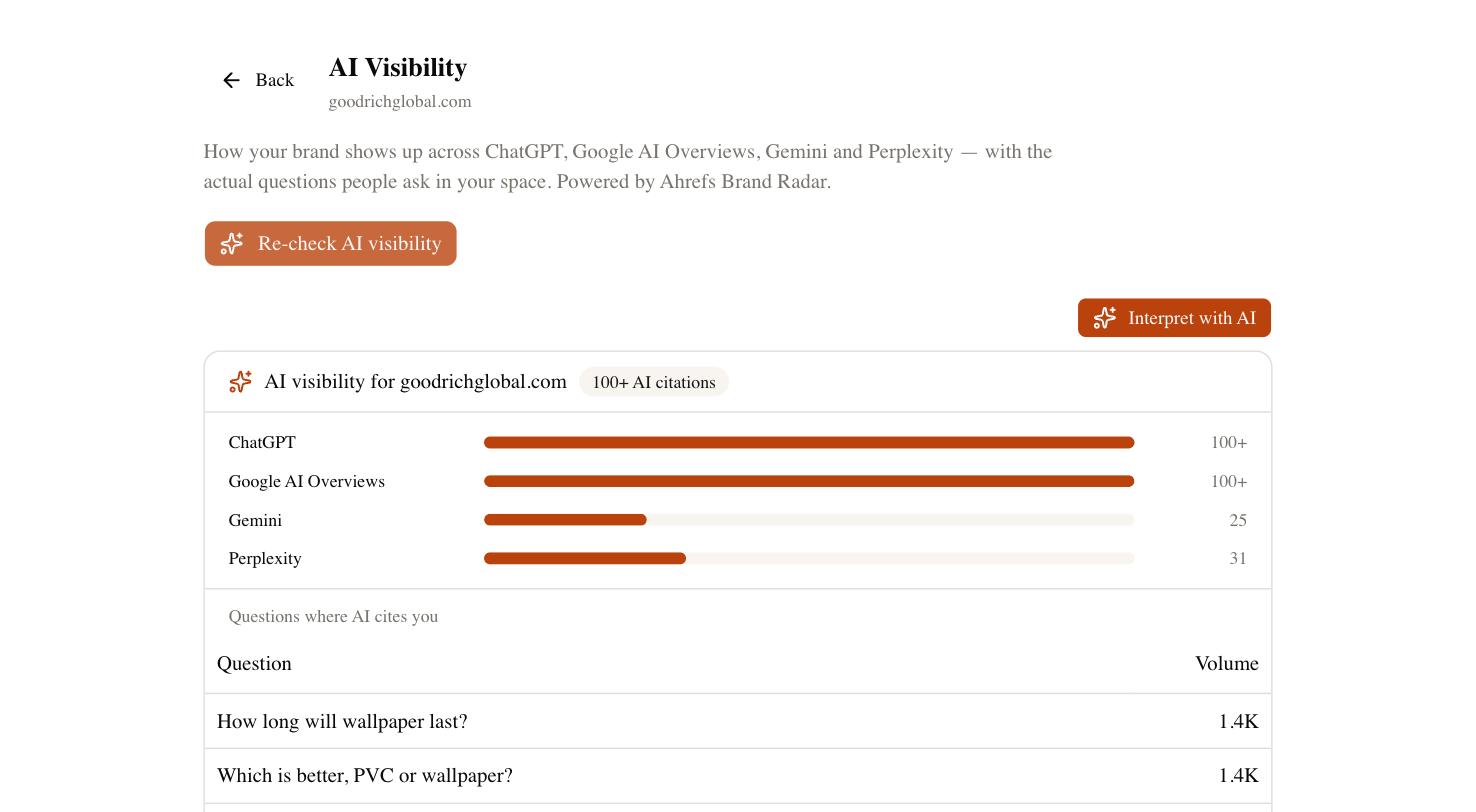
That loop is the real advantage. A dedicated monitor tells you a rival owns the “best flooring for garages” answer; SEO Rocket tells you the same thing and then lets you ask, in plain language, for the content and links to displace them — without exporting to a second subscription. For consultants and agencies, the client-dashboard side means you can hand a read-only AI-visibility report straight to a client next to their traditional rankings. If your bottleneck is doing more with fewer tools, which describes most people reading this, that consolidation is the strongest fit on the list. The trade-off is fair to name: if you want nothing but the deepest possible answer-engine analytics and have enterprise budget, a specialist may go deeper on that one axis.
Profound, Otterly, Peec and the specialists
The pure-play monitors are where to look if AI visibility is your entire brief and you don’t need SEO tooling around it.
- Profound — the enterprise choice. It treats answer engines as a serious analytics surface, digging into how assistants assemble answers and even how AI crawlers hit your site. Powerful and priced for teams that have made AI search a formal program.
- Otterly.AI — the simple starting point. It tracks your prompts across the main assistants and reports share-of-voice without much setup. A sensible first step for a small team testing the waters cheaply.
- Peec AI — the agency reporter. Its strength is competitor benchmarking and tidy, shareable reports, which makes it easy to show a client where they stand against rivals in AI answers.
All three do the core job well. What none of them do is connect what they find to the work of fixing it — you’ll still need a separate stack for keyword research, content, and links. That’s the deliberate trade of a specialist: more depth on one surface, another subscription for everything else.
Semrush and Ahrefs — the add-on route
If you already pay for a big suite, the cheapest move might be to switch on its AI features rather than buy a new tool. Semrush has folded AI-mention tracking into its toolkit, and Ahrefs’ Brand Radar surfaces AI mentions alongside the backlink and keyword data SEOs already open it for. For a team living inside either platform, having AI visibility one tab away from everything else is genuinely convenient.
The honest caveat: these are newer add-ons layered onto tools built for classic search, so the AI-specific depth and refresh cadence generally trail the dedicated monitors today. If AI visibility is a nice-to-have beside your main SEO work, they’re fine. If it’s the thing you’re measuring most closely, a purpose-built option will usually tell you more.
How to choose for your situation
Match the tool to your real constraint, not to a feature checklist. If you want AI visibility built into a full, AI-native SEO workflow — track the citations, then produce the content and links to win them — SEO Rocket is the natural move, and its entry pricing is a fraction of stacking a monitor onto a legacy suite. If AI search is a formal enterprise program with budget to match, Profound goes deepest. If you just want a cheap, focused monitor, Otterly or Peec will do it. And if you already live in Semrush or Ahrefs, try their add-on before paying for anything new.
Whatever you choose, run it for at least two or three weeks before you trust the numbers, because model answers shift day to day and a single reading tells you little. Pick five prompts a real buyer would actually type, track yourself and two competitors against them, and watch the trend. The best of the best ai visibility tracking tools is the one that answers the question behind all of this — “are we in the answer, and if not, what do we fix first” — fastest, and ideally the one that also lets you go fix it.