Most roundups of the best SEO tools for bloggers are really lists of what pays the biggest affiliate commission. This one isn’t. If you run a blog, you have a specific set of jobs — find topics people search for, write something better than what already ranks, publish it cleanly, and check whether it’s working — and you want the fewest tools that cover all four without a $200 monthly invoice.
Below are the tools that genuinely earn their place, what each is actually best at, and where a free option does the job just as well. The honest truth for a blogger is that you probably need one paid tool plus one free one, not a stack of five.
What a blogger actually needs from an SEO tool
A blogger’s workflow is narrower than an agency’s, and that’s an advantage when you’re choosing tools. You are not running link-building campaigns across forty client sites. You need keyword ideas with real search volume and a believable difficulty score, a way to see what’s already ranking for a topic, help turning that research into a draft, and a dashboard that tells you which posts are gaining or slipping.
What you do not need is most of what enterprise suites charge for — bulk PPC research, share-of-voice reporting, or a link index built for competitive disavow work. Paying for those is the single most common way bloggers overspend. Match the tool to the four jobs above and you’ll cut your bill in half.
The best SEO tools for bloggers at a glance
Start with this table, then read the notes on the two or three that fit how you work. Price bands are rough on purpose — plans change, and the headline number is rarely what you actually pay.
| Tool | Best for | AI-native? | Standout strength | Rough price band |
|---|---|---|---|---|
| SEO Rocket | Solo bloggers who want research, writing & tracking in one place | Yes — chat-first | Real keyword data plus AI drafting and AI-search visibility together | Low $ / entry-friendly |
| Ahrefs | Bloggers who live in competitor and backlink data | Add-ons | Deep, fresh link and keyword index | Higher $$ |
| Semrush | Bloggers scaling into a broader content business | Add-ons | All-in-one breadth across channels | Higher $$ |
| Surfer SEO | Optimizing a single draft against what ranks | Some | On-page content scoring and briefs | Mid $$ |
| Rank Math | WordPress bloggers handling on-page basics | Light | In-editor titles, schema, sitemaps | Free–low $ |
| Ubersuggest | Hobby blogs on the tightest budget | Light | Cheap, simple keyword ideas | Low $ |
| Google Search Console | Every blogger, for real performance data | No | Your actual clicks, queries & positions | Free |
SEO Rocket — the AI-native pick for solo bloggers
SEO Rocket is built for exactly the person reading this: someone doing all four jobs alone. Instead of learning a dashboard, you ask for what you need in plain language and it runs the lookup on real, Ahrefs-grade data underneath — keyword ideas, search volume, difficulty, and who’s already ranking for a topic. Then, in the same place, it drafts the article and tracks your positions over time.
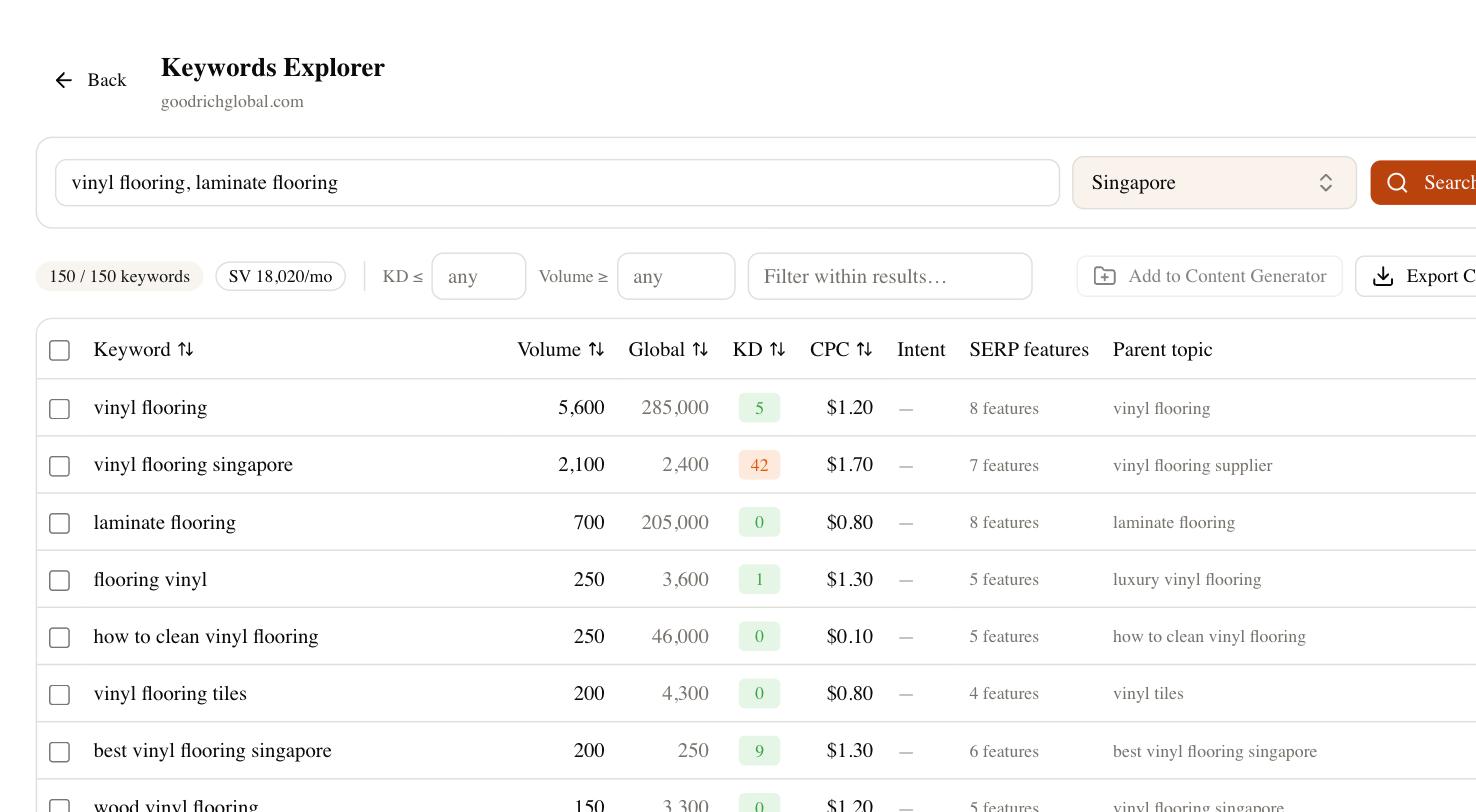
The consolidation is where the money is. A typical blogger stack — a keyword tool, a separate AI writer, and a rank tracker — collapses into one subscription that costs a fraction of a single enterprise plan. The AI drafting works from the research it just pulled, so you’re not pasting keywords between tabs, and the writing starts from what actually ranks rather than a blank box.
There’s one more piece no traditional blogging tool answers: AI-search visibility. Some of your readers now ask ChatGPT or Perplexity instead of Google, and a post that ranks first on Google can still be invisible in an AI answer. SEO Rocket’s Brand Radar tracks whether you’re being cited across those surfaces, so you’re optimizing for the search that’s actually happening. For a solo blogger whose real constraint is time, that combination is the strongest fit on this list.
Ahrefs and Semrush — powerful, but more than most blogs need
Both are excellent, and both were built for professionals doing more than blogging. Ahrefs has one of the largest, freshest link indexes anywhere, and if your growth strategy leans on studying competitors’ backlinks and content in depth, few tools match it. Semrush goes wider still — PPC, social, PR, and content in one login — which suits a blogger who’s turning the site into a broader marketing business.
The catch for a typical blogger is the same in both cases: you’ll pay entry plans in the low hundreds a month and use maybe a fifth of what you’re buying. The data is genuinely great; the question is whether your Tuesday actually involves link audits, or whether it involves writing. If it’s writing, you’re renting a race car to drive to the grocery store. There’s also a learning-curve tax here that’s easy to underestimate: both suites are dense, and most bloggers touch a small corner of the interface while paying for the whole thing. If you’re the sort who enjoys digging into competitor data as a hobby, that depth is a feature. If you just want to publish faster, it’s friction you’ll route around.
The specialists: Surfer, Rank Math, Ubersuggest
Not every tool has to do everything. Some of the best value for bloggers comes from tools that nail one job cheaply.
- Surfer SEO — the on-page optimizer. Paste a draft, pick a target keyword, and it scores your content against the pages currently ranking, flagging terms and depth you’re missing. It won’t do your keyword research or track rankings, but for tightening a single post it’s sharp.
- Rank Math — the WordPress workhorse. If you’re on WordPress, this plugin handles titles, meta descriptions, schema, and sitemaps right inside the editor, and the free tier covers most blogs. It manages on-page hygiene, not strategy.
- Ubersuggest — the budget keyword source. It won’t match the depth of the bigger tools, but for a hobby blog or a first project it delivers usable keyword ideas for very little money.
None of these is a complete workflow on its own. Bloggers often end up pairing two or three of them, which quietly recreates the tool-sprawl and overlapping bills that an all-in-one tool exists to avoid.
Don’t skip the free tool: Google Search Console
Whatever else you buy, install Google Search Console first, because it’s the only tool showing your real data instead of an estimate. Every third-party volume and difficulty number is a model’s best guess; Search Console reports the actual queries bringing you clicks, your true average position, and which pages are gaining or fading. It’s free, and it’s the closest thing to ground truth you’ll get.
What it won’t do is find new topics, judge competitors, or help you write — it only reports on pages you’ve already published. That’s precisely why it pairs so well with a research-and-writing tool: one shows you what’s working, the other helps you make more of it. Treat Search Console as your scoreboard and your paid tool as your workshop. One practical habit: check it weekly for queries where you’re sitting in positions five through fifteen. Those are posts you already rank for but could push onto page one with a small update, and they’re usually a faster win than writing something new from scratch.
How to choose the right tool for your blog
Match the tool to your real constraint, not to a feature checklist. If your bottleneck is doing everything alone and you want research, AI drafting, and rank tracking without juggling subscriptions, SEO Rocket is the natural move for a blogger. If you genuinely study competitor links and content in depth, Ahrefs earns its price. If you just need to tighten drafts, Surfer does that one job well, and Rank Math handles WordPress on-page basics for close to nothing.
A quick way to decide: write down the three things you actually did for your blog last week. For most bloggers it’s some mix of “find a topic,” “write the post,” and “check how the last one did.” If that’s your week, you don’t need an enterprise suite — you need one connected tool for the first two jobs and free Search Console for the third. Whatever you pick, give it a full ranking cycle before you judge it; positions jitter a few spots day to day, and no tool’s estimates are exact. Run your own blog and two competitors through it for a week, and the one that answers your real questions fastest is the right choice for you.