If you are weighing Clearscope vs SEO Rocket, you are comparing two very different bets on how content gets made and how it gets found. Clearscope is a focused content-optimization tool: you give it a target keyword, and it grades your draft against the terms and topics the current top-ranking pages already cover. SEO Rocket is a chat-first SEO platform that pulls real, Ahrefs-grade data, drafts the article for you, tracks your rankings, and watches whether AI engines are citing your brand. Both help you write content that ranks. They just disagree about how much of the surrounding job the tool should own.
This comparison is written for someone who has to actually choose. Below is a side-by-side table, an honest account of where Clearscope is the stronger tool, the case for SEO Rocket’s AI-native approach, and a plain recommendation by use case. If you only ever need to polish drafts against a term list, the honest answer may be Clearscope — and I will say so.
Two tools, two different jobs
Clearscope earned its reputation on one thing done well: content grading. Paste a draft, and it scores your coverage of the entities and phrases that top pages share, flags what you are missing, and nudges word count and readability toward what is already winning. Editors like the output because it is unambiguous — a letter grade a writer can chase. It plugs into Google Docs and WordPress, so the optimization happens where the writing already happens.
SEO Rocket starts from a different question: not “how good is this draft” but “what should we make, and is it working.” You ask for keyword research, a competitor gap, a backlink profile, or a rank check in plain language, and it runs the lookup on real data. Then it drafts the piece and reports whether ChatGPT, Perplexity, and Google’s AI Overviews are surfacing you. Clearscope optimizes a document; SEO Rocket runs the whole workflow around it.
Clearscope vs SEO Rocket at a glance
Start with the table, then read the notes for the two or three rows that matter to your situation.
| Dimension | SEO Rocket | Clearscope |
|---|---|---|
| Content grading / optimization | Yes, built into drafts | Yes — its core specialty |
| AI article writing | Yes — full first drafts | No — you write it |
| Keyword & competitor data | Real, Ahrefs-grade | Content-scoped only |
| Backlink index | Yes | No |
| Rank tracking | Yes | Limited |
| AI-search visibility (Brand Radar) | Yes | No |
| Site audit | Yes | No |
| Editor integrations (Docs/WordPress) | Export-based | Native, live grading |
| Best for | Doing the whole job with fewer tools | Editorial teams polishing drafts |
| Rough price band | Entry-friendly | Roughly $150–200/mo, metered |
Where Clearscope is genuinely stronger
Give credit where it is due. Clearscope’s content grading is more opinionated and, for pure editorial polish, more refined than a generalist tool’s. Its term recommendations feel curated rather than dumped, its readability guidance is tuned for working editors, and the letter-grade system creates a clean target for freelance writers who need a number to hit. If your team’s entire problem is “our drafts are thin and inconsistent,” that single-minded focus is a real advantage.
The integrations matter too. Writing and optimizing inside Google Docs, with a grade updating live as you type, is a smoother loop than copying text between tabs. And because Clearscope does one thing, there is almost nothing to learn — a new writer is productive in an afternoon. Narrow tools stay shallow on purpose, and for content-heavy teams that already own a backlink and rank-tracking stack elsewhere, that narrowness is a feature, not a gap.
Where SEO Rocket pulls ahead
The moment your job is bigger than grading drafts, the single-purpose tool starts to cost you. With Clearscope you still need a separate keyword and backlink tool, a separate rank tracker, a separate site auditor, and a separate AI writer if you want first drafts at all. SEO Rocket folds those into one chat-first surface backed by real, Ahrefs-grade data — so the research that informs the brief, the draft itself, and the tracking that tells you it worked all live in the same place.
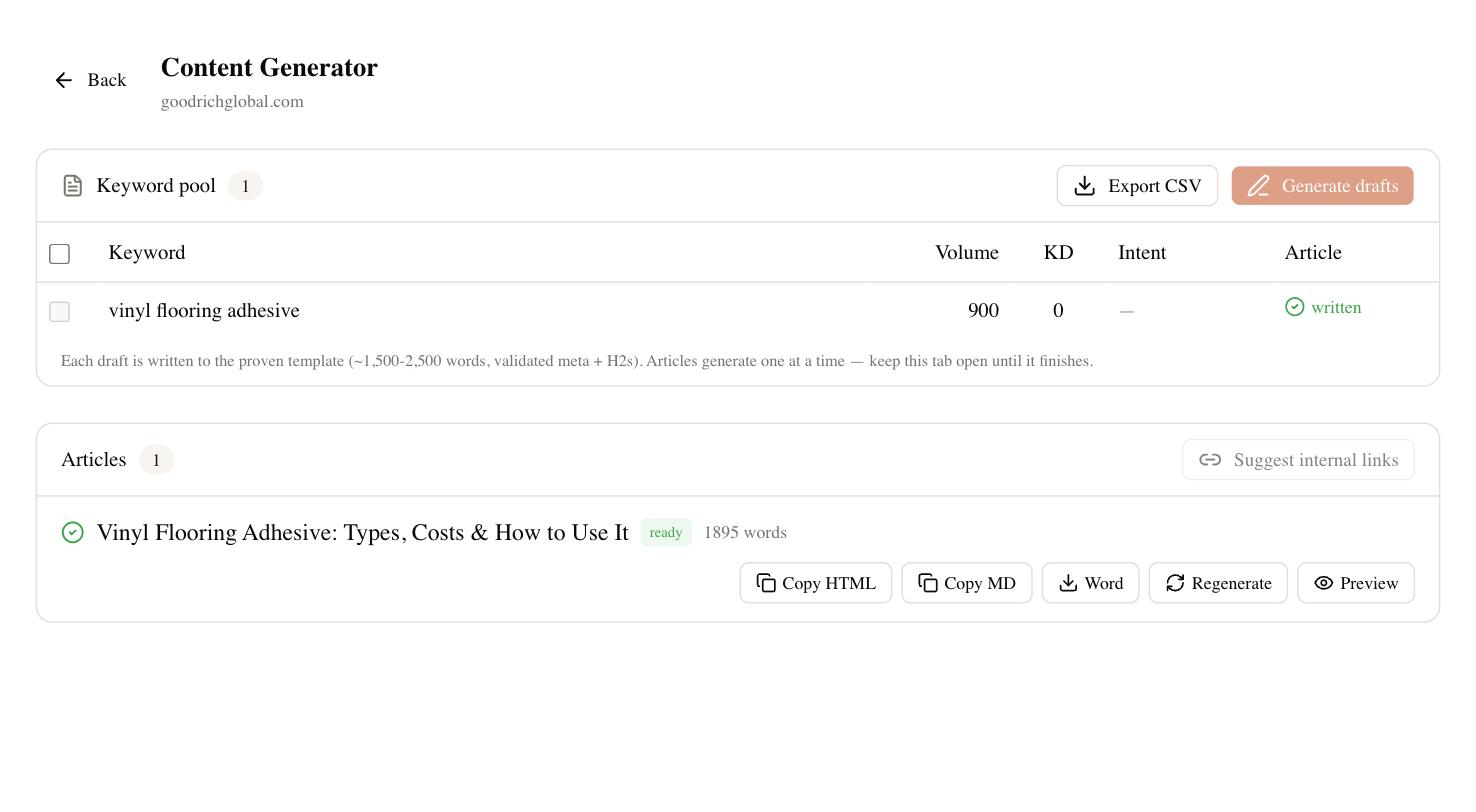
The AI writing is the part Clearscope leaves entirely to you. SEO Rocket drafts the full article — title, meta description, heading structure, and body — from the same data it used to find the opportunity, and then you edit rather than start from a blank page. For a solo SEO or a lean agency, that is the difference between shipping two posts a week and shipping eight. You are not optimizing a document someone else still has to write; you are steering a draft that already exists.
The AI-search question Clearscope does not answer
Content grading quietly assumes the game is ranking blue links on Google. That game is changing. A growing share of buyers now ask ChatGPT or Perplexity instead of searching, and Google increasingly answers with an AI Overview that may never send a click at all. A page can score an A in Clearscope, rank on page one, and still be invisible in the AI answer your customer actually reads.
SEO Rocket’s Brand Radar tracks whether — and where — you are being cited across those AI surfaces. That is the optimization no term-coverage grade can give you, because it measures a different search entirely. If any part of your audience has started asking an assistant instead of typing into a search box, a tool that only grades on-page term coverage is answering last year’s question well.
Pricing and who each really suits
On cost, both sit above hobby-tier tools, but they charge for different things. Clearscope’s entry plans run in the rough band of $150 to $200 a month and are metered around content reports, so heavy publishing months get expensive and the price buys optimization only. SEO Rocket’s entry pricing is friendlier and buys the whole workflow — data, writing, tracking, and AI-visibility — so the honest comparison is rarely one subscription against another. It is usually SEO Rocket against Clearscope plus the three or four tools you would still need beside it.
That said, price should follow fit, not lead it. A large content team that already owns a backlink tool and a rank tracker, and just wants the best possible editorial grading layer on top, can justify Clearscope easily. A consultant or small team trying to do the entire job with fewer logins will get far more out of one connected platform.
How to choose between them
Match the tool to your real bottleneck. If your writers already produce plenty of drafts and your only weakness is making each one thorough and on-topic — and you have separate tools for research, links, and rank tracking — Clearscope is a clean, focused choice, and I would not talk you out of it. Its grading is excellent at the one job it owns, and buying more tool than you need is its own kind of waste.
If instead your constraint is doing more of the job with fewer tools — researching, writing, tracking, and staying visible in AI answers without stitching four subscriptions together — SEO Rocket is the stronger fit. Choose Clearscope when optimization is the whole task; choose SEO Rocket when the writing is only one step in a workflow you would rather run from a single place. Whichever you pick, give it a full content cycle before you judge it: publish, wait for a ranking cycle, and let the results settle it, not the feature list.