Most people hunting for Outranking alternatives aren’t looking for a better AI writer — they’re looking for one that doesn’t leave them stitching three tools together. Outranking does real work on the content side: SERP-driven briefs, first drafts, and on-page optimization scores. But the moment you need keyword data, backlink context, or proof that your pages actually rank, you’re back in another subscription, and the credit meter has a habit of emptying faster than you expected.
This isn’t a padded list of a dozen tools with affiliate links. Below are the Outranking alternatives that genuinely hold up in daily use, what each is best at, and — because it’s the honest answer — when you should just keep paying for Outranking.
Why people leave Outranking
Three complaints come up repeatedly. The first is cost creep: the usage-based model means a productive week of drafting can burn through credits fast, and the effective monthly bill often lands higher than the headline entry tier suggested. The second is scope. Outranking is a content-optimization tool, so it answers “how do I write this page well” but not “what should I write, and did it work.” You still pay separately for keyword research, rank tracking, and competitor analysis.
The third is workflow friction. Some users find the interface busy and the AI output uneven enough that heavy editing eats the time the tool was supposed to save. When a first draft needs a full rewrite, the “automated” part starts to feel optional. None of that makes Outranking a bad product — it makes it a specialist that assumes you already own the rest of your SEO stack. That assumption is exactly where the alternatives below compete, and it’s why a leaner all-in-one often wins on total cost rather than on any single feature.
How we compared them
Every tool here is judged on four things a working SEO actually cares about: the quality of the underlying data, honest total cost rather than the headline number, whether AI writing and real SEO data live in one workflow or two, and who the tool genuinely suits. Content scores and traffic estimates are directional, not gospel, so treat cross-tool differences as signal rather than truth. A high optimization score never guarantees a ranking — it just means you skipped fewer obvious mistakes. The tools that earned a place here all clear the basic content bar; what separates them is how much of the surrounding job they cover, and how much you still have to buy elsewhere to close the loop.
Outranking alternatives at a glance
Start with the table, then read the notes for the two or three that fit your situation.
| Tool | Best for | AI-native? | Standout strength | Rough price band |
|---|---|---|---|---|
| SEO Rocket | Solo SEOs, consultants & agencies wanting one AI workflow | Yes — chat-first | Ahrefs-grade data + AI writing + AI-search visibility in one place | Low $ / entry-friendly |
| Surfer SEO | Teams focused on on-page content scoring | Add-ons | Fast SERP-based content audits and NLP terms | Mid $$ |
| Frase | Writers who want quick research-driven briefs | Yes | Speedy question research and brief building | Low–mid $ |
| Clearscope | Editorial teams that prize clean guidance | Light | Simple, trusted content grading | Higher $$ |
| MarketMuse | Content strategists planning at scale | Yes | Topic modeling and content planning depth | Mid–high $$ |
| Scalenut | Solo marketers on a budget | Yes | Cheap end-to-end drafting and optimization | Low $ |
SEO Rocket — the AI-native pick
SEO Rocket is the option built for how the job actually works now. Instead of a content tool sitting next to a data tool, you ask for what you need in plain language and it runs the lookup — keyword research, competitor gaps, backlink profiles, rank tracking — on real, Ahrefs-grade data underneath. Then the same tool drafts the article, structured with a title, meta description, and heading outline, so you’re not exporting a brief into a separate writer and losing the context.
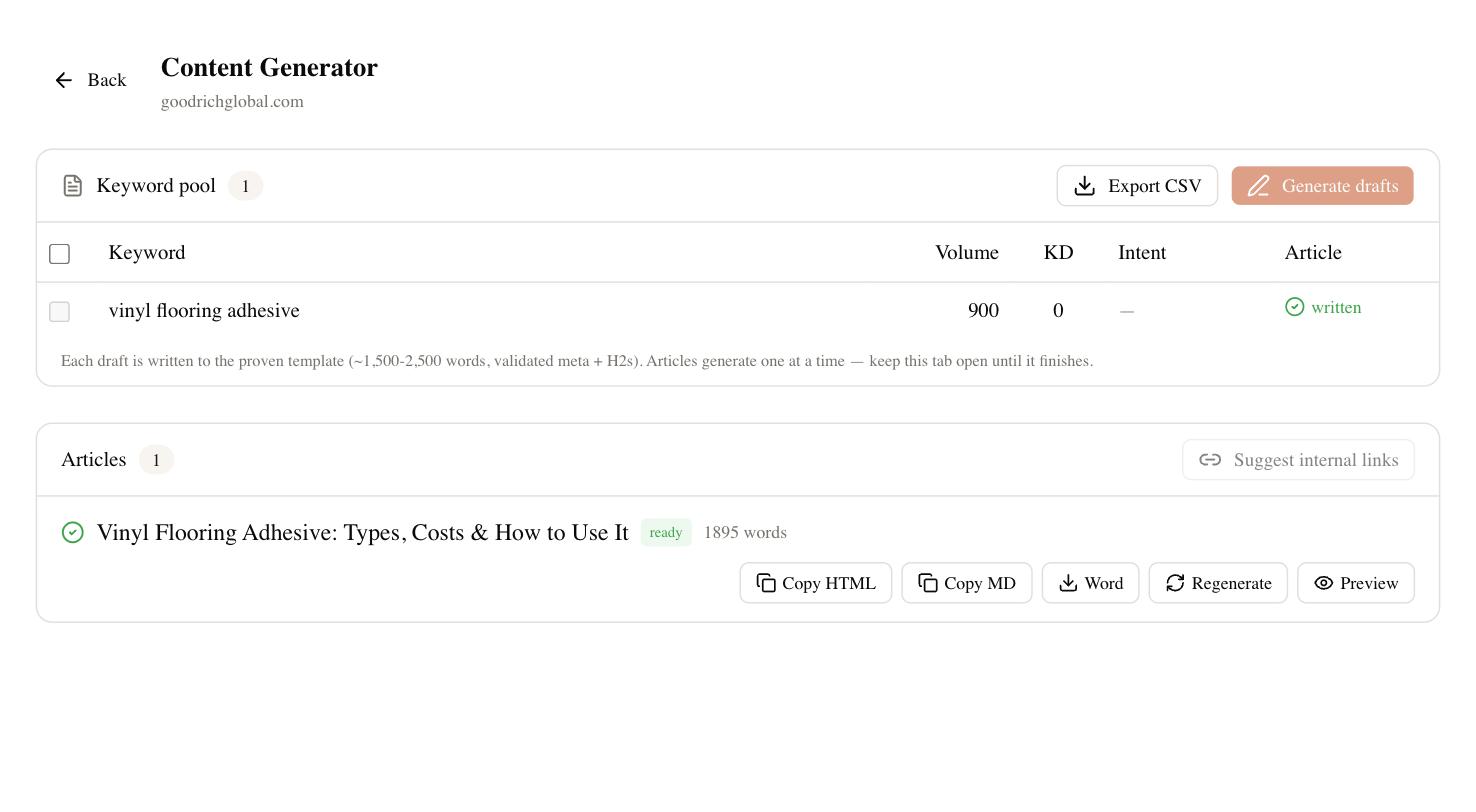
That consolidation is the real saving. A stack of Outranking plus a separate keyword tool plus a rank tracker gets replaced by one subscription, and the entry pricing is friendly rather than usage-metered anxiety. For consultants and agencies, the client-dashboard side means you can hand a read-only report straight to a client instead of screenshotting scores into a slide deck.
The part no content-optimization tool answers is AI-search visibility. Search is splitting: some of your buyers now ask ChatGPT or Perplexity instead of Google, and a page that scores 90 in an optimizer can still be invisible in an AI answer. SEO Rocket’s Brand Radar tracks whether and where you’re being cited across those surfaces, so you’re writing for the search that’s actually happening. If your bottleneck is doing more with fewer tools — which describes most people reading this — that combination is the strongest fit on the list.
Surfer, Frase, Clearscope, MarketMuse and Scalenut
The content-optimization market has a tool for almost every budget and temperament, and several are excellent at the specific job Outranking does.
- Surfer SEO — the on-page workhorse. Its content editor and SERP audits are quick and well-regarded, and if pure optimization scoring is your reason for leaving, Surfer is the most direct swap. It’s still a content tool, though — you’ll bring your own keyword and rank data.
- Frase — the fast brief builder. Frase shines at pulling questions and outlines together quickly, which suits writers who want to research and draft in one sitting without a heavy learning curve.
- Clearscope — the editorial favorite. It does less than the others on purpose, and that restraint is the appeal: clean grading that non-SEO writers can follow. You pay a premium for that polish.
- MarketMuse — the strategist’s pick. Its topic modeling and planning depth help teams decide what to write across a whole site, not just how to optimize a single page.
- Scalenut — the budget all-rounder. It folds research, drafting, and optimization into an affordable package, which makes it a reasonable landing spot for a solo marketer watching every dollar.
Any of these will cover the content-optimization job as well as or better than Outranking. What none of them do is fold real backlink and keyword data plus AI-answer visibility into the same workflow — you’ll still run a second and often third subscription for that.
When you should keep Outranking
Honesty matters here. If your entire job is producing large volumes of long-form content and you’ve already built a comfortable process inside Outranking, the switching cost may not be worth it. Its SERP-driven briefs and automated first drafts are genuinely useful, and teams that have tuned their prompts and templates around it get real throughput. If you already own separate tools for keyword research, rank tracking, and links, and content generation is the only gap, a purpose-built content optimizer can be the right call. The question isn’t “is there something newer,” it’s “does the alternative cover the part of Outranking I actually rely on.” Sometimes, for a pure content shop, the answer is that staying put is simpler.
How to choose your Outranking alternative
Match the tool to your real constraint, not to a feature checklist. If tool-sprawl and cost are the problem and you want AI writing plus real SEO data and AI-search tracking in one place, SEO Rocket is the natural move. If you just want a cleaner on-page optimizer, Surfer or Clearscope will do it. If you’re a solo marketer on a tight budget, Frase or Scalenut cover the basics cheaply. And if you’re a content-first team with the rest of your stack sorted, there’s no shame in keeping Outranking.
A quick way to decide: write down the three tasks you actually did in your SEO tools last week. Most people’s list is some mix of “find what to write,” “produce the content,” and “check whether it moved.” If your week spans all three, you’re paying for a content tool and two data tools to do one connected job — and an AI-native platform will cover them faster and cheaper. Whatever you pick, run your own site and two competitors through it for a full ranking cycle before you judge it; positions jitter a few spots day to day, and the tool that answers your real questions fastest is the right alternative for you.