If you are weighing MarketMuse vs SEO Rocket, you are really comparing two different bets about what modern SEO work looks like. MarketMuse is a content-strategy and optimization platform built to model topic authority and tell you what to write. SEO Rocket is an AI-native, chat-first tool that runs real keyword and backlink lookups, drafts the article, and then tracks whether you show up in AI answers — all in one place.
Both are good at what they do, and one of them is probably a better match for how you actually spend your week. This comparison is honest about where MarketMuse wins outright, then makes the case for the AI-native approach and recommends by use case at the end.
What each tool is built for
MarketMuse earned its reputation on content planning. It crawls your site, builds a picture of the topics you cover, and scores individual pages against a target so you can see which subtopics and terms you are missing. Its content briefs and topic-authority modeling are genuinely deep, and teams that run large editorial calendars lean on that structure to keep a content library coherent across hundreds of pages.
SEO Rocket starts from a different premise. Rather than a dashboard of modules, you ask for what you need in plain language and it runs the work: keyword research, competitor gap analysis, backlink profiles, rank tracking, and site audits on real, Ahrefs-grade data. Then the same tool drafts the piece and shows you whether ChatGPT, Perplexity, and Google’s AI Overviews are citing your brand. It is less a research library and more an operator that does the task end to end.
MarketMuse vs SEO Rocket at a glance
Start with the side-by-side, then read the sections below for the two or three rows that matter to your situation.
| Dimension | SEO Rocket | MarketMuse |
|---|---|---|
| Core strength | AI-native, chat-first SEO workflow | Content planning & topic-authority modeling |
| Content optimization depth | Solid, AI-assisted drafting & briefs | Deep — page scoring, topic gaps, inventory |
| Keyword & SERP data | Real, Ahrefs-grade index | Present, focused on content topics |
| Backlink index | Ahrefs-grade referring domains | Not a core focus |
| Rank tracking | Built in | Not the primary job |
| AI writing | Yes — drafts full articles | Briefs & guidance, lighter drafting |
| AI-search visibility | Yes — Brand Radar | No |
| Interface | Chat-first, plain language | Module dashboard |
| Rough price band | Entry-friendly, low $ | Free tier; paid runs into low hundreds/mo |
Where MarketMuse is genuinely stronger
Be clear about this before you switch. If your bottleneck is content strategy at scale — deciding what to publish across a large library, spotting the subtopics you have not covered, and keeping a big editorial team pulling in one direction — MarketMuse’s topic modeling is more mature and more opinionated. It will map your existing inventory against a topic and flag the exact gaps in a way that is hard to replicate by asking questions one at a time.
Its page-level content scoring is also a real methodology, not a word-count gimmick. Editors who like a target number to write toward, and content directors who need a defensible framework for what “comprehensive” means, get value from that rigor. For an in-house content team whose whole job is planning and optimizing a sprawling site, MarketMuse can earn its place, and pretending otherwise would be dishonest.
Where SEO Rocket pulls ahead
The gap opens up once your week involves more than content planning. Most working SEOs and consultants do a mix of jobs: check what they rank for, see what a competitor is doing, produce a piece of content, and increasingly, find out whether an AI assistant ever mentions their client. MarketMuse answers one of those well. SEO Rocket is built to answer all of them from the same chat box.
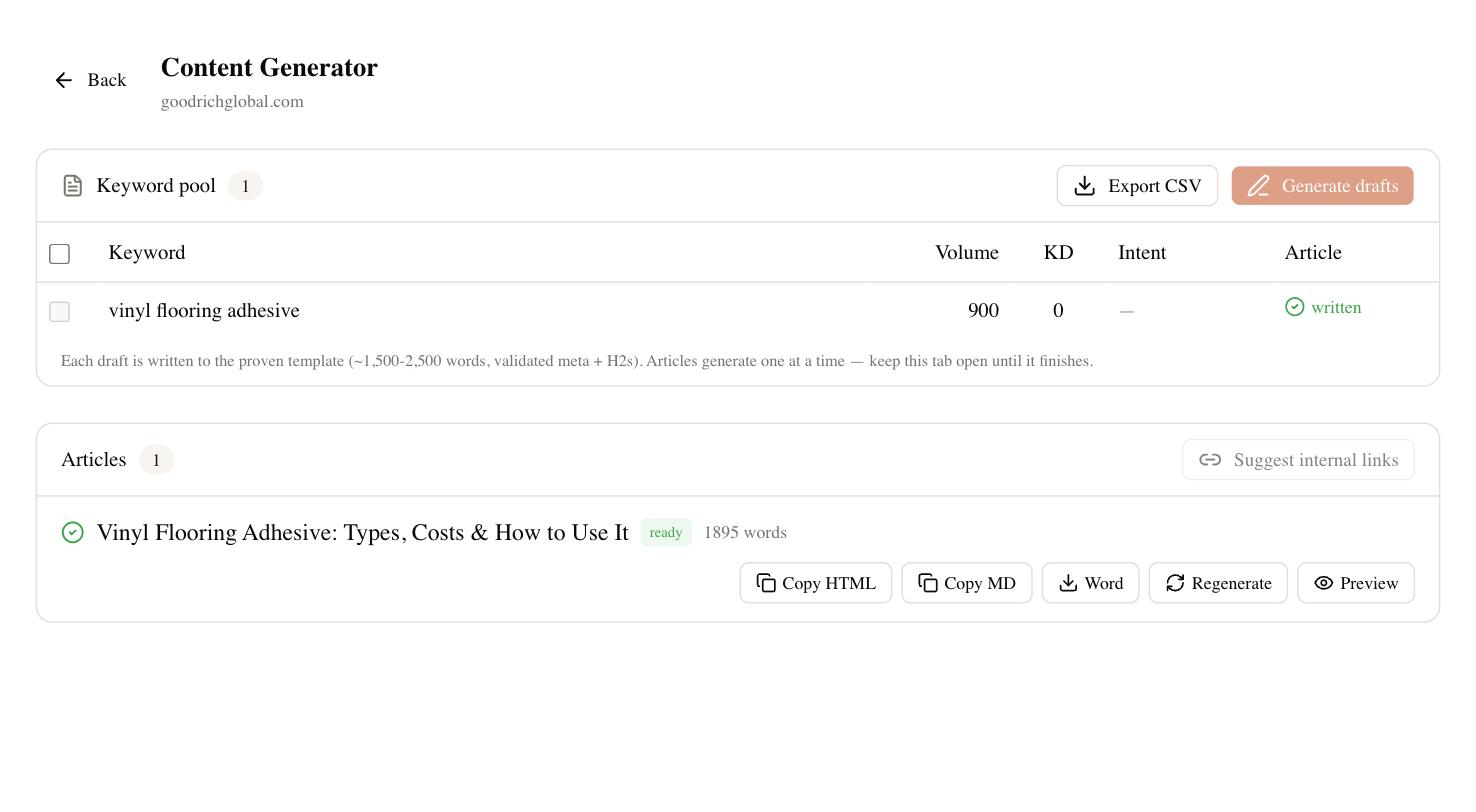
The AI writing is the obvious example. You research the keyword, review the competitor gaps, and then ask for a draft — title, meta description, heading structure, and body — without exporting a brief into a separate writing tool. The draft is a starting point you still edit, but the round trip that usually eats an afternoon collapses into one conversation. That consolidation, not raw output, is the point.
The AI-search piece is the part no content-optimization tool answers. Search is splitting, and some of your buyers now ask ChatGPT or Perplexity instead of typing into Google. A page that ranks first can still be invisible in an AI answer. SEO Rocket’s Brand Radar tracks whether, and where, you are being cited across those surfaces, so you are optimizing for the search that is actually happening. That is a different question than “is my content comprehensive,” and it is the one growing fastest.
Data, backlinks, and rank tracking
This is where the two tools stop overlapping. MarketMuse is a content instrument; it was never meant to be your backlink or rank-tracking system, and it does not pretend to be. If you need to audit a competitor’s referring domains, run a link gap, or watch positions move week to week, that lives in another subscription when MarketMuse is your center of gravity.
SEO Rocket folds those in on a real, Ahrefs-grade index. You can pull a domain’s backlink profile, compare it against a rival, track a set of keywords over a full ranking cycle, and run a technical site audit — the core lookups people usually open Ahrefs for — inside the same tool that writes the content. It is worth being honest that a dedicated backlink specialist with one of the very largest link indexes will still see more raw depth for heavy link audits. For everyday competitive and content-driven work, the built-in data is more than enough, and it is right there in the conversation.
Pricing and total cost
Compare the real invoice, not the headline. MarketMuse offers a limited free tier, and its paid plans climb into the low hundreds a month once you need meaningful query volume and multiple projects. On its own that can be reasonable for a content team — but it is a content tool, so you are typically still paying for a separate rank tracker, a backlink tool, and an AI-visibility tracker alongside it.
SEO Rocket’s case is the total. Entry pricing is a fraction of a comparable stack, and because keyword data, backlinks, rank tracking, AI writing, and AI-search visibility sit under one login, the second and third subscriptions disappear. If you are a consultant or agency, the client-dashboard side lets you hand a read-only report straight to a client without exporting anything. For most solo operators and small teams, the consolidated bill is the deciding number.
Which should you choose
Match the tool to your real constraint. If your job is planning and optimizing a large content library and you already have your data and tracking sorted elsewhere, MarketMuse’s topic modeling is the stronger, more specialized pick, and you should not switch just to save a login. If instead you want one AI-native workflow that researches, writes, tracks rankings, and shows your AI-search visibility, SEO Rocket is the natural move — and it will cover most of what MarketMuse does for content along the way.
A quick test: write down the three tasks you actually did last week. If all three were content inventory and briefs, MarketMuse fits. If they were a mix of ranking checks, competitor research, and shipping a piece of content, you are paying for a specialist when an AI-native operator would cover the whole list faster. Whatever you pick, run your own site and two competitors through it for a full ranking cycle before you judge it — positions jitter a few spots day to day, and no tool’s estimates are gospel. The right choice is the one that matches how you spend Tuesday.