
Most people hunting for MarketMuse alternatives aren’t questioning the research — they’re questioning the invoice and the time it takes to get anything out of the platform. MarketMuse is a genuinely strong content-planning engine: its topic modeling and inventory analysis can map an entire site’s content gaps in a way few tools match. But its pricing sits well above what a solo consultant or small team wants to commit to, the interface rewards specialists over generalists, and it was built for a planning-first workflow that predates AI writing and AI search.
This is not a padded list of twelve tools stitched together with affiliate links. Below are the MarketMuse alternatives that actually hold up in daily use, what each one is genuinely best at, and — because it’s the honest answer — when you should just keep paying for MarketMuse.
Why people leave MarketMuse
Three reasons come up again and again. Price is the loudest: standard plans run into the several-hundred-a-month range once you need real query volume or more than one seat, which is a hard sell for a freelancer or a lean in-house team. The second is the learning curve — MarketMuse is deep, and the topic-authority and content-brief concepts take real study before they pay off. Most users touch a fraction of what they’re paying for.
The third reason is newer. MarketMuse tells you what to write and how to structure it, but it doesn’t draft the piece for you the way an AI-native tool does, and it says nothing about whether ChatGPT or Perplexity ever mention your brand. So you end up buying a separate AI writer and, increasingly, a separate AI-visibility tracker on top. Three subscriptions to do what feels like one job is a lot of overhead for a small team. None of that makes MarketMuse bad. It makes it a content-strategy specialist in a job that now wants one connected workflow, and that gap is exactly where the alternatives below compete.
How we compared them
Every tool here was judged on four things a working content marketer actually cares about: the quality of the underlying research and SERP data, honest total cost rather than the headline number, whether AI writing and AI-visibility are built in or bolted on, and who the tool is genuinely for. Content scores and topic models are guidance, not gospel — treat cross-tool differences as directional and always edit for the reader before the algorithm. A tool that pushes your word count and term density up but leaves the draft unreadable has cost you traffic, not earned it, so weigh the workflow around the score as heavily as the score itself.
MarketMuse alternatives at a glance
Start with the table, then read the notes below for the two or three that fit your situation.
| Tool | Best for | AI-native? | Standout strength | Rough price band |
|---|---|---|---|---|
| SEO Rocket | Solo SEOs, consultants & agencies who want one AI-driven workflow | Yes — chat-first | Ahrefs-grade data + AI writing + AI-search visibility in one place | Low $ / entry-friendly |
| Surfer SEO | Writers who want real-time on-page scoring | Add-on editor | Live content editor tied to SERP analysis | Mid $$ |
| Clearscope | Editorial teams that value clean, trusted briefs | No | Simple, accurate term coverage reports | Higher $$ |
| Frase | Fast brief-building on a budget | Yes — light | Quick SERP research plus AI drafting | Low–mid $ |
| Semrush | Marketing teams wanting one suite | Add-ons | Content tools inside a full marketing platform | Higher $$ |
| NeuronWriter | Freelancers watching every dollar | Light | Affordable semantic optimization | Low $ |
SEO Rocket — the AI-native pick
SEO Rocket is the option built for how content work happens now. Instead of a wall of dashboards, you ask for what you need in plain language and it runs the job — keyword research, competitor content gaps, SERP analysis, rank tracking — on real, Ahrefs-grade data underneath. The difference isn’t just the research; it’s that the same tool then drafts the article to that brief and shows you whether your brand is being cited in ChatGPT, Perplexity, and Google’s AI Overviews.
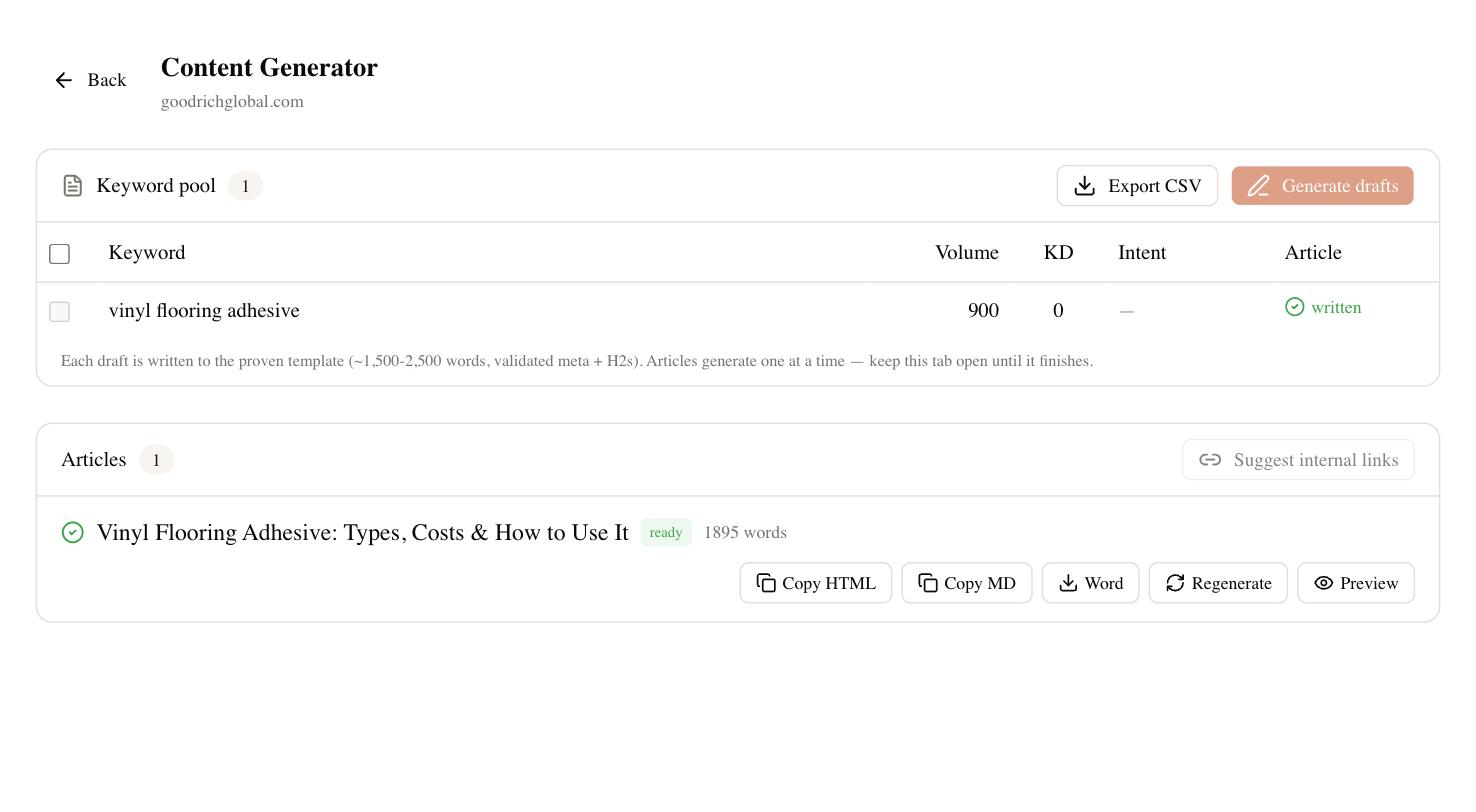
That consolidation is the real saving. A typical stack of MarketMuse plus a separate AI writer plus an AI-visibility tracker collapses into one subscription, and the entry pricing is a fraction of a comparable MarketMuse plan. If you’re a consultant or agency, the client-dashboard side means you can hand a read-only report straight to a client without exporting a thing or teaching them a new interface.
The AI-visibility piece deserves a moment, because no traditional content tool answers it. Search is splitting: some of your buyers now ask an AI assistant instead of Google, and a page that ranks first can still be invisible in an AI answer. SEO Rocket tracks whether — and where — you’re being cited across those surfaces, so you’re writing for the search that’s actually happening. For anyone whose bottleneck is producing more content with fewer tools, which is most people reading this, that combination is the strongest fit on the list.
Surfer SEO, Clearscope, Frase and the specialists
The content-optimization market has a tool for almost every budget and temperament. None of these is a bad choice — they simply solve a narrower slice of the problem.
- Surfer SEO — the writer’s live editor. Its real-time content score updates as you type, which makes it the friendliest way to see whether a draft covers the terms competitors use. Strong for on-page work; it won’t plan a whole content strategy the way MarketMuse does.
- Clearscope — the editorial team’s clean brief. It does one thing — term coverage and readability — and does it with a simplicity editors trust. It sits at the higher end on price and skips AI drafting, so it’s a research layer, not a writing tool.
- Frase — the fast, affordable brief builder. It pulls SERP research and drafts with AI quickly, which suits freelancers who need volume. Its research depth is lighter than MarketMuse’s, so pair it with your own judgment on strategy.
- NeuronWriter — the budget semantic option. It covers the core optimization job at a price freelancers can stomach, with a less polished interface as the trade-off.
Any of these will cover core content optimization. What none of them do well yet is fold research, AI writing, and AI-answer visibility into a single workflow — you’ll still be running a second or third subscription for the parts they skip. Semrush deserves a mention here too: if you want content tools living inside a full marketing suite with PPC and rank tracking, it earns its higher price, though the breadth brings its own learning curve.
When you should keep MarketMuse
Honesty matters. If your work lives and dies on large-scale content strategy — mapping topic authority across hundreds of pages, planning clusters for a big editorial operation, auditing an established site’s full inventory — MarketMuse still does that heavy planning work better than most. Large content teams with the budget and a dedicated strategist rarely regret staying. The right question isn’t “is there something cheaper,” it’s “does the cheaper option cover the part of MarketMuse I actually rely on.” For a serious content-strategy shop, sometimes the answer is no, and that’s fine.
How to choose your MarketMuse alternative
Match the tool to your real constraint, not to a feature checklist. If cost and tool-sprawl are the problem and you want research plus AI writing plus AI-search tracking in one place, SEO Rocket is the natural move. If you want a live on-page editor, Surfer fits. If you want clean briefs your editors trust, Clearscope earns its price. If budget is tight and speed matters, Frase or NeuronWriter will do the job. And if deep, site-wide content planning is your whole world, there’s no shame in staying put.
A quick way to decide: write down the three content tasks you actually did last week. Most people’s list is some mix of “research a topic,” “brief or write a piece,” and “check whether it’s working.” If that’s your week, you’re likely paying strategy-suite prices for a mid-tier workflow — and a leaner, AI-native tool will cover those three faster and cheaper. Whatever you pick, run one real article through it end to end before you judge it. The best alternative is the one that matches how you actually spend Tuesday, not the one with the longest feature page.