
If you write for search, you have almost certainly bumped into Surfer. This Surfer SEO review is the honest version — not an affiliate scorecard — covering what the tool genuinely does well, where it quietly frustrates people, roughly what it costs, and who should actually pay for it. I have used it on real client content, so this is about how it behaves in a working week, not what the sales page promises.
Surfer sits in a specific lane: on-page content optimization. It is not a backlink tool, it is not a rank tracker, and it is not trying to be an all-in-one suite. Judge it on that lane and it is one of the better options available. Judge it as your whole SEO stack and you will be disappointed — but that is a fairness problem, not a Surfer problem.
What Surfer SEO actually does
At its core, Surfer reverse-engineers the pages already ranking for your target term. You give it a keyword, it pulls the current top results, and it builds a brief: a target word count, a content score that updates live as you write, and a list of terms and headings the ranking pages tend to use. The Content Editor is the part most people live in — you draft or paste your article, and a gauge on the right tells you how close you are to the shape of what is already winning.
Around that editor sits an on-page Audit that scores existing URLs against their competitors, a keyword research module, an outline generator, and an AI writing feature that can produce a full draft against the same brief. The through-line is always the same idea: match the measurable patterns of the pages that already rank, then ship faster than you would writing blind.
What Surfer does well
The Content Editor is genuinely good, and it is why people stay. For a writer who is not a technical SEO, it turns a vague instruction like “make this rank” into a concrete checklist: hit this length, cover these subtopics, use these terms a handful of times. That structure is worth real money to content teams who were previously guessing, and it noticeably tightens the gap between a first draft and something competitive.
Its second strength is speed to a defensible brief. Building a content outline by hand — reading ten SERP results, noting their headings, estimating depth — takes an hour. Surfer does it in under a minute and is usually close enough that you edit rather than start over. The SERP analyzer behind it is transparent, too: you can see which pages it sampled, so you are not trusting a black box.
The interface is also clean and fast, onboarding is gentle, and the live content score gives writers a dopamine loop that keeps them engaged. None of that is glamorous, but for a team pushing out volume, low friction is a feature.
Where Surfer falls short
The biggest risk is the content score itself. Treated as a target instead of a hint, it pushes writers toward term-stuffing — cramming in phrases to nudge a number that no search engine actually reports. I have seen otherwise good drafts turned robotic in pursuit of a green gauge. Surfer’s guidance has improved on this, but the incentive is baked into the design, and you need editorial discipline to ignore it when the writing gets worse.
The correlation model has limits, too. Surfer measures what ranking pages have in common, but common patterns are not the same as causes. Sometimes the pages rank despite their word count and terms, carried by domain authority and links Surfer cannot see. Follow the brief slavishly on a low-authority site and you can produce a perfectly “optimized” page that still does not move, because your real bottleneck was never on-page.
Then there is scope. Surfer does not track your rankings over time, does not show your backlink profile, and only lightly touches keyword research. That is fine if it is one tool in a stack, but it means the monthly cost buys a slice of the workflow, and article or query limits on lower tiers can bite quickly once a team is producing at pace.
Surfer SEO at a glance
Here is the honest breakdown of where it earns its keep and where it does not.
| Area | Verdict | Notes |
|---|---|---|
| Content Editor | Strong | Best-in-class live brief; turns “make it rank” into a checklist |
| Outline & SERP analysis | Strong | Fast, transparent, usually close enough to edit not rewrite |
| Ease of use | Strong | Clean UI, gentle onboarding, low friction for writers |
| AI writing | Fair | Usable first drafts, but still needs a real editor’s hand |
| Over-optimization risk | Weak | Content score tempts term-stuffing if chased as a target |
| Rank tracking & backlinks | None | Out of scope — you still need a separate tool for both |
| Best for | Content teams | Writers and editors optimizing on-page at volume |
Pricing: what to expect
Surfer prices per tier with limits on the number of articles or audits you can run each month, plus add-ons for extra AI writing and seats. I will not quote an exact figure because plans and names change, but the honest band is this: entry plans run roughly in the low hundreds a month, and a serious team plan climbs from there once you add writers and content volume. That is not cheap for a single-purpose tool, and it is the number that sends people looking for alternatives.
The value question is simple. If your team ships enough content that faster, more defensible briefs save real hours every week, Surfer pays for itself easily. If you publish a handful of posts a month, the per-article cost is hard to justify against cheaper or broader options — and you should look elsewhere.
Surfer versus an AI-native workflow
Surfer was built before AI writing and AI search were mainstream, and it shows in the seams: optimization lives in one tool, drafting increasingly in another, and rank tracking and links somewhere else again. A newer approach folds those into one place. SEO Rocket, for instance, is chat-first — you ask for a keyword’s competitive picture, get Ahrefs-grade data, and have the article drafted against it in the same workflow, then track both classic rankings and whether AI engines like ChatGPT and Perplexity are citing you.
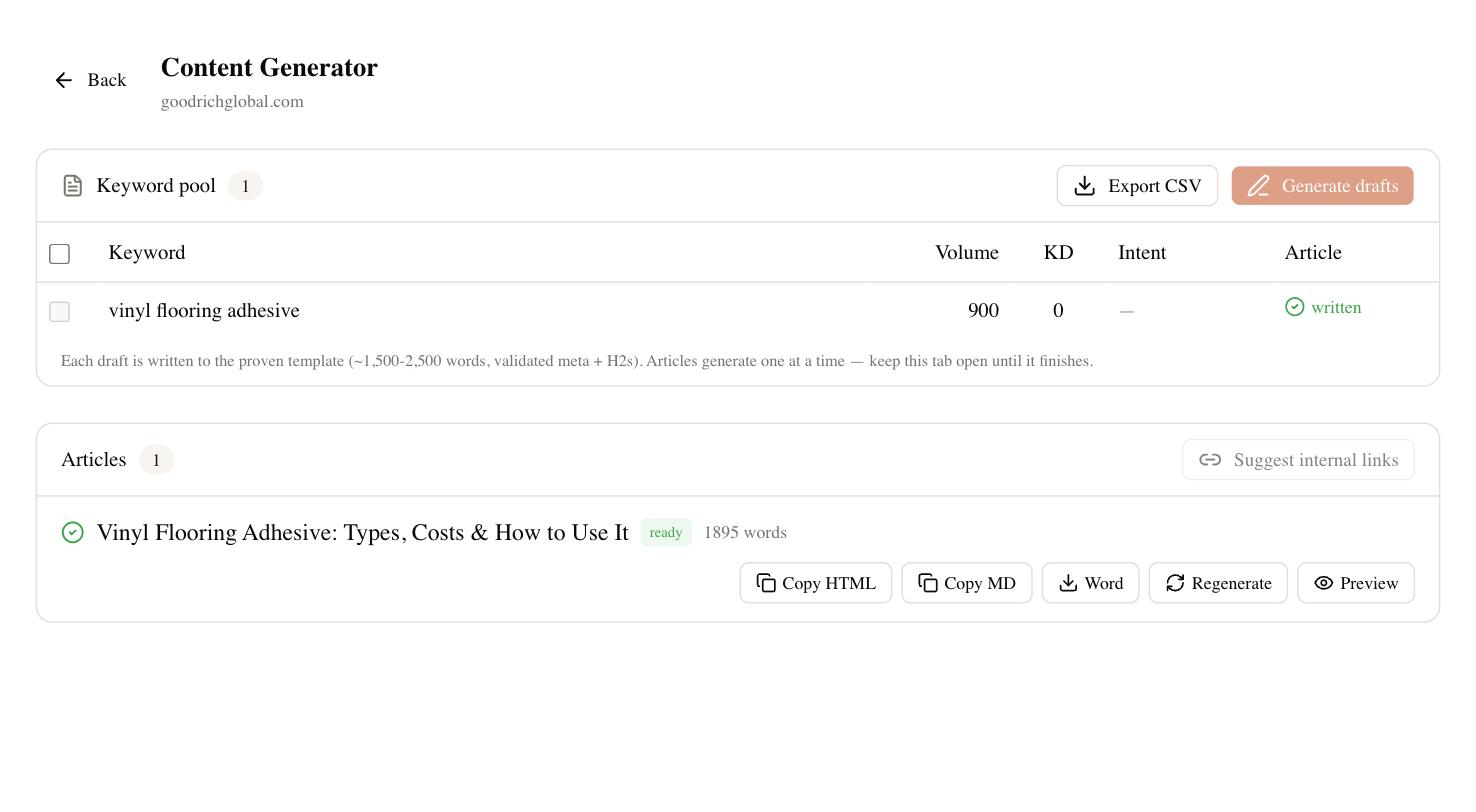
That is not a claim that Surfer is obsolete. Surfer’s Content Editor is still a more mature, focused writing surface, and a team that only wants to optimize on-page may prefer its single-minded depth. The honest distinction is scope: Surfer perfects one step, while an AI-native tool trades a little of that depth for connecting research, writing, rank tracking, and AI-search visibility under one subscription. Which matters more depends entirely on whether your problem is one step or the whole chain.
Who should buy Surfer — and who shouldn’t
Buy Surfer if you run a content operation and on-page optimization is your actual bottleneck. For editors briefing freelance writers, or a team producing volume that needs consistent structure, the Content Editor alone can justify the price by making every draft more competitive and less of a guess. Used with discipline — as a guide, never a scoreboard — it is a genuinely useful instrument.
Skip it if you publish infrequently, if your real gap is backlinks or authority rather than on-page depth, or if you would rather not run three subscriptions to cover research, writing, and tracking. In those cases a broader or more AI-native tool will serve you better for the money. The fair conclusion of any Surfer SEO review is that this is an excellent tool with a narrow, well-defined job — and the smart move is to be honest about whether that job is the one standing between you and better rankings.