
Most people looking for KeySearch alternatives aren’t disappointed by the price — KeySearch is cheap, and that’s the whole point. They’ve simply outgrown it. Once you’re doing this for a living or for clients, the shallow backlink index, the daily search caps, and the dated interface start to cost you more time than the low subscription saves you in money.
This roundup is not twelve tools stitched together with affiliate links. Below are the KeySearch alternatives that genuinely hold up in daily work, what each one is actually best at, and — because it’s the honest answer — the case for keeping KeySearch if budget is your hard constraint.
Why people leave KeySearch
Three complaints come up over and over. The first is data depth: KeySearch leans on a modest keyword database and a small link index, so competitive research and backlink audits feel thin compared with the big suites. The second is the caps — daily search limits on the entry plan interrupt a real research session, and you end up rationing lookups instead of exploring freely.
The third is newer and bigger. KeySearch was built to find low-competition keywords, and it does that job. But it treats content writing and AI-answer visibility as somebody else’s problem, so you finish your keyword list and then open a separate tool to draft the article and a third tool to check whether ChatGPT ever mentions your brand. That tool sprawl is the real reason the cheap subscription stops feeling cheap.
How we compared them
Every tool here was judged on four things a working SEO actually cares about: the depth and freshness of the underlying data, honest total cost once you add the seats and projects you really need, whether AI content and AI-search visibility are built in or bolted on, and who the tool genuinely suits. Third-party numbers like difficulty scores and traffic estimates are estimates, so treat differences between tools as directional rather than exact.
KeySearch alternatives at a glance
Start with the table, then read the notes below for the two or three rows that match your situation.
| Tool | Best for | AI-native? | Standout strength | Rough price band |
|---|---|---|---|---|
| SEO Rocket | Solo SEOs, consultants and agencies who want one AI-driven workflow | Yes — chat-first | Ahrefs-grade data plus AI writing and AI-search visibility in one place | Low $ / entry-friendly |
| Mangools | Freelancers who want friendly keyword research | No | KWFinder’s ease of use and clean difficulty scores | Low $ |
| LowFruits | Niche site builders hunting weak-spot keywords | Light | SERP-level analysis that surfaces beatable results | Low $ / credit-based |
| SE Ranking | Agencies watching cost per project | Some | Affordable rank tracking that scales across clients | Low–mid $ |
| Semrush | Marketing teams wanting an all-in-one suite | Add-ons | Breadth — PPC, content, social and PR in one login | Higher $$ |
| Ubersuggest | Hobbyists and very small budgets | Light | Cheap, simple keyword ideas | Low $ |
SEO Rocket — the AI-native pick
SEO Rocket is the option built for how the job works now. Instead of clicking through a keyword tool and rationing searches, you ask for what you need in plain language and it runs the lookup — keyword ideas, competitor gaps, backlink profiles, rank tracking — on real, Ahrefs-grade data underneath. The keyword research alone is a step up from KeySearch’s database, but the bigger difference is that the same tool then drafts the article and shows you whether your brand is being cited in AI answers.
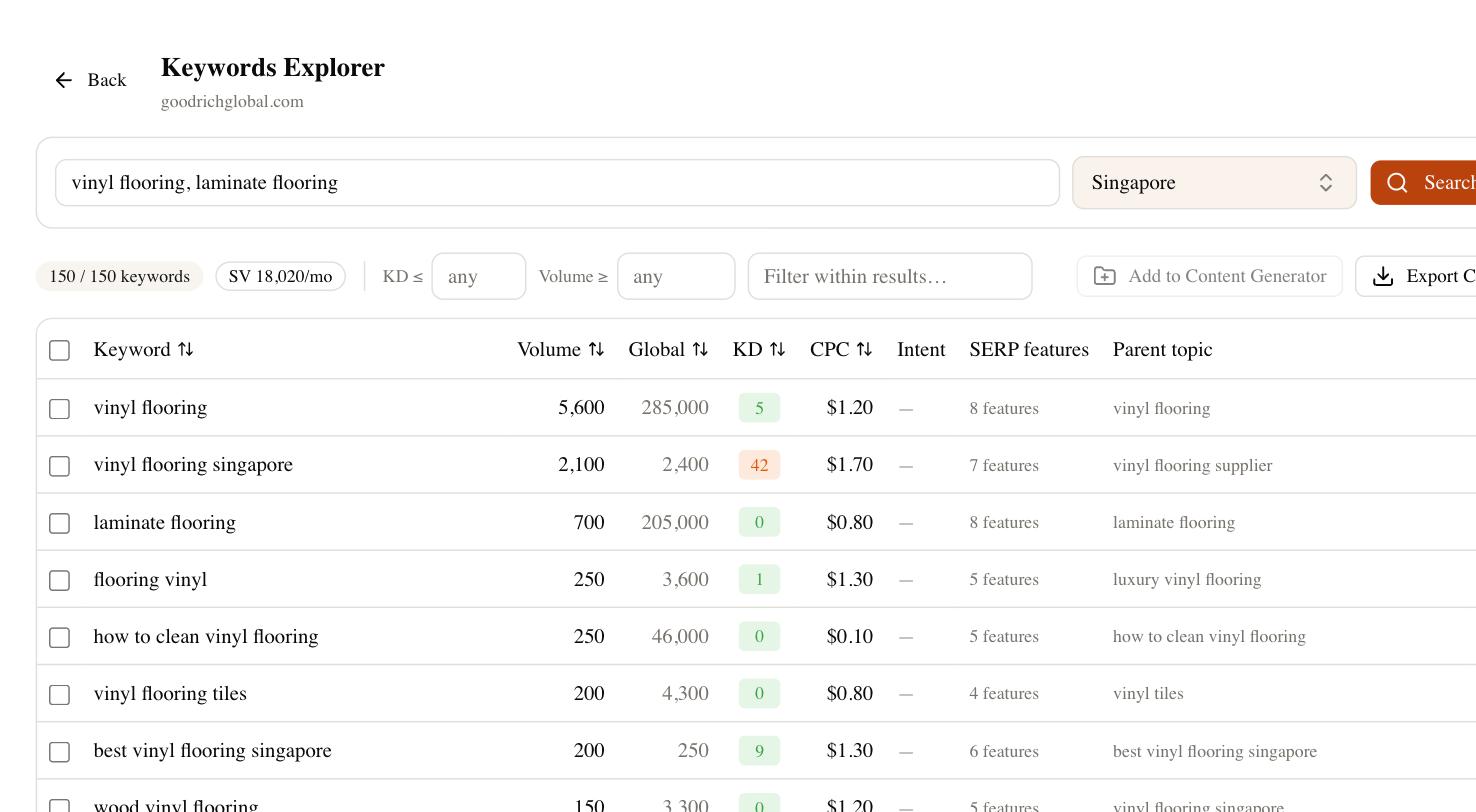
That consolidation is where the money goes back in your pocket. A typical budget stack of KeySearch plus a separate AI writer plus an AI-visibility tracker collapses into one subscription, and the entry pricing stays in the same low band you were already comfortable paying. If you’re a consultant or agency, the client-dashboard side means you can hand a read-only report straight to a client without exporting spreadsheets.
The AI-visibility piece is the part no traditional keyword tool answers. Search is splitting: some of your buyers now ask ChatGPT or Perplexity instead of Google, and a page that ranks first can still be invisible in an AI answer. SEO Rocket tracks whether and where you’re being cited across those surfaces, so you’re optimizing for the search that’s actually happening. For anyone whose bottleneck is doing more work with fewer tools, which is most people trading up from KeySearch, that combination is the strongest fit on this list.
Mangools, LowFruits, SE Ranking and Ubersuggest
If you want a like-for-like swap rather than a bigger platform, the mid-market has a tool for almost every budget and temperament.
- Mangools — the friendliest upgrade. KWFinder is one of the nicest keyword-research experiences going, its difficulty scores are easy to read, and the bundle stays affordable, though its index is not the deepest.
- LowFruits — the niche hunter’s pick. It analyzes the actual SERP to flag weak, beatable results, which is exactly what KeySearch users love doing, just with sharper signals. The credit model suits occasional bursts of research.
- SE Ranking — the agency value play. Rank tracking scales cheaply across many projects, and per-project pricing keeps costs predictable when you’re managing a portfolio of clients.
- Ubersuggest — the budget floor. It won’t match the suites on depth, but for a hobby site or a first client it delivers usable keyword ideas for very little outlay.
Any of these will cover core keyword and rank-tracking needs better than the KeySearch entry plan. What none of them do yet is fold AI writing and AI-answer visibility into the same workflow — you’ll still be paying for a second subscription to cover that.
Semrush — the all-in-one suite
Semrush sits at the opposite end from KeySearch. Beyond SEO it covers PPC research, content optimization, social scheduling and PR monitoring, so a marketing team that wants one login for the whole channel mix gets real value. Its keyword database is enormous and its competitive research is genuinely excellent.
The trade-off is obvious once you leave a budget tool: it’s expensive by the time you add the features that justify buying it, and the breadth brings a steep learning curve. If all you wanted was a better version of what KeySearch does, you’ll be paying for a lot of suite you never open.
When you should just keep KeySearch
Honesty matters here. If you run a small blog or a side project, your only real task is finding low-competition long-tail keywords, and your budget is genuinely tight, KeySearch still does that one job at a price almost nothing else matches. It’s simple, it’s cheap, and for a hobbyist the shallow link data and daily caps rarely bite. The right question isn’t “is there something more powerful” — there always is — it’s “will I actually use the extra power.” If you’re not writing at volume, not managing clients, and not chasing competitive terms, the more capable tools are money spent on capacity you’ll leave idle.
How to choose your KeySearch alternative
Match the tool to your real constraint, not to a feature list. If tool sprawl is the problem and you want AI writing plus AI-search tracking built in, SEO Rocket is the natural move up. If you just want a nicer keyword-and-rank tool in the same price band, Mangools, LowFruits, SE Ranking or Ubersuggest will each do the job. If you want one platform for every marketing channel, Semrush earns its higher price. And if you’re a hobbyist on a tight budget, there’s no shame in staying put.
A quick way to decide: write down the three things you actually did in KeySearch last month. If the list is some mix of “find easy keywords,” “check a competitor,” and “write a post,” you’re already doing work KeySearch only half-supports, and an AI-native tool will cover all three faster in one place. Whatever you pick, run your own site and two competitors through it for a week before you judge it — estimates jitter, positions move a few spots day to day, and the tool that answers your real questions fastest is the right alternative for you.