
Most people who land on a mangools review already suspect the same thing: the big SEO suites are more tool than they need, and more money than they want to spend. Mangools is the answer a lot of freelancers reach for, and for good reason — it is genuinely pleasant to use. But “pleasant” and “enough” are not the same thing, so this mangools review covers what the bundle nails, where it quietly falls short, and who should pick something else.
Mangools is not one product. It is five tools sold together: KWFinder for keyword research, SERPChecker for analyzing a results page, SERPWatcher for rank tracking, LinkMiner for backlinks, and SiteProfiler for a quick domain overview. KWFinder is the star, and honestly the reason most people subscribe at all.
What Mangools Does Really Well
The single best thing about Mangools is speed to a usable answer. You type a seed keyword into KWFinder, and within a second or two you get search volume, a keyword difficulty score, related terms, and a clean SERP preview — all on one screen without a single confusing menu. For someone who just wants to know “is this keyword worth writing about,” it is one of the fastest experiences in the category.
The keyword difficulty score deserves specific praise. Mangools presents it as a simple 0–100 color-coded number, and it maps to reality well enough that a beginner can trust it without a course in link metrics. The interface is uncluttered, the onboarding is short, and nothing about the product feels like it was built to intimidate you into an enterprise plan. That approachability is real, and it is why so many solo consultants stay for years.
SERPWatcher, the rank tracker, is similarly friendly. You add keywords, pick a location, and get a clean daily chart with a “Performance Index” that rolls your positions into one trend line. It will not replace an agency-grade tracker, but for watching 50 to 200 keywords on a handful of sites, it is more than adequate and far cheaper than the suites.
The Real Weaknesses
Here is where an honest review has to slow down. Mangools’ backlink data — through LinkMiner and SiteProfiler — is its weakest link, and it is not close. The index is meaningfully smaller than what Ahrefs or Semrush maintain, so if your work involves competitive link audits, disavow files, or link building at scale, you will hit the ceiling fast. LinkMiner is fine for a quick sanity check; it is not a serious backlink instrument.
Depth is the second problem. The tools are shallow by design. You get the headline numbers quickly, but there is little room to go deeper — no rich content-gap analysis across multiple competitors, no site audit crawler of any real substance, no meaningful technical SEO reporting. Once your questions get more sophisticated than “what should I target next,” you start reaching for a second tool.
Limits are the third. Mangools plans are metered by daily keyword lookups and tracked keywords, and on the entry tier those caps are tight enough that a busy research day can hit the wall before lunch. It is a fair trade for the price, but you should know it exists before you build a workflow around unlimited digging.
Mangools vs the AI-Native Approach
The gap that matters most in 2026 is not data volume — it is workflow. Mangools was built for a job that ended when you exported a keyword list. It does not draft the article, and it does not tell you whether your brand shows up when a buyer asks ChatGPT or Perplexity instead of Google. Those are now two of the most important parts of the job, and Mangools answers neither.
That is the honest case for looking at an AI-native tool like SEO Rocket. Instead of five dashboards, you ask for what you need in plain language and it runs the lookup on Ahrefs-grade data underneath — then the same tool drafts the content and tracks whether you are being cited across AI search surfaces. For a freelancer whose real bottleneck is doing more with fewer subscriptions, that consolidation matters more than any single metric.
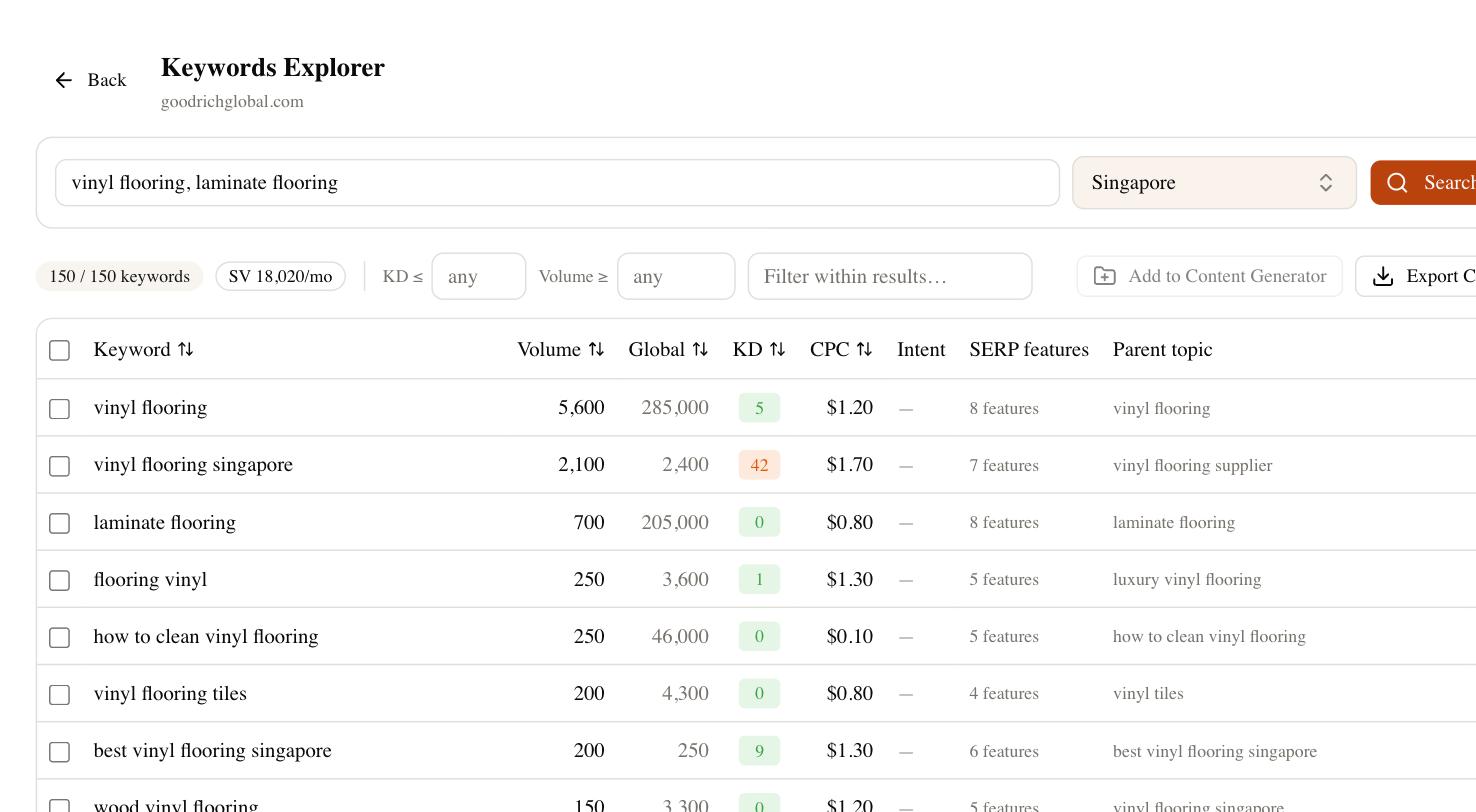
None of that makes Mangools a bad buy. If your entire need is fast keyword research and light rank tracking, Mangools does that job cleanly and cheaply, and you may never miss the rest. The question is whether “the rest” — content, AI visibility, deeper backlink data — is part of your week or not.
Feature and Fit Comparison
Here is how the honest trade-offs line up. Treat the price bands as rough — every vendor changes tiers — and note that third-party metrics like keyword difficulty are estimates across all of these tools, not gospel.
| Tool | Best for | Backlink depth | AI content & AI-search | Rough price band |
|---|---|---|---|---|
| Mangools | Freelancers wanting fast, friendly keyword research | Light — LinkMiner is a quick check, not an audit | No | Low $ |
| SEO Rocket | Solo SEOs & agencies who want one AI-driven workflow | Ahrefs-grade data underneath | Yes — built in, chat-first | Low $ / entry-friendly |
| Ahrefs | Serious link builders & large teams | Among the largest, freshest indexes | No native AI writing | Higher $$$ |
| Semrush | Marketing teams wanting one suite | Strong | Add-ons | Higher $$ |
Rough Pricing and Value
Mangools sits at the affordable end of the market. Its plans generally land in the low tens of dollars a month on annual billing, climbing modestly as you move up tiers for more lookups, tracked keywords, and seats. Against Ahrefs and Semrush — whose serious plans run into the low hundreds a month — that is a dramatic saving, and it is the whole appeal.
The value math is simple: you are trading depth and breadth for price and simplicity. If keyword research and basic rank tracking are 90% of what you actually do, that trade is excellent and Mangools is one of the best deals in SEO. If they are 40% of your job and the rest is content, links, and AI visibility, the low price stops being a bargain because you will pay again for the tools it does not cover.
Who Should Buy Mangools — and Who Shouldn’t
Buy Mangools if you are a freelancer, blogger, or small-site owner who wants clean keyword research, a trustworthy difficulty score, and light rank tracking without a steep learning curve or a scary invoice. For that person it is close to ideal, and I would recommend it over an oversized suite every time.
Look elsewhere if backlink analysis is central to your work — Ahrefs still owns that ground — or if you want content drafting and AI-search visibility folded into the same workflow, which is where a tool like SEO Rocket fits better. The smartest move is to write down the three tasks you actually did in an SEO tool last week. If they are all keyword-and-rank tasks, Mangools is your tool. If content and AI answers are on that list, buy for where the job is going, not where it was.