
Most tools that promise “SEO content optimization” are thin wrappers around a word count and a keyword density meter. This NeuronWriter review exists because the tool is genuinely more than that — it reads the live search results for your target term, pulls the language the ranking pages actually use, and hands you a working brief. It is also cheaper than most of its rivals, which is a large part of why people keep asking about it.
This NeuronWriter review is not a sales page. Below is what the tool does well in daily use, where it frustrates people, roughly what you should expect to pay, and who should look elsewhere. If you write or edit content for a living, this is the honest version.
What NeuronWriter actually does
NeuronWriter is a content optimization and SERP-analysis tool built around a natural-language-processing editor. You give it a keyword, it scrapes the top-ranking pages for that query, and it extracts the terms, entities, and questions those pages share. You then write inside its editor while a content score climbs as you cover the recommended terms. Think of it as a research assistant that tells you what “complete” looks like for a given topic, then grades your draft against that target in real time.
Around that core it adds competitor content analysis, a basic internal-linking helper, an AI writer for generating sections or full drafts, and shared workspaces so teams and clients can collaborate. The center of gravity, though, is always the editor and its term recommendations. Everything else is supporting cast.
Where NeuronWriter is genuinely good
The term extraction is the star. Its NLP suggestions tend to be more relevant and less noisy than the padded keyword lists you get from cheaper optimizers, and the entity coverage often surfaces subtopics you would have missed — the kind of gaps that separate a page that ranks from one that stalls on page two. For writers who know their subject but not the search intent behind it, that brief is worth the subscription on its own.
The SERP analysis is fast and practical. You can see the ranking pages’ word counts, heading structures, and shared questions in one view, which makes outlining a new article far quicker than opening ten tabs by hand. The AI writer is competent for filler paragraphs and first drafts, and because it is fed the same SERP context, its output usually stays on topic rather than drifting into generic fluff.
Price is the other genuine strength. NeuronWriter sits at the affordable end of the market, and its query-based plans mean a freelancer publishing a handful of articles a month pays very little compared with an enterprise content platform. For the value, the depth of the content analysis is hard to beat.
NeuronWriter’s real weaknesses
The interface shows its age. It is functional but cluttered, and new users routinely spend their first few sessions hunting for features. Nothing is broken, but the polish you get from pricier tools is not here, and the learning curve is steeper than the marketing suggests.
The bigger limitation is scope. NeuronWriter optimizes content and nothing else. It does not track your rankings over time, it does not analyze backlinks, and it does not audit your site’s technical health. That is a deliberate focus, not a bug — but it means NeuronWriter is one tool in a stack, never the whole stack. You will still be paying for rank tracking and a data tool alongside it.
The query model can also bite. Because plans are metered by content analyses, a busy month of research can exhaust your allowance faster than you expect, nudging you toward the next tier. And treat the content score as a guide, not gospel — chasing a perfect number can push writers to stuff terms in ways that read badly to humans, which is the opposite of what actually ranks.
NeuronWriter vs the alternatives
It helps to see where NeuronWriter sits against the tools people usually weigh it against. Prices are broad bands, not quotes — check current plans before you buy.
| Tool | Best for | Core focus | Full SEO suite? | Rough price band |
|---|---|---|---|---|
| NeuronWriter | Freelancers & small teams on a budget | SERP-driven content optimization | No — content only | Low $ |
| Surfer SEO | Content teams wanting polish | Content editor + audit | No — content only | Mid $$ |
| Frase | Writers who want research + briefs | Content briefs + AI writing | No — content only | Low–mid $ |
| Clearscope | Enterprise editorial teams | Premium content grading | No — content only | Higher $$$ |
| SEO Rocket | Solo SEOs & agencies wanting one workflow | AI writing + data + rank tracking | Yes — AI-native | Low $ / entry-friendly |
Against Surfer, NeuronWriter usually wins on price and loses on interface polish. Against Frase, the two are close, with NeuronWriter stronger on term depth and Frase smoother for brief-building. Clearscope is the premium option and priced like it — worth it for large editorial teams, overkill for a freelancer. The pattern is clear: these are all content optimizers, and none of them handle the rest of the SEO job.
Who NeuronWriter is for
NeuronWriter suits freelance writers, content-focused SEOs, and small agencies who want serious content optimization without a serious bill. If your bottleneck is producing well-researched, thorough articles that cover a topic completely, and you already have separate tools for keyword research and rank tracking, NeuronWriter slots in neatly and earns its keep.
It is a poor fit if you want one login for the whole job. Anyone hoping to research keywords, track positions, check backlinks, and write — all in one place — will find NeuronWriter covers only the last of those. It is a specialist, and specialists are excellent right up until you need the parts they do not do.
Where SEO Rocket fits
If the deal-breaker in this review is scope, that is worth naming directly. SEO Rocket is built as an AI-native workflow rather than a single-purpose editor: you ask for what you need in plain language and it runs keyword research, competitor gaps, and rank tracking on real data, then drafts the article with the title, meta, and heading structure already in place.
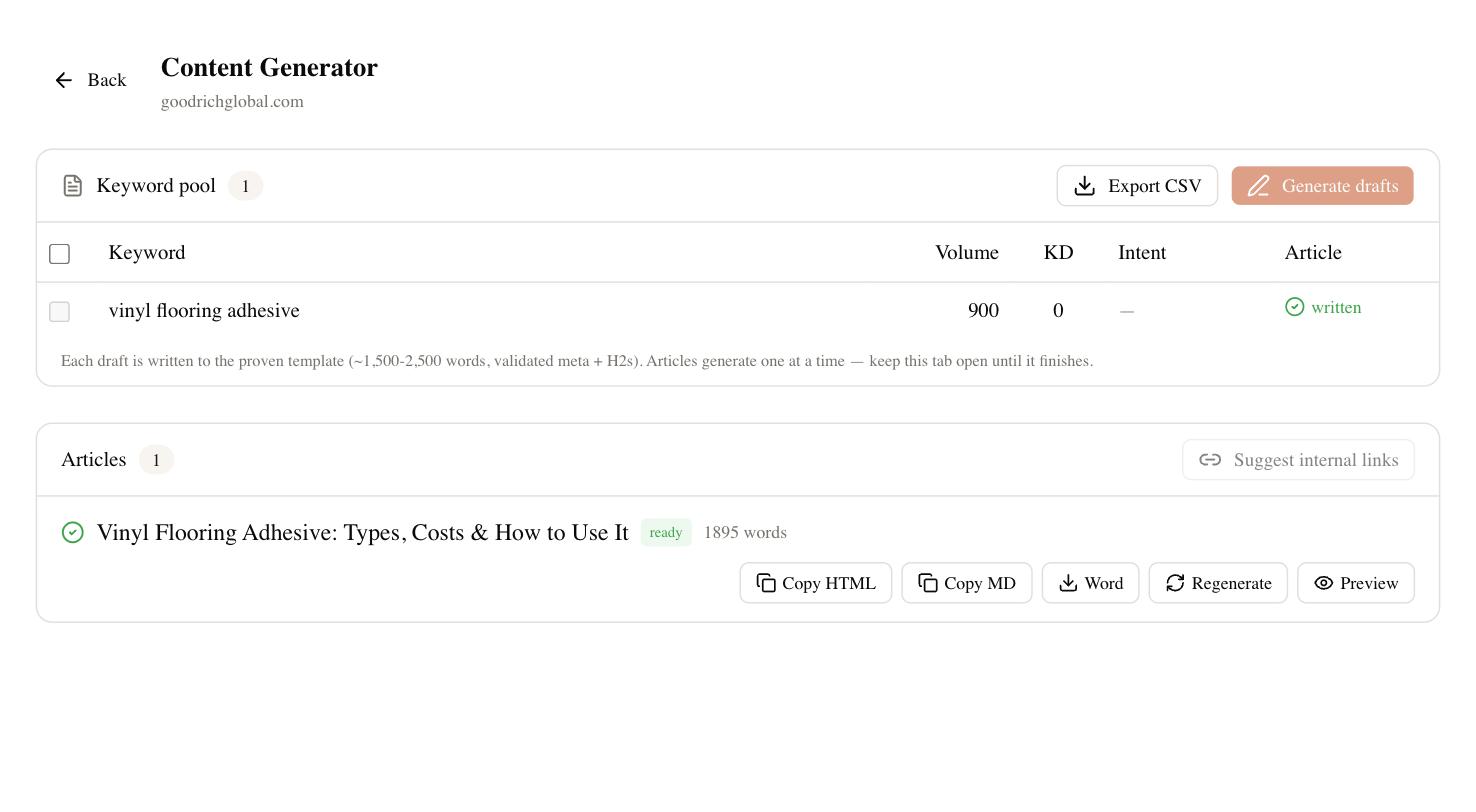
The honest distinction is this: NeuronWriter is the better tool if all you want is a deep, term-level content grade and you are happy running it beside other subscriptions. SEO Rocket makes more sense if tool-sprawl is your actual problem and you want the writing, the data, and the tracking — plus visibility into whether AI search engines cite you — under one roof. Different problems, different answers.
The honest verdict
NeuronWriter is a strong, affordable content optimizer with genuinely useful NLP analysis, held back by a dated interface and a narrow scope. For a writer or small team who needs better briefs and higher content quality on a tight budget, it is one of the best-value picks available, and the SERP analysis alone will sharpen most people’s drafts. Just go in knowing what it is not — it will not track your rankings, audit your site, or replace a full toolkit. Buy it for what it does best, pair it with the tools it deliberately skips, and it will pull its weight. If you would rather not run three subscriptions to get one article published, look at an AI-native workflow instead.