
Most people searching for GrowthBar alternatives aren’t unhappy with the idea of an all-in-one AI writer — they’ve hit its ceiling on data depth or content quality. The strongest GrowthBar alternatives now do the writing and the research on heavier data, and a few even track whether AI search engines are citing your brand at all.
This is not a padded list of a dozen tools stitched together with affiliate links. Below are the options that genuinely hold up in daily use, what each one is actually best at, and — because it is the honest answer — when you should just keep GrowthBar.
Why people leave GrowthBar
GrowthBar earned a loyal following as a fast, approachable AI content tool with a handy Chrome extension. It was one of the first to bundle keyword research, competitor peeks, and one-click article drafting into a friendly interface aimed at bloggers and small teams. For a solo writer publishing a couple of posts a week, that was plenty.
The friction shows up when you scale. The underlying keyword and backlink data is lighter than what a dedicated research platform gives you, so competitive analysis feels shallow once you are working on harder niches. The AI drafts get you a skeleton, but they still need heavy editing to sound like a person and to survive a fact check. And like most tools built before 2024, GrowthBar has no view of AI search — it cannot tell you whether ChatGPT, Perplexity, or Google’s AI Overviews ever mention your site. Add seats or push past the word and tracking caps, and the bill starts to look less like a bargain.
How we picked these alternatives
Every tool here was judged on four things a working SEO actually cares about: the depth and freshness of the underlying data, the real quality of the AI writing, whether AI-search visibility is built in or missing entirely, and honest total cost rather than the headline number. Third-party metrics like domain rating and traffic estimates are exactly that — estimates — so treat differences between tools as directional, not gospel.
GrowthBar alternatives at a glance
Start with the table, then read the notes below for the two or three that fit your situation.
| Tool | Best for | AI writing | Standout strength | Rough price band |
|---|---|---|---|---|
| SEO Rocket | Solo SEOs, consultants & agencies wanting one AI workflow | Yes — chat-first | Heavy data + AI writing + AI-search visibility in one place | Low $ / entry-friendly |
| Surfer SEO | Writers optimizing drafts against the SERP | Yes | On-page content scoring and briefs | Mid $$ |
| Frase | Content teams building briefs at speed | Yes | Fast SERP research and outline generation | Low–mid $ |
| Scalenut | Publishers wanting a content-to-cluster flow | Yes | Topic clusters and long-form drafting | Low–mid $ |
| Semrush | Marketing teams wanting an all-in-one suite | Add-ons | Breadth across SEO, PPC and content | Higher $$ |
| Ahrefs | Link builders who live in backlink data | Light | One of the largest, freshest link indexes | Higher $$ |
SEO Rocket — the AI-native pick
SEO Rocket is the option built for how content SEO works now. Instead of hopping between a keyword tab, a brief tool, and a separate writer, you ask for what you need in plain language and it runs the work on real, research-grade data underneath — keyword research, competitor gaps, backlink profiles, and rank tracking. The same tool then drafts the article, structured with a proper title, meta description, and heading hierarchy rather than a generic wall of text.
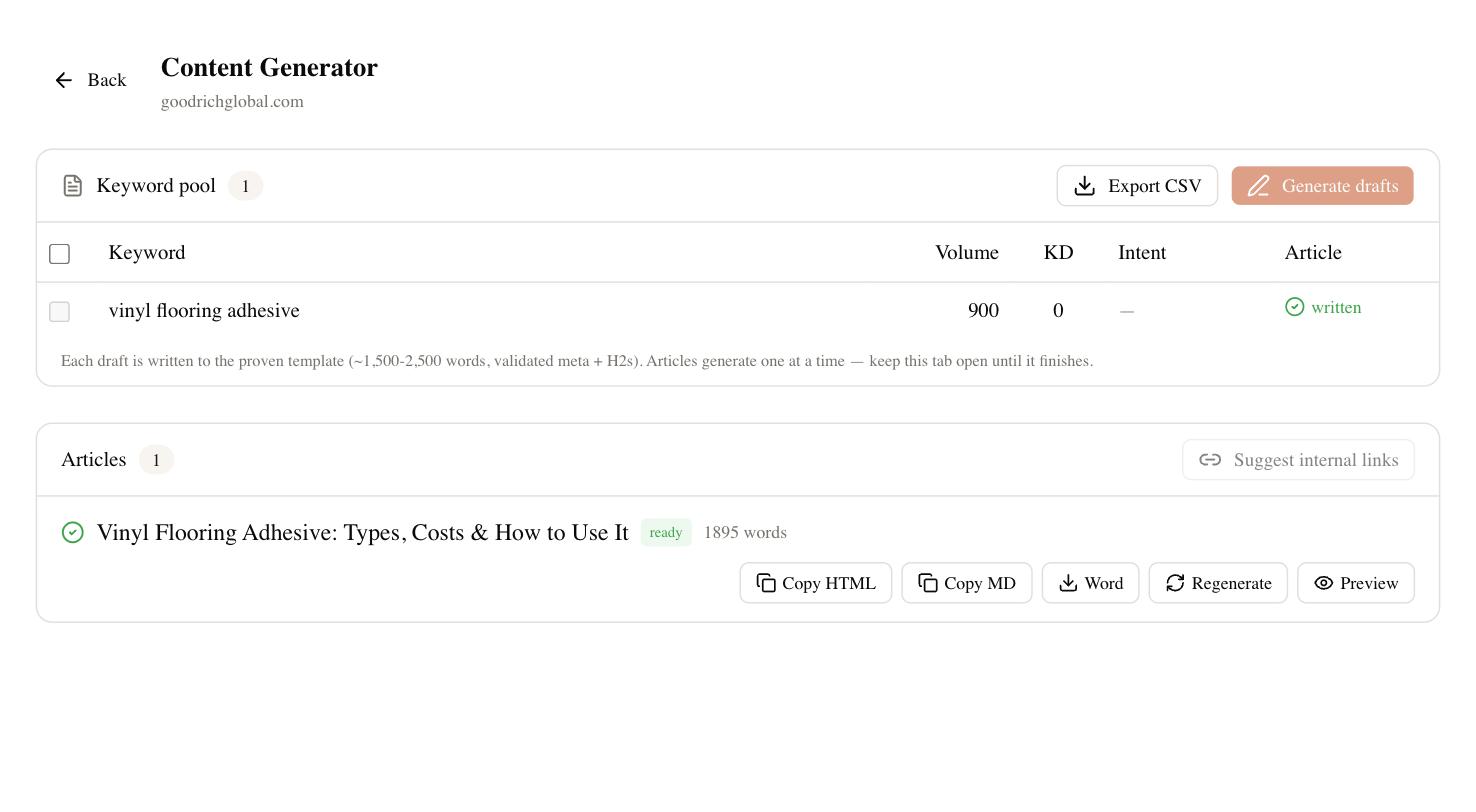
That consolidation is the real saving. A typical GrowthBar-era stack — one tool for keywords, one for briefs, one for AI drafting, and nothing for AI search — collapses into a single subscription, and the entry pricing stays friendly for solo operators. If you are a consultant or agency, the client-dashboard side means you can hand a read-only report straight to a client without exporting anything to a spreadsheet.
The AI-visibility piece is the part no content-first tool answers. Search is splitting: some of your buyers now ask ChatGPT or Perplexity instead of typing into Google, and a page that ranks first can still be invisible inside an AI answer. SEO Rocket’s Brand Radar tracks whether — and where — you are being cited across those surfaces, so you are optimizing for the search that is actually happening. For anyone whose bottleneck is producing more work with fewer tools, which is most people reading this, that combination is the strongest fit on the list.
Surfer SEO, Frase and Scalenut — the content-first tools
These three sit closest to GrowthBar’s core promise: help you write pages that rank. Each takes a slightly different angle, and any of them will feel like a step up if content optimization is your main job.
- Surfer SEO — the on-page scorer. Surfer grades your draft against the pages already ranking and tells you what to add, and its content editor is a genuine pleasure to write in. It leans on you to bring the keyword strategy, though.
- Frase — the brief machine. Frase pulls the SERP apart fast and hands you an outline in minutes, which is a real time-saver for teams briefing freelancers at volume. Its research is strong; its raw drafting still needs an editor.
- Scalenut — the cluster planner. Scalenut is built around topic clusters and long-form drafting, so if you think in content hubs rather than single posts, its workflow maps neatly onto that.
What none of these three do yet is fold heavy research data and AI-search tracking into the same place. You will still pair them with a separate keyword and backlink tool, and none of them can tell you whether an AI answer engine is quoting you.
Semrush and Ahrefs — when you need heavier data
If your reason for leaving GrowthBar is that its data feels thin, the fix might be a heavier research platform rather than another AI writer. Semrush is the closest thing to a do-everything marketing suite — SEO, PPC research, content, and competitive analysis under one login — with AI features available as add-ons. It is powerful and broad, but you pay for the breadth, and much of the suite sits unused if you only want SEO.
Ahrefs is the specialist’s choice for backlink and keyword depth. Its link index is one of the largest and freshest in the industry, and serious link builders rarely regret it. What it is not is an AI content tool — writing sits at the edge of what it does. Both platforms run into the higher price bands quickly once you add seats or projects, so they suit teams whose constraint is data, not budget.
When you should keep GrowthBar
Honesty matters here. If you are a solo blogger or a small team publishing a steady trickle of straightforward content, GrowthBar’s simplicity is a feature, not a limitation. The Chrome extension is handy for quick keyword checks, the interface never overwhelms, and the entry price is gentle. Switching tools has a real cost in time and habit, and if what you have already gets your posts written and shipped, a heavier platform may just add friction you do not need. The right question is not “is there something better in the abstract,” it is “does GrowthBar block something I am actually trying to do this month.” For plenty of casual users, the answer is no.
How to choose your GrowthBar alternative
Match the tool to your real constraint, not to a feature checklist. If the problem is tool sprawl and you want research, AI writing, and AI-search tracking in one workflow, SEO Rocket is the natural move. If you mainly want to optimize drafts against the SERP, Surfer, Frase, or Scalenut will each do that well. If your bottleneck is data depth, Semrush or Ahrefs earns its higher price. And if GrowthBar still ships your content without getting in the way, there is no shame in staying put.
A quick way to decide: write down the three things you actually did in your content tool last week. Most people’s list is some mix of “find a keyword,” “check what a competitor is doing,” and “produce a piece of content.” If that is your week, you are the exact reader an AI-native tool serves — it will cover those three faster and in one place. Whatever you pick, run your own site and two competitors through it for a full week before you judge it; positions jitter a few spots day to day, and the tool that answers your real questions fastest is the right alternative for you.