
Most people hunting for NeuronWriter alternatives don’t dislike the tool — they’ve outgrown the shape of it. NeuronWriter does one thing well: it pulls the top-ranking pages for a query, runs NLP on them, and hands you a term list and a content score to hit. That’s genuinely useful. But it’s a content-optimization editor and nothing more, so the moment your work spills into rank tracking, competitor research, or checking whether ChatGPT ever cites you, you’re back to juggling other subscriptions.
This is not a padded list of twelve tools with affiliate links bolted on. Below are the NeuronWriter alternatives that actually earn their place, what each is genuinely best at, and — because it’s the honest answer — when you should just keep NeuronWriter.
Why people leave NeuronWriter
Three reasons come up repeatedly. The first is scope: NeuronWriter optimizes drafts, but it doesn’t track your rankings, map backlinks, or audit a site, so it lives inside a larger stack rather than replacing one. The second is the query and credit model — heavy users bump into per-query limits and end up rationing analyses or upgrading sooner than they’d planned. The third is the interface itself, which is powerful but dense; the term-weighting and scoring take a while to read fluently, and newer writers often over-optimize toward a number instead of writing for a reader.
None of that makes NeuronWriter a bad tool. It makes it a specialist in a job that increasingly rewards one connected workflow, especially now that AI writing and AI-search visibility have become part of the day. That gap is exactly where the alternatives compete.
How we compared them
Every tool here is judged on four things a working SEO actually cares about: the depth of the underlying SERP and keyword data, whether AI drafting is built in or bolted on, honest total cost rather than the headline number, and who the tool genuinely suits. Content scores and term recommendations are directional signals, not physics — two tools will disagree on the “right” list for the same query, so treat any single score as a guide, not a grade.
One thing worth saying up front: no optimization score has ever ranked a page on its own. Terms and headings help a search engine understand a document, but relevance, links, and genuine usefulness still do the heavy lifting. The tools below that push you toward a number are best used as a checklist you can override, not a target you chase to 100. Keep that in mind as you read, because it changes which trade-offs actually matter for your work.
NeuronWriter alternatives at a glance
Start here, then read the notes below for the two or three that fit your situation.
| Tool | Best for | AI-native? | Standout strength | Rough price band |
|---|---|---|---|---|
| SEO Rocket | Solo SEOs, consultants & agencies wanting one AI-driven workflow | Yes — chat-first | Ahrefs-grade data + AI writing + AI-search visibility in one place | Low $ / entry-friendly |
| Surfer SEO | Writers who want fast, visual on-page optimization | Add-on writer | Clean editor with a widely trusted content score | Mid $$ |
| Frase | Teams building briefs and outlines at speed | Yes | Research-to-brief workflow with SERP question mining | Low–mid $ |
| Clearscope | Editorial teams who want simple, premium optimization | No | Clean term reports and readability grading | Higher $$ |
| MarketMuse | Content strategists planning whole topic clusters | Some | Topic modeling and content planning at scale | Mid–higher $$ |
| Jasper | Marketers who want brand-voice AI drafting first | Yes | Flexible long-form generation and templates | Mid $$ |
SEO Rocket — the AI-native pick
SEO Rocket is the option built for how the job works now. Instead of a query box and a term panel, you ask for what you need in plain language and it runs the work — keyword research, competitor gaps, rank tracking, and a full site audit — on real, Ahrefs-grade data underneath. The optimization NeuronWriter gives you is here too, but it’s one part of a loop rather than the whole product: the same tool researches the topic, drafts the article, and tells you where you actually rank afterward.
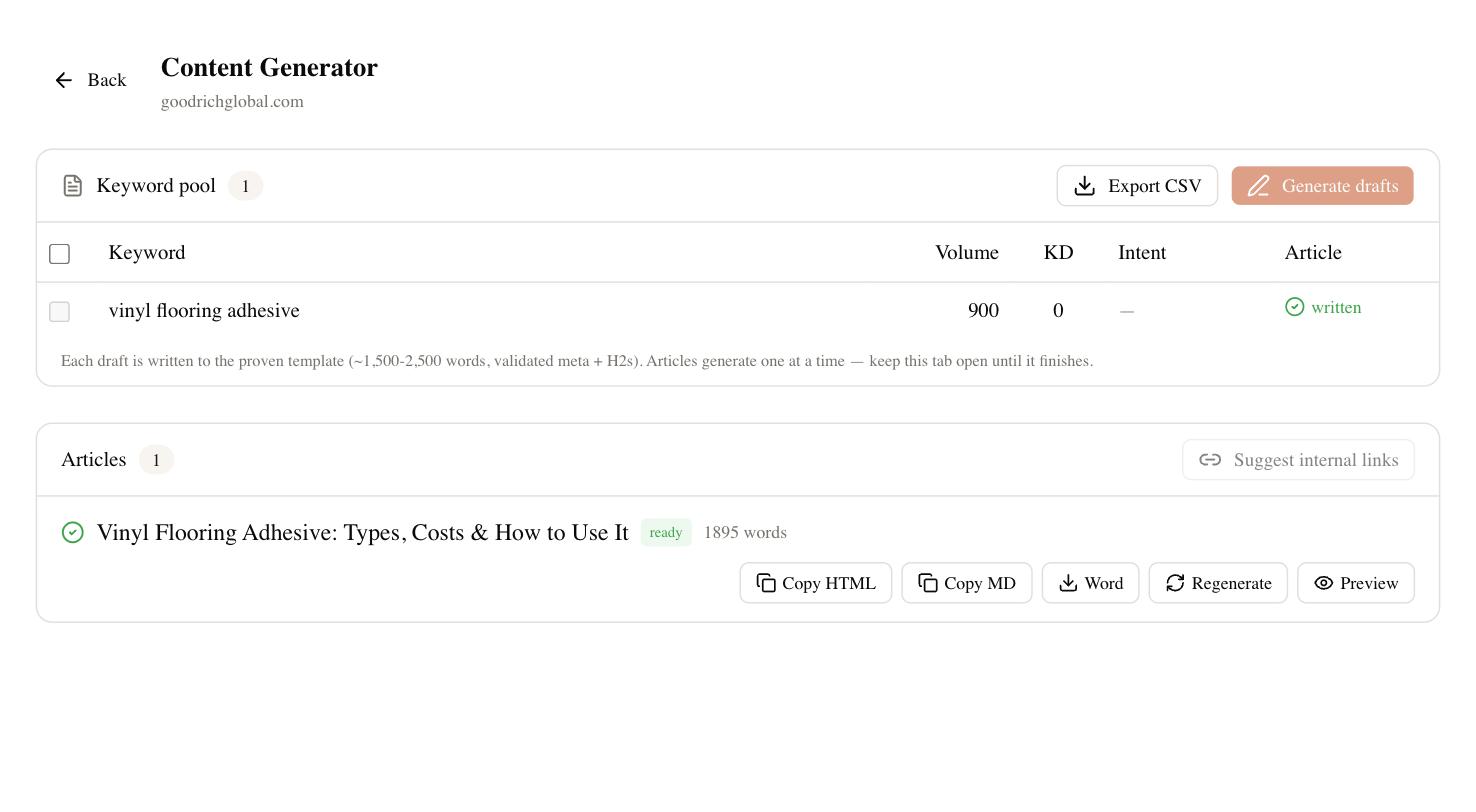
That consolidation is the real saving. A typical stack of NeuronWriter for optimization, a separate rank tracker, and an AI writer collapses into one subscription, and the entry pricing lands well below what those three cost together. If you’re a consultant or agency, the client-dashboard side lets you hand a read-only report straight to a client without exporting a single spreadsheet. The workflow also stays honest with you: because the tool sees your live rankings, it can tell you when a published, well-optimized page still isn’t moving — the signal that the problem is links or intent, not term coverage, which is precisely the blind spot a standalone editor leaves you with.
The piece no optimization tool answers is AI search. Some of your buyers now ask ChatGPT or Perplexity instead of Google, and a page that scores a perfect content grade can still be invisible in an AI answer. SEO Rocket’s Brand Radar tracks whether — and where — you’re being cited across those surfaces, so you’re optimizing for the search that’s actually happening. For anyone whose bottleneck is doing more with fewer tools, which is most people reading this, that combination is the strongest fit on the list.
Surfer, Frase, Clearscope, MarketMuse and Jasper
The optimization market has a tool for almost every temperament and budget.
- Surfer SEO — the closest like-for-like swap. Its content editor is cleaner than NeuronWriter’s, the score is widely trusted, and there’s an AI writer available, though it stays firmly on-page and costs more.
- Frase — the brief-builder. If your bottleneck is turning a SERP into an outline and question list, Frase’s research-to-brief flow is fast and affordable, with lighter term depth than the specialists.
- Clearscope — the premium simple option. Editorial teams love its clean term reports and readability grading; the trade-off is a higher price for a narrower feature set.
- MarketMuse — the strategist’s pick. It’s less about a single draft and more about planning entire topic clusters and spotting gaps across a site.
- Jasper — the writing-first choice. If you care more about brand-voice generation than SERP term matching, Jasper leads on drafting but is lighter on optimization data.
Any of these will cover the optimize-a-draft job. What none of them fold in is rank tracking, backlink data, and AI-answer visibility in the same place — you’ll still run a second and third subscription for that.
When you should just keep NeuronWriter
Honesty matters here. If your entire workflow is “take a keyword, get a term list, hit the score, publish,” NeuronWriter does that at one of the friendliest price points in the category, and its multi-language support is genuinely strong for teams writing outside English. Agencies producing high volumes of optimized drafts on a tight budget often have no reason to move. The right question isn’t “is there something newer,” it’s “does the newer option cover the part of NeuronWriter I actually rely on.” For a pure content-optimization shop, sometimes staying is the correct call.
How to choose your alternative
Match the tool to your real constraint, not to a feature checklist. If tool-sprawl is the problem and you want research, AI writing, rank tracking, and AI-search visibility in one workflow, SEO Rocket is the natural move. If you only want a cleaner optimization editor, Surfer or Clearscope will feel like an upgrade. If briefs are your bottleneck, Frase earns its keep; if strategy is, MarketMuse does. And if writing quality matters more than term matching, Jasper leads.
A quick way to decide: write down the three tasks you actually did last week. Most lists are some mix of “research a topic,” “optimize a draft,” and “check what I rank for.” If that’s your week, you’re paying for one narrow slice and patching the rest with other tools — and a connected, AI-native option covers all three faster and cheaper. If instead your week was pure high-volume optimization on a budget, keep the specialist. The best alternative is the one that matches how you actually spend Tuesday, not the one with the longest feature page — so run your own topic and two competitors through your shortlist for a week before you commit.