SpyFu vs SEO Rocket is not really a like-for-like fight, and pretending otherwise would waste your time. SpyFu built its name on one thing — showing you the exact keywords and ads your competitors buy on Google — and it does that cheaply and well, which is why the SpyFu vs SEO Rocket question usually comes down to whether competitor PPC intelligence or an AI-native SEO workflow is the bigger gap in your week.
This comparison leads with where SpyFu is genuinely the better buy, because for some readers it is. Then it makes the case for SEO Rocket where that case is honest — and points you to a clear pick by use case at the end.
Where SpyFu is genuinely stronger
SpyFu’s core strength is competitor ad intelligence, and it has held that ground for well over a decade. Type in a competitor’s domain and you get years of their Google Ads history — the keywords they bought, the ad copy they ran, roughly when they turned campaigns on and off. If your job is reverse-engineering a rival’s paid search strategy, very few tools give you that much history for that little money.
Price is the second real advantage. SpyFu sits firmly in the low monthly band and famously does not meter you into the ground — a single mid-tier plan gives most solo users effectively unlimited lookups. For a freelancer or a small PPC shop watching every dollar, that flat, predictable cost is a legitimate reason to choose it, and no honest comparison should skip past that.
It is also fast to grasp. SpyFu does a handful of things — domain overview, keyword research, competitor comparison, ad history — and does not bury them under a hundred menus. If you want a cheap window into what competitors rank and bid for, and nothing more, SpyFu is a rational, defensible choice.
Where SpyFu shows its age
The honesty cuts both ways. SpyFu’s data skews heavily toward the United States and a few large English-speaking markets; if you work on a Singapore, Gulf, or European site, coverage thins out and estimates get looser. Its backlink data has never been its strong suit, so serious link analysis usually sends you elsewhere anyway.
The deeper limitation is that SpyFu was designed for a job that ended at the report. It tells you what competitors do — then hands you a spreadsheet and stops. It does not draft the article that closes the gap, and it has no view at all into whether your brand shows up when a buyer asks ChatGPT or Perplexity instead of Google. That is not a knock on old software; it is simply the boundary of what SpyFu set out to do.
What SEO Rocket does differently
SEO Rocket starts from a different premise: you should be able to ask for what you need in plain language and have the tool run the work, not just render a dashboard. Instead of learning where each report lives, you type “show me the keyword gaps between my site and these two competitors” and it runs the lookup on real, Ahrefs-grade data underneath, then explains the result. The chat-first workflow is the product, not a chatbot bolted onto a legacy UI.
That same interface then does the two things SpyFu structurally cannot. It drafts the content — full articles written by Claude, using your keyword and competitor data as the brief — so the gap you just found becomes a draft in the same session. And it tracks AI-search visibility through a Brand Radar view, showing whether you are being cited in ChatGPT, Perplexity, and Google’s AI Overviews. That is the surface where a growing share of buyers now start, and it is invisible to a traditional keyword-and-ads tool.
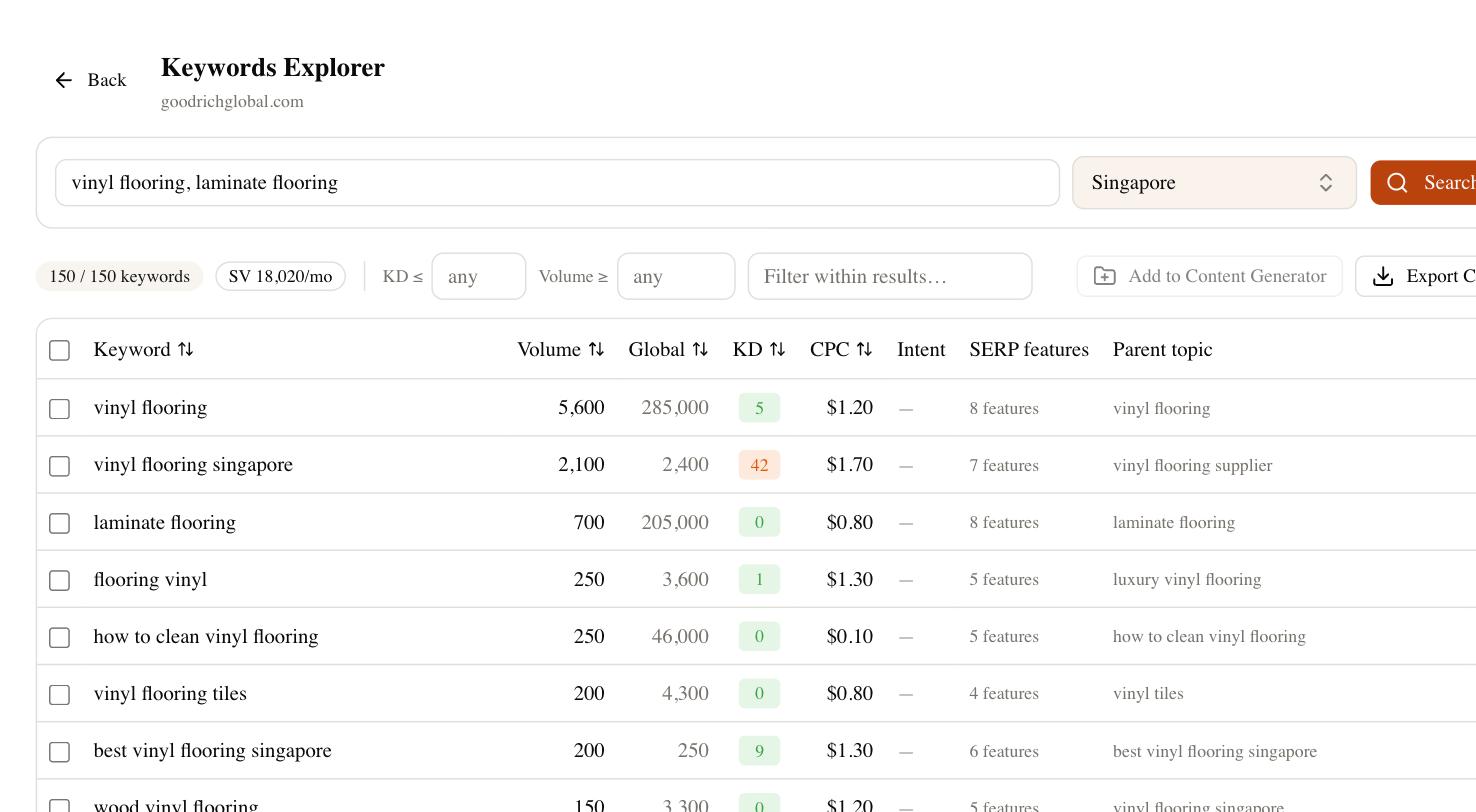
The data underneath deserves a fair word too, because AI features are worthless on bad numbers. SEO Rocket runs on Ahrefs-grade keyword volumes, difficulty scores, backlink profiles, and rank tracking — the same class of data you would open a heavyweight tool for — not a lighter estimate dressed up with a chat box. For agencies and consultants, read-only client dashboards let you hand a live report to a client without exporting anything, which is its own quiet time-saver.
SpyFu vs SEO Rocket at a glance
Here is the honest side-by-side. Read it for the shape of each tool, not as a scoreboard — the right winner depends entirely on which row matches your actual work.
| Capability | SpyFu | SEO Rocket |
|---|---|---|
| Core focus | Competitor PPC & keyword intelligence | AI-native SEO workflow, end to end |
| Interface | Classic dashboard, report-first | Chat-first — ask in plain language |
| Ad / PPC history | Deep, many years of Google Ads data | Not a focus |
| Keyword & rank data | Solid, US-centric | Ahrefs-grade, broader market coverage |
| Backlink analysis | Limited | Full referring-domain profiles |
| AI content writing | No | Yes — full drafts via Claude |
| AI-search visibility | No | Brand Radar (ChatGPT, Perplexity, AI Overviews) |
| Client dashboards | Limited | Read-only client reporting built in |
| Rough price band | Low $ / flat, generous limits | Low $ / entry-friendly |
Cost and who each one really suits
On headline price the two are closer than you might expect — both live in the low monthly band, and neither will shock you the way an enterprise suite does. The difference is what the money buys. SpyFu buys depth in one lane: competitor and ad research with generous limits. SEO Rocket buys breadth in a connected line: research, writing, and AI-visibility tracking that would otherwise be three separate subscriptions.
So the real cost question is not “which is cheaper” but “how many tools am I paying for.” If SpyFu already sits next to a separate AI writer and an AI-visibility tracker in your stack, the consolidated tool is usually the better economics even before you count the hours saved switching between them.
Which one should you choose?
Pick SpyFu if your center of gravity is paid search and competitor ad research, your market is mainly the US, and you want a cheap, no-nonsense window into what rivals bid and rank for. If that describes your Tuesday, SpyFu earns its keep and you do not need anything heavier — that is the honest recommendation, not a hedge.
Pick SEO Rocket if your bottleneck is doing the SEO work, not just seeing it — if you research keywords, then need to actually write the content and know whether AI engines cite your brand, all without stitching three tools together. Consultants and agencies who value a chat-first workflow and client-ready dashboards will feel the difference fastest.
A quick gut check: write down the three things you did in your SEO tool last week. If they were “spy on a competitor’s ads,” “spy on a competitor’s ads,” and “spy on a competitor’s ads,” stay with SpyFu. If instead the week was research, writing, and wondering whether ChatGPT ever mentions you, the AI-native tool covers all three in one place — and that, in the end, is what the SpyFu vs SEO Rocket decision comes down to.