Most people weighing Serpstat vs Semrush are really asking one question: do you need the biggest, most complete SEO suite on the market, or a leaner tool that does the core jobs for a fraction of the money? Both are legitimate, mature platforms, and neither is a trap — the honest answer to Serpstat vs Semrush depends entirely on your budget, your team, and how much of a giant suite you’ll actually open.
This is a segment-by-segment comparison, not a coronation. You’ll get a verdict on each dimension that matters — data depth, ease of use, AI features, price, and best-fit user — and then an honest look at where a newer, AI-native option changes the math. Where one tool clearly wins a category, it’s named. Where it’s a wash, that’s said too.
How this comparison works
Every judgment below rests on the things a working SEO cares about day to day: how big and fresh the underlying keyword and backlink data is, how long it takes a new user to get value, whether AI writing and AI-search visibility are built in or missing, honest total cost rather than the headline number, and who each tool genuinely suits. Third-party metrics like traffic estimates and authority scores are estimates on both platforms, so treat cross-tool number gaps as directional, not gospel.
Serpstat vs Semrush at a glance
Start with the summary, then read the segment verdicts underneath for the two or three rows that apply to you.
| Dimension | Serpstat | Semrush |
|---|---|---|
| Data quality & depth | Solid keyword and rank data; smaller backlink index | Very large keyword and backlink databases; broad coverage |
| Ease of use | Cleaner, faster to learn | Powerful but dense; steeper curve |
| AI features | Some AI writing assists | More AI add-ons, often priced separately |
| Best for | Freelancers, small teams, cost-watchers | Agencies and marketing teams wanting one suite |
| Rough price band | Low–mid $ / entry-friendly | Higher $$ once you add seats and add-ons |
Data quality and depth
On raw data, Semrush wins this segment, and it isn’t especially close. Its keyword database is one of the largest in the industry, its backlink index is deep and refreshed often, and its competitive research pulls in PPC, display, and PR signals that Serpstat doesn’t try to match. If your work depends on wide keyword coverage or serious link analysis, that scale is the whole point of paying more.
Serpstat is not thin, though. For everyday keyword research, rank tracking, and site audits it returns numbers that are perfectly usable, and for many markets the gap you’d actually notice is small. Where you’ll feel the difference is in long-tail keyword volume and backlink completeness on competitive niches. Verdict: Semrush for depth; Serpstat if “good enough data at a lower price” describes your real need.
Ease of use and learning curve
This segment flips. Serpstat is the easier tool to pick up — its interface is cleaner, the menus are shorter, and a new user tends to run a useful report within the first session. Semrush is genuinely powerful, but that power shows up as density: dozens of modules, overlapping reports, and a learning curve that most users never fully climb. Plenty of Semrush subscribers touch a fraction of what they pay for.
If you have a dedicated SEO analyst who’ll invest the time, Semrush’s depth rewards the effort. If you’re a freelancer or a small team that wants answers without a training week, Serpstat’s simplicity is a real, daily advantage. Verdict: Serpstat wins ease; Semrush wins ceiling. Which matters more is a question about your team, not the software.
AI features
Both platforms have moved toward AI, and neither has fully closed the loop. Semrush offers more AI-assisted tooling overall — content optimization, writing help, and newer features aimed at AI-search — but several of these arrive as separate add-ons that raise the bill beyond the base plan. Serpstat includes some AI writing assists closer to its core price, though the breadth is narrower.
The honest read is that AI is bolted onto both tools rather than woven through them. You can draft content and check optimization inside either, but the workflow still feels like a traditional keyword suite with AI features stapled on the side. Verdict: Semrush has more AI surface area; Serpstat bundles its lighter set more affordably. For AI as a native, first-class way of working, keep reading.
Price and who each tool is for
Pricing is where the two diverge most clearly. Serpstat sits in a low-to-mid monthly band and stays approachable for a solo operator or a small shop; its entry plans are a genuine reason people choose it. Semrush runs materially higher, and the number climbs fast once you add extra users, more projects, or the add-ons that make the suite worth buying in the first place.
So the best-for verdict writes itself. Serpstat suits freelancers, small in-house teams, and anyone whose main constraint is cost per month while still needing reliable core data. Semrush suits agencies and marketing teams that want one login covering SEO, PPC, and content across many clients, and who have the budget to justify the depth. Neither choice is wrong — they’re aimed at different wallets.
The AI-native third option
Here’s what the Serpstat-versus-Semrush framing misses: both were built for a workflow that predates AI writing and AI search. You still end up paying for a second tool to draft articles well and a third to see whether ChatGPT or Perplexity ever cites your brand. SEO Rocket is built the other way around — chat-first, with Ahrefs-grade data underneath, so you ask for a keyword gap, a backlink profile, or a rank check in plain language and the same tool then drafts the content and tracks your visibility in AI answers.
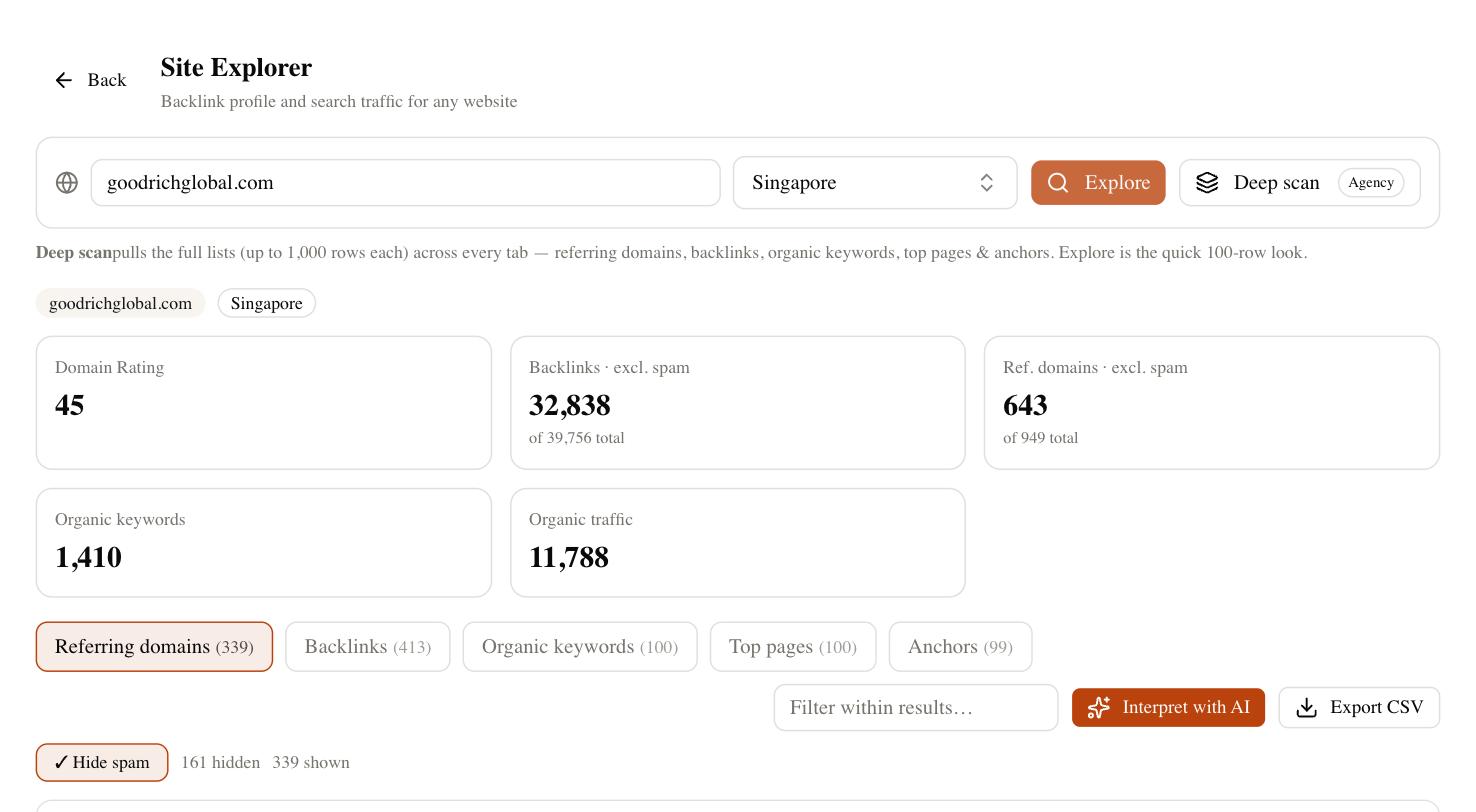
That consolidation is the real saving. A stack of a keyword suite plus a separate AI writer plus an AI-visibility tracker collapses into one subscription, and the entry pricing lands at the friendly end of the range rather than the enterprise end. The Brand Radar side answers a question neither Serpstat nor Semrush was designed for: some of your buyers now ask an AI assistant instead of Google, and a page that ranks first can still be invisible in an AI-generated answer. If your bottleneck is doing more with fewer tools, that combination is worth a look before you renew either incumbent.
So which should you pick
Match the tool to your real constraint. If you need the deepest keyword and backlink data and run a full marketing stack across clients, Semrush earns its higher price and is the honest pick. If you want reliable core SEO at a genuinely lower monthly cost and value a tool you can learn in an afternoon, Serpstat is the smarter buy and there’s no shame in choosing it over the pricier suite. And if tool-sprawl and AI-search visibility are your actual problems, an AI-native option like SEO Rocket covers the core jobs while folding in the writing and AI-answer tracking the older suites leave out.
A quick way to decide: list the three things you actually did in your SEO tool last week. If they were deep link audits and cross-channel competitor research, pay for Semrush. If they were keyword checks, rank tracking, and a bit of content, Serpstat does that for less. And if one of those three was producing content or wondering whether an AI assistant mentions you, that’s the signal to test a newer tool built for how search works now. Whatever you choose, run your own site and two competitors through it for a full ranking cycle before you judge — positions jitter a few spots day to day, and no tool’s estimates are exact.