The SEO vs PPC debate gets framed as a rivalry more often than it should be. In practice, search engine optimization and pay-per-click advertising solve different problems on different timelines, and most mature marketing programs end up running both rather than picking a winner. This article compares them honestly across the dimensions that actually matter — speed, cost, longevity, intent, and control — so you can decide what fits your situation right now, not what sounds best in a sales pitch.
The core difference in one sentence
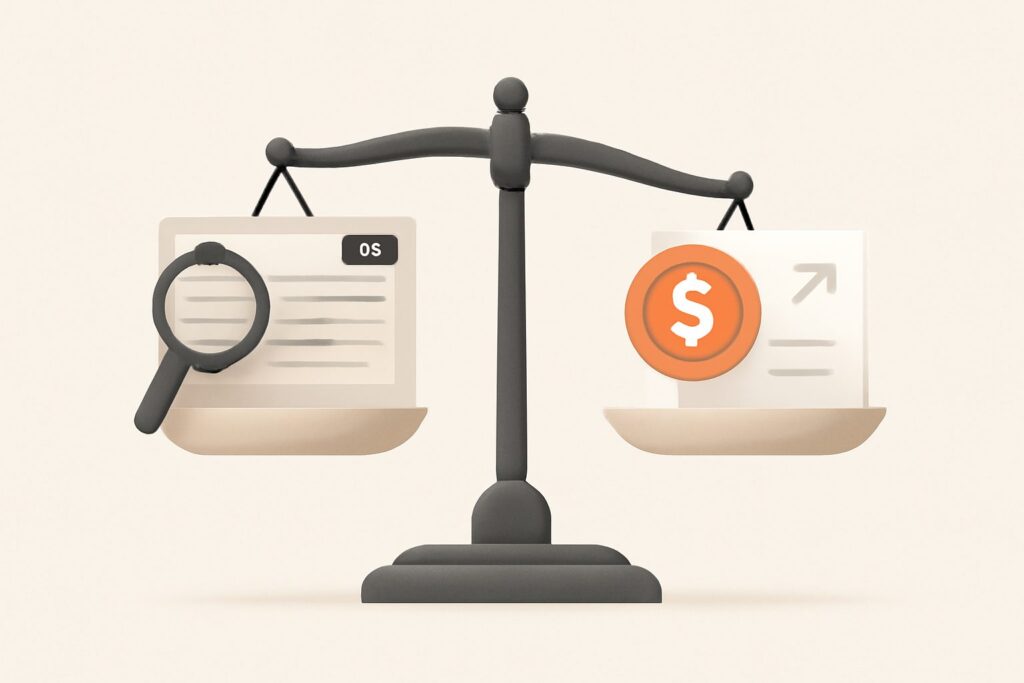
PPC rents visibility for as long as you pay for it; SEO builds visibility that persists (with maintenance) after the active work slows down. That single distinction explains almost every other tradeoff between the two channels, so it’s worth keeping in mind as you read the rest of this comparison.
Speed to results
This is PPC’s clearest advantage. Launch a well-structured Google Ads or Meta Ads campaign and you can be generating clicks, leads, or sales within hours of going live. There’s no waiting for a search engine to crawl, index, and trust your content — you’re simply buying placement. SEO, by contrast, is slow by nature. Even technically flawless content needs time to be indexed, evaluated, and gradually trusted enough to rank, and in competitive niches that process realistically takes months. If your business needs revenue this week, PPC wins this category outright — there’s no honest argument otherwise.
Cost structure over time
This is where SEO usually wins, but only if you look far enough out. PPC cost scales with volume: double your traffic, and in most cases you roughly double your spend, forever, because the moment you stop paying, the traffic stops. SEO has a different shape — you invest in content, technical fixes, and authority-building up front, and the resulting traffic is largely free at the margin once a page ranks. The catch is that SEO isn’t actually free; it costs time, tools, and often content or agency fees, and some of that investment doesn’t pay off if pages never rank competitively. The realistic comparison isn’t “SEO is free and PPC is expensive” — it’s “PPC has a stable, predictable cost per click and SEO has an upfront cost with a payoff that compounds or, sometimes, doesn’t materialize.”
Longevity
Turn off a PPC campaign and your traffic drops to zero almost immediately — there is no residual effect once the ads stop showing. Turn off active SEO work and rankings typically decay slowly, not instantly; well-established pages can hold position for a long time with minimal upkeep, though they will eventually lose ground to competitors who keep investing. This is the strongest structural argument for SEO as a long-term asset: it depreciates far more slowly than paid traffic does.
Search intent and traffic quality
Both channels can target the same keywords and the same intent, but they tend to be used for different stages of that intent in practice. PPC is excellent for capturing high-intent, ready-to-buy searches immediately, and for testing which offers and messages convert before you invest in organic content around them. SEO tends to capture a wider spread — from early research queries to high-intent transactional ones — but takes longer to build authority across that full spread. Neither channel has an inherent monopoly on quality traffic; quality depends far more on how well the landing page matches the query than on which channel sent the visitor.
Control and flexibility
PPC gives you granular, near-real-time control: you can change bids, pause campaigns, test ad copy, and adjust targeting within minutes, which makes it a strong tool for experimentation. SEO offers much less immediate control — you can’t simply “bid more” to outrank a competitor, and changes to content or site structure take time to be recognized and re-evaluated by search engines. This makes PPC the better channel for fast iteration and SEO the better channel for building something durable that doesn’t require constant intervention.
Side-by-side comparison
| Factor | SEO | PPC |
|---|---|---|
| Time to first results | Weeks to months | Hours to days |
| Cost pattern | Upfront investment, lower marginal cost over time | Ongoing cost that scales with traffic volume |
| Traffic when you stop | Decays slowly, often persists for a while | Stops almost immediately |
| Control and iteration speed | Slow to change and re-evaluate | Fast, real-time adjustments |
| Best for | Long-term brand and traffic building | Immediate leads, promotions, testing offers |
| Risk | Time and effort with no guaranteed ranking | Budget waste if targeting or landing pages are weak |
| Scalability | Compounds across more content over time | Scales instantly but costs rise with it |

When to choose SEO, when to choose PPC, and when to run both
Choose PPC first if you need revenue quickly, you’re testing a new offer or market and want fast feedback, or you’re launching something with zero existing search presence and can’t wait for organic authority to build. Choose SEO first if you have a runway of at least several months, your margins support a longer payback period, and you want an asset that keeps producing traffic without ongoing ad spend. Choose both, run concurrently, if your budget allows it — this is genuinely the strongest setup for most established businesses. PPC data (which keywords convert, which ad copy resonates) can directly inform your SEO content priorities, and PPC can cover the gap in traffic while your organic content is still building authority in the background. Many businesses use PPC as a bridge during the months when SEO is still ramping up, then gradually shift budget as organic traffic takes over some of the load.
A note on AI search and paid visibility
Both channels are being reshaped by the same shift: AI-powered search experiences like Google’s AI Overviews and tools like ChatGPT are changing how people find answers, sometimes reducing clicks on traditional organic and paid listings for certain queries. This doesn’t erase either channel’s usefulness, but it does mean visibility increasingly includes being cited or referenced inside AI answers, not just ranking or bidding for a slot. Platforms like SEO Rocket now track this AI-search visibility (via Brand Radar) alongside traditional keyword rankings, which is worth watching regardless of which channel you lean on more.
Common mistakes on both sides
A lot of the frustration people feel with SEO and PPC comes down to a handful of avoidable mistakes rather than the channel itself being flawed. On the PPC side, the most common error is sending traffic to a generic homepage instead of a landing page built for the specific ad and keyword, which quietly wastes a large share of spend on visitors who bounce before converting. A close second is judging a campaign after a few days instead of letting it run long enough to gather statistically meaningful data on what’s actually working. On the SEO side, the most common error is giving up after two or three months because rankings haven’t moved yet, when competitive terms often take considerably longer to build authority for. Another frequent mistake is writing content aimed at search engines instead of the person reading it — thin, keyword-stuffed pages tend to underperform on both fronts, since modern algorithms and AI systems alike are reasonably good at detecting content that isn’t genuinely useful.
Budget allocation in practice
If you’re deciding how to actually split a limited budget rather than choosing one channel outright, a reasonable starting approach is to let PPC cover the queries and offers you need to validate or convert on quickly, while directing SEO effort toward the topics and keywords with durable, ongoing search volume that will keep paying off long after a campaign ends. Some businesses run this as a deliberate handoff: PPC funds and tests a keyword cluster, and once the data shows it converts well, that cluster becomes a priority for organic content investment, since you already know the demand and the messaging that works. This reduces the guesswork in SEO content planning and gives PPC a clearer job than just generating leads in isolation.
The honest bottom line
SEO vs PPC isn’t really a competition — it’s a question of what timeline and budget structure fits your business right now. PPC is the tool for speed and control; SEO is the tool for durability and compounding returns. Neither is objectively better, and treating them as interchangeable, or as enemies, leads to worse decisions than treating them as complementary parts of the same funnel. If you’re unsure where your budget would go furthest, start by looking at your actual keyword landscape and competition — SEO Rocket‘s free plan can help you see that picture before you commit spend to either channel.