
The google bert update was announced in 2019 and represented one of the biggest shifts in how Google’s search engine processes language. BERT — short for Bidirectional Encoder Representations from Transformers — is a natural-language processing model that helps Google understand the context, prepositions, and nuance of a search query far more accurately than earlier keyword-matching approaches. Like RankBrain before it, BERT is a query- and content-understanding system, not a penalty, and it is not something you can directly “optimise” for with a technical checklist.
This article explains what BERT actually is, when it rolled out, what it changed, and the realistic, evergreen approach to writing content that aligns well with how Google now reads language.
What is the Google BERT update?
BERT is a machine-learning model originally developed and published by Google’s research team, built on a neural network architecture called a “transformer.” What made BERT notable is that it processes language bidirectionally — looking at the words before and after a given word simultaneously — which allows it to understand context far more precisely than older models that only read text in one direction.
In practical search terms, BERT helps Google understand small words that carry a lot of meaning, such as “for,” “to,” “not,” and “no,” as well as the way word order and phrasing change the intent of a sentence. Google described BERT at launch as one of the largest leaps forward in the history of Search, specifically because it improved understanding of natural, conversational language rather than isolated keywords.
When did BERT roll out?
Google announced BERT in 2019, describing it as affecting a significant portion of search queries in English, with expansion to more languages following afterward. Unlike a link-spam or content-quality update that targets specific site behaviors, BERT was a change to how Google’s core language-processing systems interpret queries and passages of text — so its effects were felt broadly across search rather than concentrated in one niche or site type.
Because BERT is a foundational language model rather than a periodic algorithm sweep, Google has continued refining and building on transformer-based language understanding in the years since, rather than it being a one-time event with a clear “before and after” for most sites.
What problem was BERT solving?
Search engines have historically struggled with queries where small connecting words change the meaning of the whole sentence. Google’s own launch example was a query like “2019 brazil traveler to usa need a visa” — where the word “to” is critical to understanding that the query is about a Brazilian traveling to the USA, not the reverse. Older systems could easily misread that kind of nuance and match the query to less relevant results.
BERT helps Google parse these subtleties: prepositions, negations, and word relationships that previous keyword-based matching tended to flatten out. The result is that Google can better match a full, naturally phrased query — the kind people increasingly type or speak — to a page that genuinely answers it, even if that page doesn’t contain the query’s exact wording.
What BERT changed for search results
| Before BERT | After BERT |
|---|---|
| Queries often matched based on individual keywords | Queries are interpreted with attention to context and word relationships |
| Small words (prepositions, negations) had limited weight | Small words can meaningfully change how a query is interpreted |
| Long, conversational queries could be misread | Long, natural-language queries are understood more accurately |
| Content needed close keyword matches to rank well | Naturally written content that answers intent can match without exact phrasing |
Why you can’t “optimise for BERT”
This is the most important point for site owners to understand: BERT is not a ranking factor with levers you can pull. It doesn’t reward a keyword pattern, a piece of markup, or a formatting trick. It’s a language-understanding layer that helps Google read what a query means and what a page is actually about.
Because of that, there is no legitimate “BERT SEO checklist.” Any advice framed as a specific BERT optimisation tactic should be treated with skepticism. The honest, evergreen guidance Google itself has given is essentially: write naturally, and write for people. BERT is designed to reward exactly that kind of content — clear, well-structured writing that directly addresses what a reader is asking — because that’s the writing it’s built to understand well.
What actually helps content align with BERT
- Write in natural, complete sentences. Avoid fragmented, keyword-stuffed phrasing; BERT is built to understand full sentences and their internal relationships.
- Answer the actual question being asked. Pay attention to qualifiers in a topic — “for,” “without,” “vs.,” “not” — since these change intent and BERT is specifically better at picking up on them.
- Provide context, not just definitions. Explain the “why” and “how,” not just isolated facts, since context is exactly what a bidirectional language model is designed to weigh.
- Structure content clearly. Logical headings and well-organized sections help both readers and language models understand what a passage is about.
- Don’t chase exact-match phrasing at the expense of clarity. Since BERT can match intent even without literal keyword matches, prioritise clear communication over rigid keyword placement.
How research tools help you write for real intent
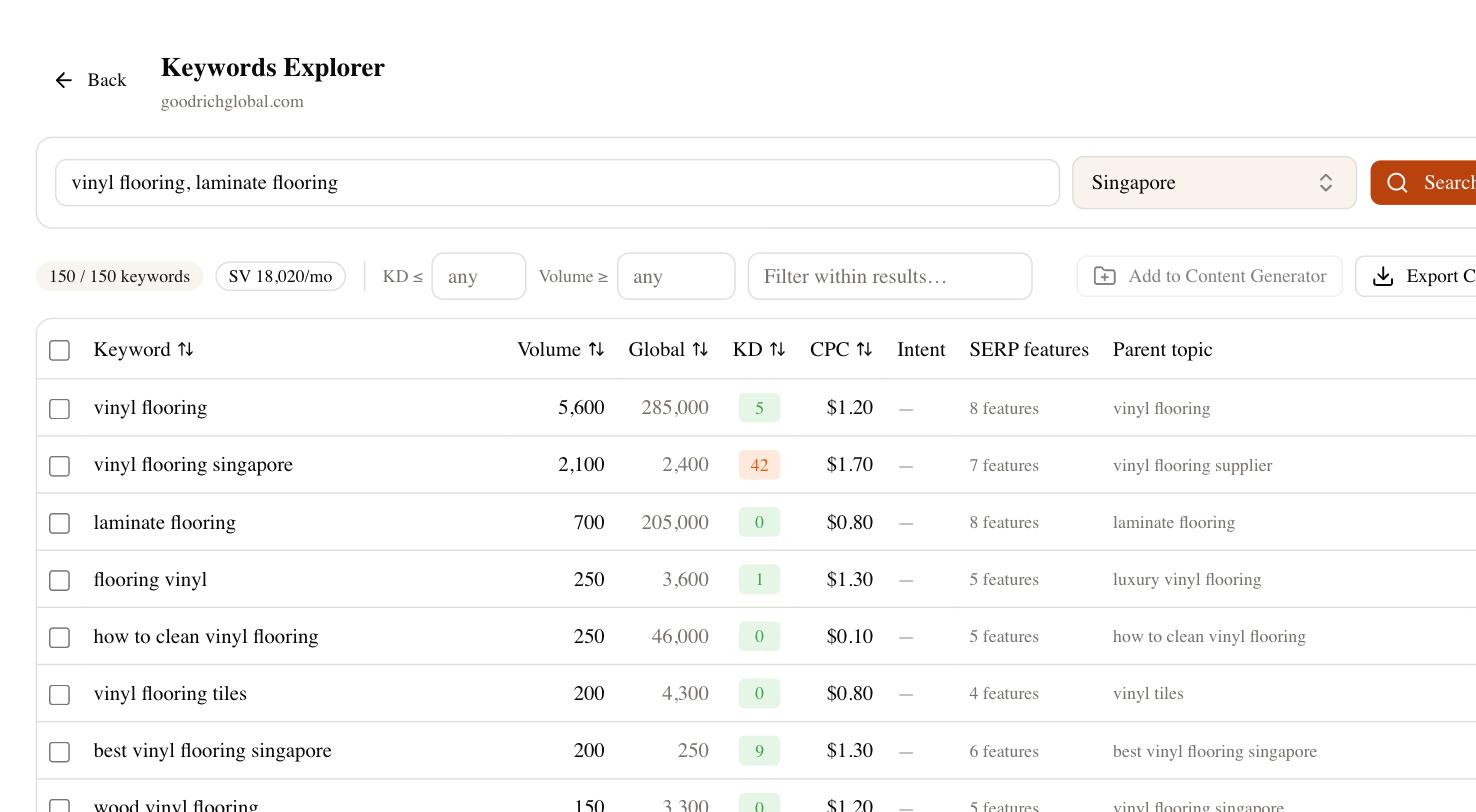
Even though you can’t optimise directly for BERT, understanding the actual phrasing and context people use when searching a topic still matters — it tells you which nuances and qualifiers to address in your content. This is where conversational research tools are genuinely useful: instead of a flat keyword list, you can explore how a topic’s related questions and phrasing vary, and use that to shape content that naturally covers the nuance BERT is built to detect. SEO Rocket supports this kind of chat-first keyword and intent research, alongside audits and content tools, with a free plan and paid plans from $49/mo.
Why BERT is a language model, not a “spam update”
It’s worth drawing a clear line between BERT and updates like Panda, Penguin, or later spam-focused rollouts. Those updates were built to identify and demote specific patterns of low-quality or manipulative behavior — thin content, unnatural link schemes, and similar tactics. BERT was not designed to identify bad actors at all. It’s a general-purpose language-understanding model applied to the interpretation layer of Search, meaning it changes how queries and passages are read, not which sites get penalised for what they’ve done.
This distinction matters because it explains why there’s no “BERT recovery” process the way there can be a Panda or Penguin recovery. If your rankings shifted around the time BERT rolled out, the more useful question isn’t “how do I fix my BERT penalty” — there isn’t one — but “is my content actually answering the full, nuanced version of what people are asking, or only a simplified keyword version of it?”
A practical example of BERT-style understanding
Consider two very similarly worded queries: “can you get medicine for someone pharmacy” and “can you get medicine for someone else pharmacy.” Before bidirectional context modeling, a search engine might treat both queries as close to identical because they share almost all the same words. But the word “else” fundamentally changes the question — one is about picking up a prescription in general, the other is specifically about picking one up on someone else’s behalf, which involves different pharmacy rules.
This is the exact kind of nuance BERT was built to catch. For content creators, the practical implication isn’t “add more filler words” — it’s that thorough, precise writing which anticipates these small-but-important variations in a topic tends to serve readers (and by extension, BERT-powered interpretation) far better than content written narrowly around one head-term keyword.
BERT compared to RankBrain and MUM
BERT sits between two other major Google language systems worth knowing about. RankBrain, introduced in 2015, was Google’s earlier machine-learning system for interpreting novel and ambiguous queries and helping weigh ranking signals. BERT, in 2019, went further by modeling bidirectional context and nuance directly. In 2021, Google introduced MUM (Multitask Unified Model), a substantially more capable multimodal and multilingual system, rolled out gradually to specific search features rather than as a broad, one-time ranking change.
All three share the same underlying philosophy: better understanding of language and intent, not a new set of technical signals to game. Site owners who focus on genuinely useful, clearly written, intent-matched content tend to do well across all of them, precisely because that’s what each system is designed to recognise.
Key takeaways
- The Google BERT update launched in 2019 as a natural-language model that better understands context and nuance in search queries.
- BERT is especially good at interpreting prepositions, negations, and word relationships that earlier systems often missed.
- It is a language-understanding system, not a penalty and not a tunable ranking factor.
- You can’t optimise directly for BERT — the best approach is writing clear, natural content that genuinely answers searcher intent.
- BERT builds on RankBrain (2015) and precedes MUM (2021) in Google’s ongoing push toward better language understanding.