Mangools vs SEO Rocket is a fair fight to stage, because the two tools are chasing different problems. Mangools has spent years earning a reputation as the friendliest, cheapest way to do keyword research, and if that is all you need, this comparison may end with you keeping it. But the job has changed, and Mangools vs SEO Rocket is really a question about whether you want a clean, affordable keyword tool or an AI-native workflow that writes content and tracks AI-search visibility too.
Let’s start with where Mangools genuinely wins, because it wins in places that matter.
Where Mangools is genuinely stronger
Mangools earned its following honestly. KWFinder is one of the most approachable keyword-research interfaces ever shipped — you type a seed, you get ideas with search volume, difficulty, and trend, and there is almost nothing to learn. For a freelancer or a small-site owner who opens an SEO tool twice a week, that simplicity is a feature, not a limitation. The bundle also includes SERPWatcher for rank tracking, SERPChecker for SERP analysis, LinkMiner for backlinks, and SiteProfiler, so you get a tidy five-tool suite under one login.
Price is the other real advantage. Mangools sits firmly in the low-cost band — entry plans run roughly $30 to $50 a month on annual billing — which undercuts most of the market and nearly all of the enterprise suites. There are no seat games or credit systems that punish a busy week, and the plans scale gently as you grow. If your constraint is budget and your need is core keyword research, Mangools is hard to beat on cost per feature, and it would be dishonest to pretend otherwise.
Where the two tools differ most
The gap opens up once your work moves past looking up keywords. Mangools is a research-and-tracking suite: it tells you what to target and whether you moved, and then you leave the tool to actually write the content somewhere else. SEO Rocket is built around a chat interface, so instead of clicking through tabs you ask for what you need in plain language and it runs the lookup, then keeps going — drafting the article, checking rankings, and showing where your brand appears in AI answers, all in the same thread.
That is the crux of the comparison. One tool hands you data and gets out of the way; the other tries to close the loop from research to published content to AI-search visibility without a context switch. Neither approach is wrong, but they suit very different weeks. A researcher who lives in spreadsheets may prefer the clean handoff Mangools gives; an operator racing to publish will value having the draft appear in the same window as the keyword list.
Mangools vs SEO Rocket at a glance
Here is the honest side-by-side. Read the notes underneath before you decide, because the right pick depends entirely on how you actually spend your time.
| Feature | Mangools | SEO Rocket |
|---|---|---|
| Interface | Classic dashboard, very easy to learn | Chat-first — ask in plain language |
| Keyword research | Excellent, beginner-friendly (KWFinder) | Ahrefs-grade data via Keywords Explorer |
| Rank tracking | Yes (SERPWatcher) | Yes, with ranking URL and traffic |
| Backlink data | Yes (LinkMiner), smaller index | Ahrefs-grade backlink profiles |
| AI content writing | No | Yes — full articles with Claude |
| AI-search visibility | No | Yes — Brand Radar across AI answers |
| Competitor gap analysis | Basic | Yes, built in |
| Client dashboards | Limited reporting | Read-only client dashboards |
| Rough price band | Low $ (very affordable) | Low–mid $ (entry-friendly) |
Keyword research: friendly vs deep
Both tools do keyword research well, but they optimize for different users. Mangools optimizes for speed and calm — KWFinder shows you a clean list of ideas without ever making you feel like you need a certification to read it. SEO Rocket optimizes for depth: it pulls from a large, Ahrefs-grade index, so the volume and difficulty figures hold up when you push into competitive niches, and you can ask follow-up questions instead of re-running filters.
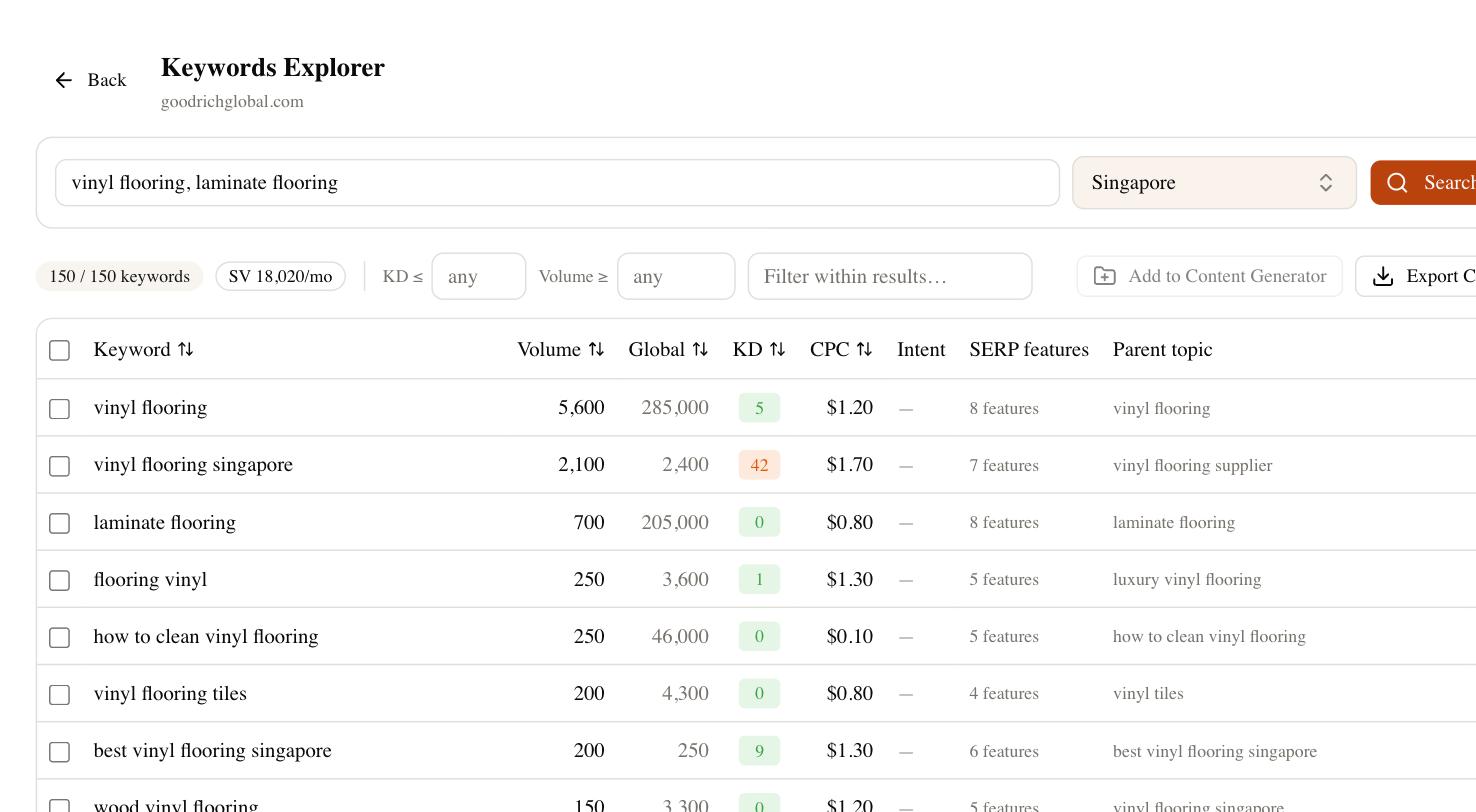
If your keyword work is straightforward — find a few hundred terms for a blog, check difficulty, move on — Mangools handles it beautifully and cheaply. If you are building content programs, sizing up tough markets, or want the same underlying data the big agencies use, SEO Rocket’s index and its ability to reason across your results in conversation pull ahead.
The AI-native case for SEO Rocket
This is where the two tools stop overlapping. Mangools does not write content and does not track AI search, and it has never claimed to — that is simply not what it was built for. SEO Rocket treats both as core. You can research a topic, have it draft the article with Claude, and then ask whether your brand is being cited in ChatGPT, Perplexity, and Google’s AI Overviews, all without leaving the chat.
That last piece matters more every quarter. Search is splitting: some of your buyers now ask an AI assistant instead of typing into Google, and a page that ranks first can still be invisible in an AI-generated answer. Mangools cannot see that surface at all. SEO Rocket’s Brand Radar tracks whether and where you are being mentioned, so you are optimizing for the search that is actually happening. If your bottleneck is producing content and staying visible in AI answers — not just finding keywords — that combination is the reason to switch.
Which one should you pick?
Match the tool to your real constraint. If you are a freelancer or small-site owner who wants clean, affordable keyword research and rank tracking, and you write your content elsewhere, Mangools is the smart, budget-friendly choice — keep it, and do not let anyone upsell you past what you need. Its ease of use is a genuine competitive advantage for people who value simplicity over breadth.
Choose SEO Rocket when your week is less about looking up keywords and more about shipping content and defending visibility. If you are a consultant or agency juggling client work, the chat-first workflow, AI writing, AI-search tracking, and read-only client dashboards replace a stack of separate subscriptions with one. A quick test: write down the three things you actually did in your SEO tool last week. If they were all “find keywords” and “check rankings,” Mangools covers it. If one of them was “write an article” or “figure out why we’re not showing up in ChatGPT,” you have outgrown a pure research suite — and that is exactly the gap SEO Rocket was built to close.
Whichever you choose, run your own site and two competitors through it for a full ranking cycle before you judge it. Positions jitter a few spots day to day, and third-party metrics are estimates, not gospel. The best tool is the one that answers your real questions fastest — for some readers that is still Mangools, and for the ones drowning in content and AI-search demands, it is SEO Rocket.