
Koala vs SEO Rocket is a fair fight only if you’re honest about what each tool is built to do. Koala — specifically KoalaWriter — is one of the fastest, cheapest ways to turn a keyword into a publish-ready article, and for a lot of people that’s the whole job. In a Koala vs SEO Rocket decision, the real question isn’t which is better; it’s whether your bottleneck is producing content or running the SEO around it.
This comparison leads with what Koala does well, because it does plenty well. Then it makes the case for SEO Rocket — a chat-first tool that folds Ahrefs-grade data, AI writing, and AI-search visibility into one workflow — and closes with a plain recommendation by use case.
What Koala is genuinely good at
Koala is a content-production machine, and it’s unapologetic about it. You give KoalaWriter a keyword, it runs real-time SERP analysis against the current top-ranking pages, pulls in the entities and subtopics they cover, and drafts a structured, long-form article in a couple of minutes. Its deep-research mode cites sources, its outline editor lets you shape structure before generating, and a one-click polish pass tightens readability.
The surrounding features are where Koala earns loyalty from publishers. It publishes straight to WordPress, Shopify, Webflow, or Ghost with a click, adds internal links automatically by indexing your site, and can bulk-generate dozens of articles at once. For affiliate operators, its Amazon product-review workflow pulls live product data into ready-to-monetize posts. If you run a niche site or a content agency where the daily metric is articles shipped, Koala is a legitimately excellent, low-cost pick.
Where Koala stops
Koala is a writer, not an SEO platform, and that’s a design choice rather than a flaw. It reads the SERP to inform a draft, but it doesn’t give you a keyword database to plan from, a backlink index to audit competitors, or rank tracking to tell you whether the article you shipped last month actually moved. Those are separate jobs, and Koala leaves them to separate tools.
So the typical Koala user still keeps a second subscription — usually Ahrefs or Semrush — open in another tab for research and tracking, plus, increasingly, a third tool to check whether ChatGPT or Perplexity ever cites them. Koala fills one box in the workflow very well. The rest of the boxes stay empty.
Koala vs SEO Rocket at a glance
Here’s the honest side-by-side. Notice how little the two overlap — they’re strong in different halves of the same job.
| Dimension | Koala (KoalaWriter) | SEO Rocket |
|---|---|---|
| Core job | Fast AI article generation | End-to-end SEO workflow, chat-first |
| AI writing | Excellent — bulk, fast, SERP-informed | Yes — drafts full SEO articles on real data |
| Keyword & backlink data | No standalone database | Yes — Ahrefs-grade data built in |
| Rank tracking | No | Yes |
| AI-search visibility | No | Yes — Brand Radar across AI answers |
| CMS 1-click publishing | Yes — WordPress, Shopify, Webflow, Ghost | Export-focused |
| Affiliate/bulk content | Strong — Amazon reviews, bulk mode | Not the focus |
| Best for | Publishers shipping volume | SEOs, consultants & agencies |
| Rough price band | Budget — starts in single digits/mo | Low $ / entry-friendly |
The case for SEO Rocket
SEO Rocket starts from a different premise: that writing is one step in a loop, not the loop itself. You work by asking for what you need in plain language, and it runs the lookup on real, Ahrefs-grade data underneath — keyword research, competitor content gaps, backlink profiles, rank tracking. Then, in the same place, it drafts the article and tells you whether your brand is showing up in AI answers.
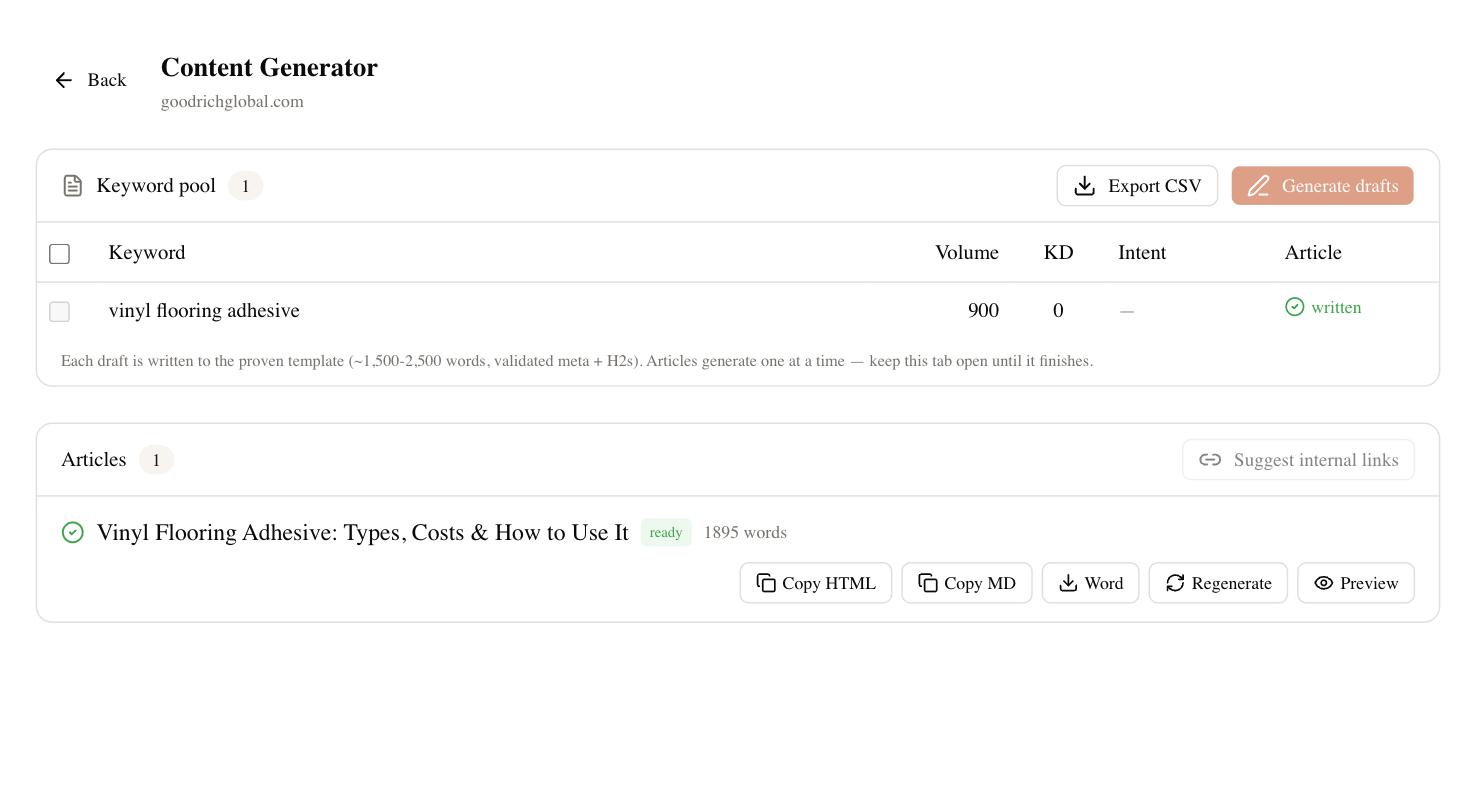
That last part is the piece no content-only tool touches. Search is splitting. Some of your buyers now ask ChatGPT, Perplexity, or Google’s AI Overviews instead of typing a query and scrolling, and a page that ranks first can still be absent from the answer they read. SEO Rocket’s Brand Radar tracks whether — and where — you’re being cited across those surfaces. You can write a brilliant Koala article and rank it, and still have no idea if the AI layer above the results ever mentions you. SEO Rocket closes that blind spot.
The consolidation is the practical win. Instead of Koala for drafts, Ahrefs for data, and a third tool for AI visibility, you run one chat-first subscription. For consultants and agencies, the same data can go into a client-facing view, so a report goes out without a manual export. The writing itself is grounded in the keyword and competitor data the tool already pulled, rather than in a SERP scrape alone.
Where Koala still wins
Be clear-eyed about this: if your entire job is pushing out a high volume of articles cheaply, Koala is likely the better buy. Its bulk mode, its one-click publishing into four major CMS platforms, and its Amazon affiliate workflow are purpose-built for that, and they’re genuinely faster for pure production than a workflow that also stops to think about tracking and links. A niche-site portfolio owner who ships fifty posts a month and monetizes with display ads or affiliate links doesn’t need a keyword database and rank tracker bolted on — they need throughput, and Koala delivers it at a price that’s hard to argue with.
SEO Rocket can draft strong articles, but it isn’t trying to out-bulk a dedicated content factory. If publishing volume is the metric you’re judged on, that’s Koala’s home turf, and there’s no shame in choosing it.
Can you use both?
Plenty of teams will, and it’s a sensible split. Use Koala as the drafting and publishing engine when you need to move fast on volume, and use SEO Rocket as the brain that decides what to write, tracks whether it worked, and watches your AI-search presence. That combination costs less than the old Ahrefs-plus-writer-plus-visibility stack and covers more of the job.
The only reason to collapse to one tool is simplicity or budget. If you want a single login and a single bill, SEO Rocket covers research, writing, tracking, and AI visibility in one, and Koala covers writing and publishing. Which single tool you keep depends entirely on which half of the workflow is your real constraint.
The recommendation, by use case
Match the tool to your actual bottleneck, not to a feature grid. If you’re a publisher or affiliate operator whose day is measured in articles shipped and CMS pushes, pick Koala — it’s fast, cheap, and built for exactly that. If you’re an SEO, consultant, or agency who needs to research, write, track rankings, and see whether AI answers cite you, SEO Rocket is the stronger fit because it does the whole loop in one chat-first place.
A quick gut check: write down the three things you did in your SEO or content tool last week. If all three were “generate an article and publish it,” Koala is your tool and you can stop reading. If the list was some mix of “find what to target,” “see what a competitor ranks for,” “check my positions,” and “produce content,” you’re stitching that together across tabs today — and one connected workflow will do it faster. Give whichever you pick a full ranking cycle before you judge it; positions jitter a few spots day to day, and no tool’s estimates are exact.