If you’re reading this, you’ve probably already opened your Ahrefs invoice at least once this year and winced. People who want to switch from Ahrefs to SEO Rocket are usually not disappointed Ahrefs users — Ahrefs is a genuinely excellent tool. They’re small teams, freelance consultants, and in-house marketers who’ve outgrown the price-to-usage ratio, who are tired of paying per seat, or who’ve noticed that none of Ahrefs’ dashboards tell them anything about how their brand shows up in ChatGPT or Google’s AI Overviews. This guide is written for that person: someone who respects what Ahrefs does, but wants a straight answer on whether switching actually makes sense, and if so, how to do it cleanly.
What Ahrefs Actually Does Well
Let’s not pretend otherwise: Ahrefs built the backlink index the rest of the industry benchmarks against. Its crawler (AhrefsBot) is one of the most active on the web, which means its link graph is deep, fast to update, and covers long-tail referring domains that smaller indexes miss entirely. Site Explorer’s historical data goes back years, which matters enormously for link reclamation, disavow audits, and understanding how a domain’s authority evolved over time. Content Explorer, the Ahrefs Academy, and the sheer maturity of features like the SEO Toolbar are hard to argue with. If your day-to-day work is heavy technical link auditing across dozens of enterprise domains, Ahrefs’ depth is still the category benchmark in 2026, and no honest comparison should claim otherwise.
Why People Actually Leave
The reasons people switch from Ahrefs rarely come down to “the data is bad.” They come down to three practical frictions. First, price and seats: Ahrefs Lite starts around $129/month for one user, and adding a second seat means jumping tiers or paying extra per seat — for a two- or three-person team, that adds up fast, especially when half the seats only need rank tracking and reporting, not the full toolset. Second, complexity: Ahrefs is built for specialists, and a lot of buyers just want answers, not another dashboard to learn — they want to ask “why did my traffic drop” and get an answer, not go digging through six reports themselves. Third, and increasingly the deciding factor: Ahrefs has no answer for how your brand is being cited (or ignored) inside ChatGPT, Gemini, Google AI Overviews, or Perplexity. As more search behavior moves into AI answers, that gap has gone from “nice to have” to “why doesn’t this exist yet” for a growing number of teams.
Ahrefs vs SEO Rocket: Feature by Feature
| Capability | Ahrefs | SEO Rocket |
|---|---|---|
| Keyword research | Keywords Explorer, deep volume/KD history, large keyword database | Keywords Explorer with volume/KD/CPC plus a 2D/3D semantic Keyword Graph for topic clustering |
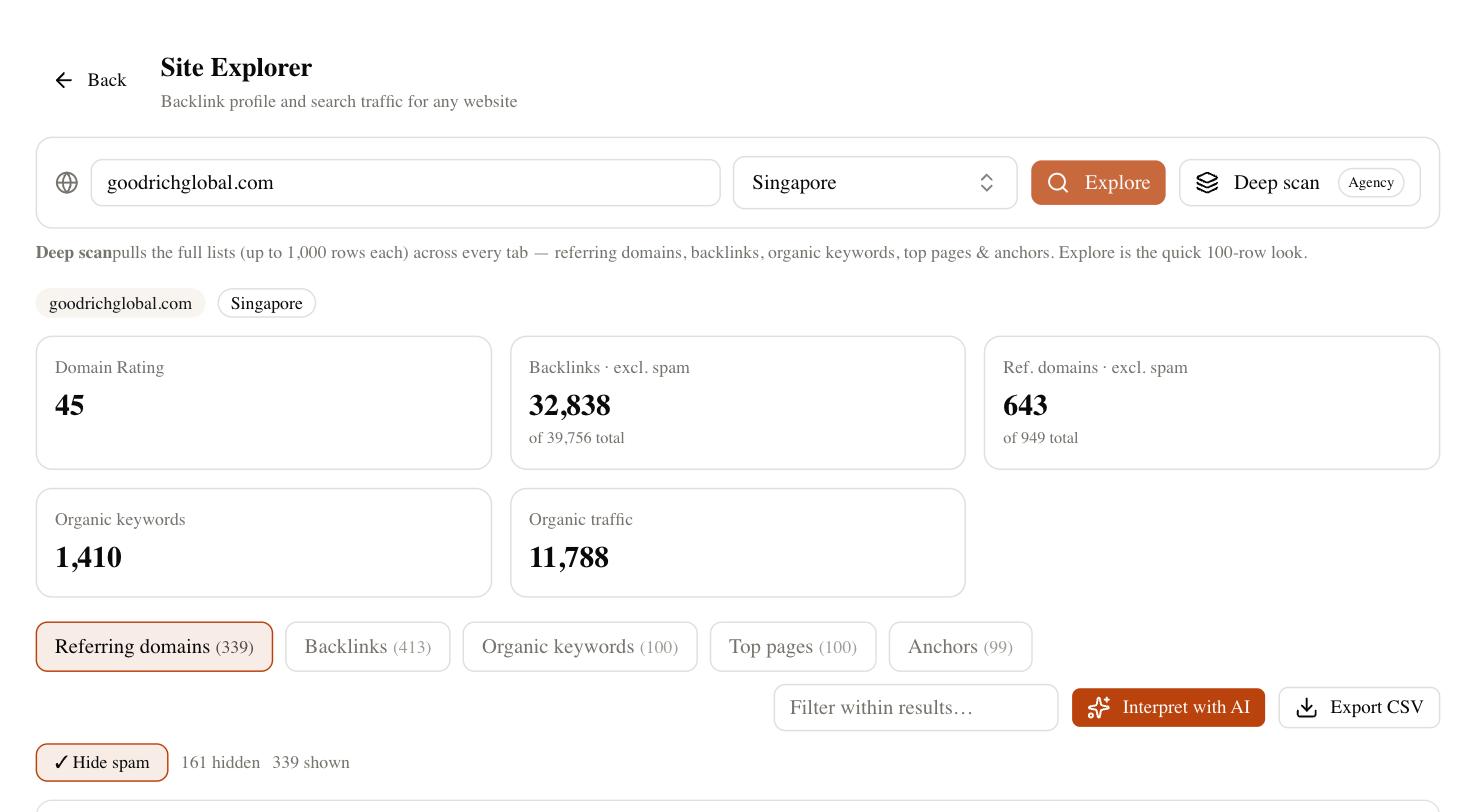
| Backlinks / Site Explorer | Industry-leading historical index, very large, frequently updated | Full Site Explorer (backlinks, referring domains, top pages, organic keywords) powered by Ahrefs Enterprise data |
| Rank tracking | Mature, granular, strong local/device segmentation | Built-in rank tracking inside the same chat-first workflow as everything else |
| AI content writing | Not a core focus; limited AI assist features | Claude-powered AI Content Writer built into the platform |
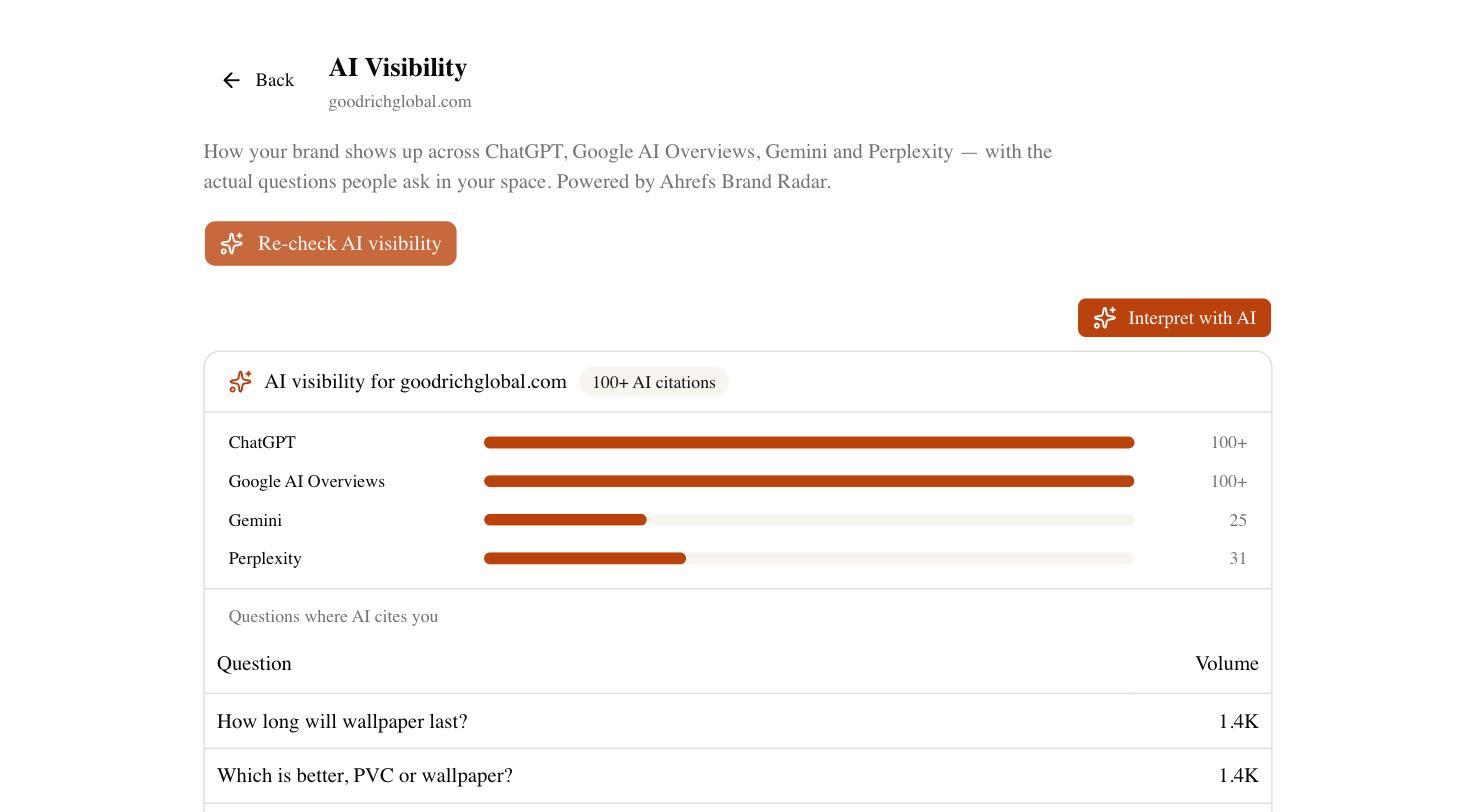
| AI-search / GEO visibility | Not offered | AI Visibility / Brand Radar — tracks citations across ChatGPT, Google AI Overviews, Gemini, Perplexity |
| Technical audit | Site Audit, well-established crawler | Technical Audits plus a free Website Speed Test, accessible via chat or dedicated tools |
| Interface | Multiple specialist dashboards | Chat-first — ask in plain language, or use dedicated tools when you want them |
| Free plan | No meaningful free tier | Free plan: 1 site, 50 starter credits |
| Entry price (2026, approx.) | ~$129/mo (Ahrefs Lite, 1 user) | $49/mo (Pro, 3 sites, 400 credits/mo) |
Prices are approximate as of 2026 entry-tier list pricing — always check current pricing on each vendor’s site before deciding.
What You Keep, What Changes
Because SEO Rocket’s Site Explorer, Keywords Explorer, and Competitive analysis run on Ahrefs Enterprise data under the hood, the numbers you’re used to seeing — search volume, keyword difficulty, referring domains — won’t feel like a downgrade in kind, even if Ahrefs’ raw index size and historical depth remain larger in some edge cases (very old links, deleted pages, extremely niche domains). What changes is the workflow: instead of navigating between Site Explorer, Keywords Explorer, Content Explorer, and Rank Tracker as separate modules, you’re mostly working inside one chat interface, asking questions and getting cards back, with dedicated tools available when you want to go deeper. You also gain a category Ahrefs doesn’t have at all: AI Visibility, which tracks how often your domain gets cited inside AI-generated answers. What you lose, if you were a heavy user, is some of Ahrefs’ longest-tail historical backlink data and the depth of its enterprise-grade custom reporting — worth knowing upfront rather than discovering later.
How to Migrate, Step by Step
A clean migration takes an afternoon, not a week, if you follow this order:
1. Export your data from Ahrefs first. Before canceling anything, pull CSV exports of your tracked keywords (Rank Tracker), your top backlinks and referring domains (Site Explorer), and any saved keyword lists from Keywords Explorer. Keep these as your baseline for comparison.
2. Set up your SEO Rocket project. Create a project for each site you manage, connect the domain, and let the initial site snapshot run — this gives you a starting technical audit and backlink profile to compare against your Ahrefs exports.
3. Recreate your rank tracking list. Import the keyword list from your Ahrefs CSV into SEO Rocket’s rank tracking, rather than starting from scratch — this preserves continuity in your reporting.
4. Connect Google Search Console and GA4. This step matters more than people expect: it lets SEO Rocket cross-reference third-party estimates (from either tool) against your actual clicks, impressions, and conversions, which is the most reliable sanity check during any migration.
5. Rebuild your content workflow. If you were using Ahrefs’ Content Explorer for ideation and a separate tool (or a writer) for drafting, consolidate that into SEO Rocket’s AI Content Writer plus Content Gap analysis, so ideation and drafting live in the same place.
6. Run parallel for two to four weeks. Don’t cancel Ahrefs the same day you sign up. Run both for a short overlap period, compare a handful of keyword positions and backlink counts between the two, and get comfortable with where the numbers agree and where they diverge before fully cutting over.
Pricing Comparison
| Plan tier | Ahrefs (approx., 2026) | SEO Rocket |
|---|---|---|
| Entry | Ahrefs Lite ~$129/mo (1 user) | Pro $49/mo (3 sites, 400 credits/mo) |
| Mid | Ahrefs Standard, higher tier, per-seat pricing | Growth $99/mo (10 sites, 1,000 credits/mo) |
| Team / Agency | Advanced, custom seats, significant jump in cost | Agency $199/mo (25 sites, 2,500 credits/mo) |
| Enterprise | Custom | Custom |
| Free tier | None meaningful | Free — 1 site, 50 starter credits |
Annual billing on SEO Rocket saves roughly 8% (one month free). Credits reset monthly on your plan allowance; one-time top-up credits never expire. All prices are approximate 2026 entry-tier figures — confirm current pricing before switching.
Who Should NOT Switch
Be honest with yourself here. If you run technical link audits across large enterprise domains and need the deepest possible historical backlink index — including obscure, long-deleted referring domains from years back — Ahrefs’ index depth is still ahead, and that gap matters for certain disavow and link-reclamation work. If your team relies heavily on Ahrefs’ custom enterprise reporting exports for client deliverables, or if you’re contractually locked into an annual Ahrefs plan with months left on it, the math on switching mid-contract rarely works out. And if AI-search visibility genuinely isn’t relevant to your niche or client base right now, that part of SEO Rocket’s pitch won’t move the needle for you — in which case, staying with the tool your team already knows how to use may be the more productive choice.
Frequently Asked Questions
Will my keyword rankings look the same in SEO Rocket as they did in Ahrefs?
They’ll be close but not identical — different crawlers and update cadences mean small day-to-day variance is normal between any two rank trackers. Running both in parallel for a few weeks is the best way to build confidence in the new numbers.
Can I import my Ahrefs keyword and backlink CSVs directly?
Yes — export your tracked keywords and top backlinks/referring domains as CSV from Ahrefs, then bring them into your new SEO Rocket project as your migration baseline.
Does SEO Rocket have anything like Ahrefs’ historical backlink data?
SEO Rocket’s Site Explorer runs on Ahrefs Enterprise data, so current backlink and referring domain data is strong. For very deep historical archives of long-dead links, Ahrefs’ own interface still has an edge.
Is there a free way to try SEO Rocket before committing?
Yes — the Free plan includes one site and 50 starter credits, enough to run a real audit and test the chat-first workflow before you decide whether to migrate fully.
If the price-per-seat math, the complexity, or the missing AI-search visibility is what’s pushing you to look elsewhere, you can start free at app.seorocket.ai and run your first site snapshot in minutes — no credit card, no commitment, just a real look at your own data side by side with what you’re used to.