If you are weighing Scalenut vs SEO Rocket, you are really choosing between two different bets on what an AI SEO tool should be. Scalenut bet on content: it grew up as an AI writing platform and later wrapped SEO scoring around the words. SEO Rocket bet on the whole workflow — real Ahrefs-grade data, AI writing, rank tracking, and AI-search visibility, all driven from one chat box. Both are good at what they set out to do, and the right answer depends less on a feature checklist than on which half of the job is your actual bottleneck.
This is an honest comparison written by the people who ship SEO Rocket, so read it with that in mind. Where Scalenut is the better buy, I will say so plainly. What follows is where each tool is genuinely stronger, where the two overlap, and which one fits how you spend your week.
What each tool is actually for
Scalenut is a content-first platform. Its core loop is research a topic, generate a brief, and write a long-form draft — its Cruise Mode can turn a keyword into a full outline and body in a few minutes, and its content editor grades your draft in real time against the pages already ranking. Around that sit a library of short-form copywriting templates and a keyword planner that clusters terms into topic groups. If your day is mostly producing words, that is a mature, well-worn workflow, and the optimization editor is one of the better ones on the market.
SEO Rocket starts from a different place. You open a chat box and ask for what you need in plain language — a keyword’s difficulty, a competitor’s backlink profile, which pages you slipped on this week, or a finished article — and it runs the lookup on real, Ahrefs-grade data underneath. Writing is one of the things it does, not the thing it is built around. The trade, in one line, is breadth of workflow against depth of a single content editor.
Scalenut vs SEO Rocket at a glance
Here is the shape of it before the detail. Read the two or three rows that describe your week most, not the whole grid.
| Dimension | SEO Rocket | Scalenut |
|---|---|---|
| Core focus | All-in-one AI SEO workflow | AI content writing & on-page optimization |
| AI article writing | Yes — drafted from chat | Yes — Cruise Mode, mature editor |
| Keyword & rank data | Real Ahrefs-grade index | Lighter, content-oriented |
| Backlink analysis | Built-in referring-domain data | Not a focus |
| AI-search visibility | Yes — Brand Radar (ChatGPT, Perplexity, AI Overviews) | No |
| Site audit & competitor gap | Built-in | Limited |
| Interface | Chat-first | Dashboard & document editor |
| Agency client dashboards | Yes | No |
| Rough price band | Entry-friendly | Entry plans roughly $40–80/mo |
Where Scalenut is genuinely stronger
Give credit where it is due. Scalenut’s content optimization editor is more opinionated and more mature than most, including ours in a couple of respects. It scores your draft against the current SERP as you type, surfaces the terms and questions the ranking pages cover, and nudges word count and heading depth toward what is winning. For a writer who lives inside a document all day, that tight feedback loop is genuinely useful, and its template library for ads, product descriptions, and social copy goes wider than a pure SEO tool needs to.
Cruise Mode is the other real strength. If your job is to publish a high volume of long-form articles on a schedule — a content agency filling an editorial calendar, or a marketer who needs forty briefs turned into forty drafts this quarter — Scalenut’s one-flow approach to outline-then-write is fast and predictable. Volume production is what it was engineered for, and it shows. If that describes your bottleneck, Scalenut is a defensible pick and I would not talk you out of it.
Where SEO Rocket pulls ahead
The gap opens on data and on everything that is not the article itself. Scalenut’s SEO signals are built for the writing surface; they are not a substitute for a real keyword, backlink, and rank-tracking index. SEO Rocket runs on Ahrefs-grade data, so when you ask what you rank for, who is beating you, or where a competitor’s links come from, you are looking at the same class of numbers a dedicated research tool would give you — inside the same chat where you then brief and draft the piece.
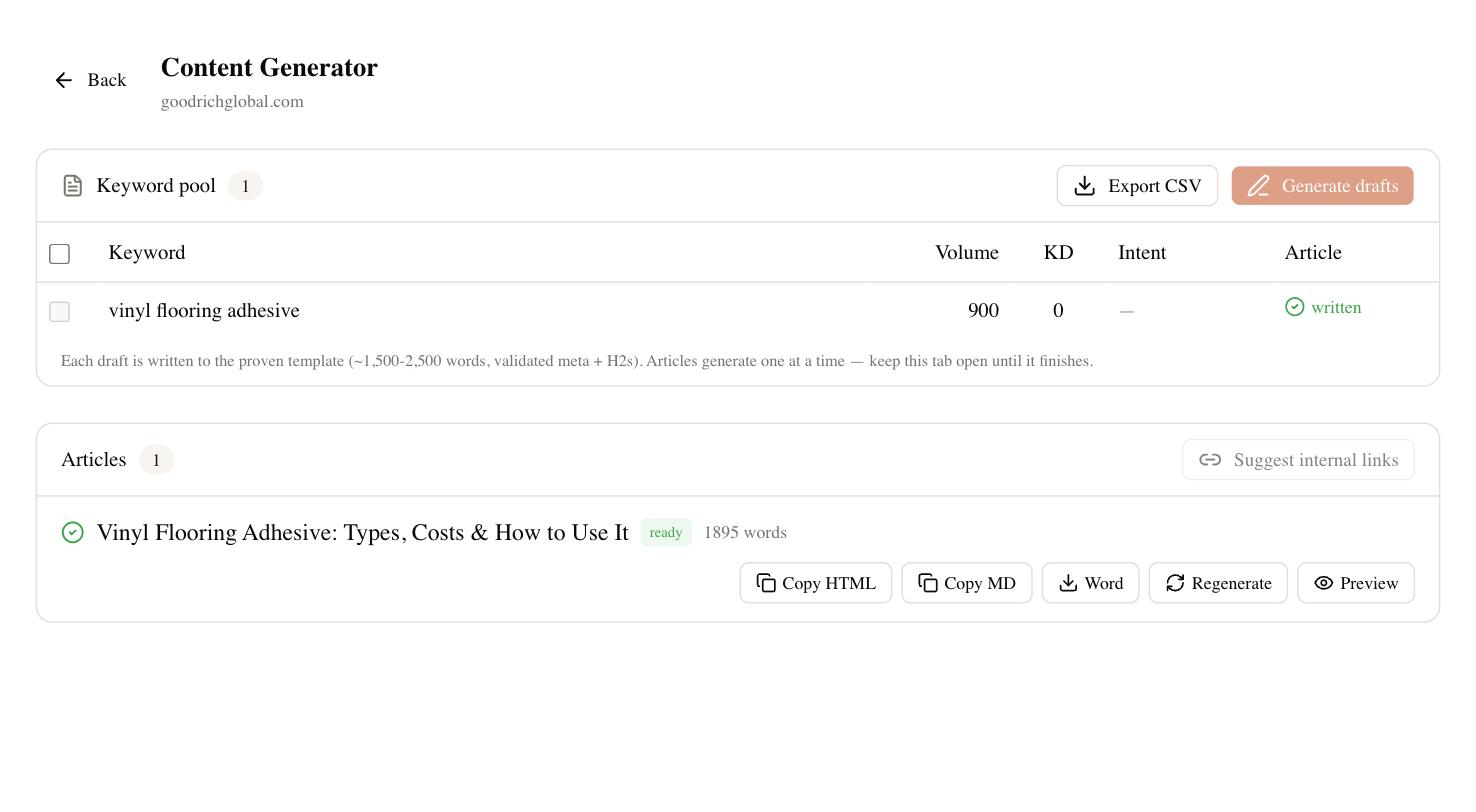
Two capabilities have no equivalent on the Scalenut side. The first is proper backlink and competitor-gap analysis: referring domains, the keywords a rival ranks for that you do not, and a site audit that flags the technical issues holding a page back. The second is AI-search visibility. Search is splitting — some of your buyers now ask ChatGPT or Perplexity instead of Google, and a page that ranks first can still be invisible in an AI answer. Brand Radar tracks whether, and where, you are being cited across ChatGPT, Perplexity, and Google’s AI Overviews, so you are optimizing for the search that is actually happening. A content-only tool cannot tell you any of that.
Data quality is the real dividing line
This is the difference that matters most, so it is worth being precise. A content optimizer infers what to write from the SERP it can see in the moment. A research platform maintains an index — crawled links, keyword volumes, position history — that you can interrogate directly. Those are different jobs. Scalenut does the first well and does not really attempt the second; SEO Rocket does both, which is the whole point of putting Ahrefs-grade data behind the chat box.
Keep the usual honesty in view, though. Every tool’s traffic estimates and difficulty scores are estimates, not gospel — treat cross-tool differences as directional. Rankings jitter a few positions day to day regardless of which platform you watch them in. Neither tool changes those physics; SEO Rocket simply gives you more of the raw signal to reason from, and gives it to you in the same place you act on it.
Pricing and what you actually pay for
Scalenut’s entry plans land in a friendly band, roughly $40–80 per month depending on tier and usage, and for a pure content workflow that is fair value. The catch is the same one every single-purpose tool has: you will still need somewhere to get real keyword, backlink, and rank data, and something to watch AI-search visibility. Add those and the true cost of the stack climbs well past the headline number on any one invoice.
SEO Rocket’s case is consolidation. One entry-friendly subscription covers the research, the writing, the rank tracking, the site audit, and the AI-visibility tracking that would otherwise be two or three separate tools. If you are a consultant or an agency, the client-dashboard side means you can hand a read-only report straight to a client without exporting anything. The saving is not just dollars; it is the tab-switching and the reconciling of numbers that never quite agree across tools.
Which one should you choose?
Match the tool to your real constraint. If your work is high-volume content production and you already have a research tool you trust, Scalenut’s optimization editor and Cruise Mode are a strong, cost-effective fit — buy it and be happy. If your bottleneck is tool sprawl, or you need real keyword and backlink data, rank tracking, competitor gaps, and AI-search visibility folded into the same place you write, SEO Rocket is the more complete answer, and usually the cheaper one once you count the whole stack.
A quick test settles most cases. Write down the three things you actually did in an SEO tool last week. If all three were some flavor of “write and optimize an article,” Scalenut will serve you well. If even one was “check what I rank for,” “see what a competitor is doing,” or “find out whether ChatGPT mentions us,” you are describing SEO Rocket’s job — and stitching that together from separate tools is the exact friction it exists to remove. Whichever you pick, run your own site and two competitors through it for a full ranking cycle before you judge it; the one that answers your real questions fastest is the right choice for you.