The Semrush vs Moz choice is rarely about which tool is “better” in the abstract — it’s about which one fits how you actually work and what you can justify spending. Both are mature, trustworthy platforms with real data behind them, and either will do the core job of keyword research, rank tracking, and site auditing. Pick wrong, though, and you either drown in a suite you barely touch or outgrow a gentler tool faster than you expected.
This is a straight comparison — no fake winner, no affiliate padding. Below you’ll see where the two tools genuinely diverge, a side-by-side table, a segment-by-segment verdict, and an honest note on where an AI-native option now fits into the same decision.
Where Semrush and Moz actually differ
Semrush is a breadth play. It started as an SEO tool and kept expanding until it became a full digital-marketing suite: keyword research, backlinks, rank tracking, plus PPC research, social scheduling, PR monitoring, and content tooling under one login. Its databases are among the largest in the industry, and its competitive-research features are a genuine reason people pay for it.
Moz is a focus play. It has never tried to be everything — it does core SEO well, wraps it in one of the cleaner interfaces on the market, and leans on Domain Authority, the metric it popularized and that half the industry still quotes in pitches. Its index is smaller than Semrush’s, and it deliberately skips the PPC-and-social sprawl. For a lot of users, that restraint is the appeal, not a shortcoming.
Semrush vs Moz at a glance
Start with the table, then read the segment verdicts below for the two or three rows that match your situation.
| Dimension | Semrush | Moz Pro |
|---|---|---|
| Data quality & index size | Very large keyword & backlink databases; strong competitive data | Smaller index; solid, trusted, Domain Authority heritage |
| Ease of use | Powerful but dense — real learning curve | Clean, beginner-friendly interface |
| AI features | AI add-ons and assistants bolted onto the suite | Minimal — traditional SEO workflow |
| Best for | Marketing teams wanting one all-in-one platform | Beginners & small teams who value simplicity |
| Rough price band | Higher — entry plans run roughly $130–140/mo | Mid — entry plans run roughly $100/mo |
Data quality and index size
On raw depth, Semrush is the heavier tool. Its keyword database and backlink index are larger, its historical data goes back further, and its competitor-analysis views surface more angles — traffic estimates, keyword gaps, ad copy, and more. If your work depends on seeing everything a rival ranks for or bids on, that breadth matters and Moz will feel thin by comparison.
Moz counters with reliability over volume. Its numbers are trusted, its Domain Authority score remains a common shorthand in client reports, and its smaller index is often enough for local businesses, blogs, and small sites that don’t need million-keyword competitive maps. Remember that every third-party metric here — DA, traffic estimates, keyword difficulty — is an estimate. Treat cross-tool differences as directional, not gospel, whichever tool you land on.
Ease of use and the learning curve
This is where Moz earns its keep. The interface is clean, the onboarding is gentle, and a beginner can run a useful site audit or keyword search on day one without a tutorial. If your last tool felt overwhelming, Moz is the easiest on-ramp of the two by a comfortable margin.
Semrush is the opposite trade. It’s powerful, but that power comes as density — dozens of reports, overlapping metrics, and menus most users never fully explore. Teams that invest the time get a lot back; solo users often end up paying for a suite while touching maybe a fifth of it. Neither approach is wrong. It depends entirely on how much complexity you want to manage.
AI features: where both tools show their age
Here’s the honest gap in the Semrush vs Moz matchup: both were architected before AI writing and AI search became daily realities, and it shows. Semrush has responded with AI add-ons and assistants layered onto the existing suite — useful, but bolted on rather than native, and often priced as extras. Moz has stayed closer to its traditional SEO roots with minimal AI tooling.
Neither tool was built to answer the question more marketers now ask: is my brand being cited in ChatGPT, Perplexity, or Google’s AI Overviews? A page that ranks first can still be invisible in an AI answer, and traditional rank tracking doesn’t see that at all. If AI-search visibility is part of your job, you’ll be adding a separate subscription on top of either of these.
Segment-by-segment verdict
There’s no single winner, so match the tool to your situation rather than to a feature count.
- All-in-one marketing team — Semrush. If you want PPC, social, PR, and SEO in one platform and have the budget, its breadth is the whole point.
- Beginner or small business — Moz. The gentle interface and lower entry price make it the easier, safer first tool.
- Deep competitive research — Semrush. The larger index and richer competitor views are hard to match at Moz’s depth.
- Simplicity and clean reporting — Moz. Domain Authority and a tidy UI still land well in client conversations.
- Tight budget — Moz’s entry tier is the lighter monthly commitment of the two.
If you recognize your team in the “all-in-one” or “deep competitive” rows, Semrush is the honest recommendation and worth its higher price. If you’re in the “beginner,” “simplicity,” or “budget” rows, Moz is the better fit and there’s no reason to overpay for suite you won’t use.
The AI-native third option worth a look
Before you commit, it’s worth weighing a newer category that neither Semrush nor Moz was designed to be. SEO Rocket is chat-first: instead of navigating a wall of tabs, you ask for what you need in plain language and it runs the lookup on real, Ahrefs-grade data underneath — keyword research, competitor gaps, backlink profiles, rank tracking. The same tool then drafts the article with Claude and shows whether you’re being cited across ChatGPT, Perplexity, and AI Overviews through its Brand Radar feature.
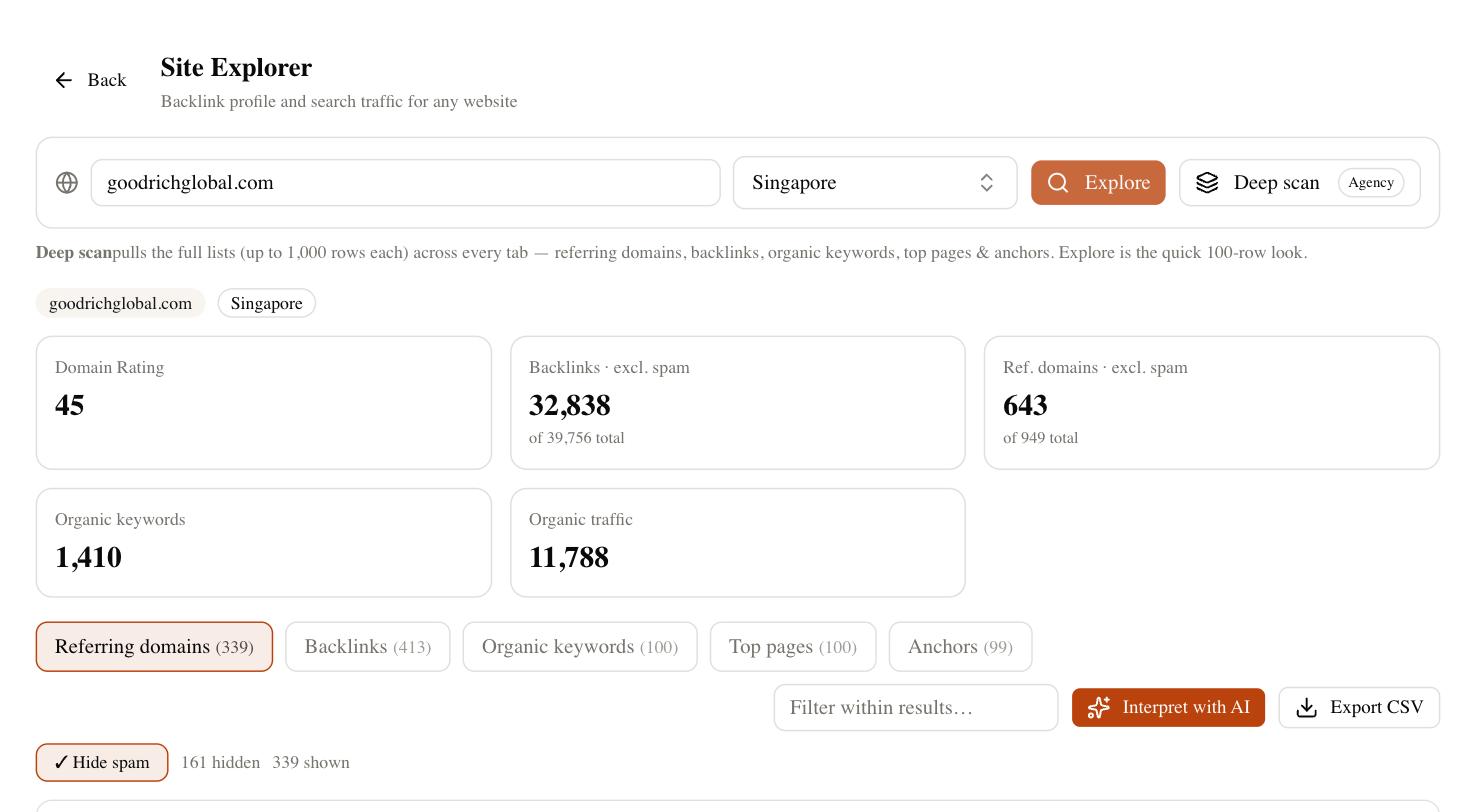
The pitch isn’t that it out-features an established suite on every axis — it’s consolidation. A typical stack of a research tool plus a separate AI writer plus an AI-visibility tracker collapses into one workflow, and entry pricing sits at the friendly end. For consultants and agencies, the client-dashboard side means you can hand a read-only report straight to a client without exporting anything. If your real constraint is tool-sprawl and you want AI writing and AI-search tracking built in rather than bolted on, it belongs on your shortlist next to these two.
How to choose between them
Write down the three tasks you actually did in your SEO tool last week. If the list is “audit a whole marketing channel, research competitor ads, plan a campaign,” Semrush is built for that and earns its bill. If it’s “check my rankings, run a quick audit, find some keywords,” Moz covers it for less and with far less friction. And if one of those tasks was “figure out whether AI search ever mentions us” or “draft the actual content,” that’s the gap an AI-native tool closes that neither of these two fully does yet.
Whatever you pick, run a trial before you commit — put your own site and two competitors through it for a week and watch which one answers your real questions fastest. Rankings jitter a few spots day to day and every tool’s estimates are approximate, so judge on workflow fit, not on whose number looks prettiest. The best choice in the Semrush and Moz debate isn’t the tool with the longest feature page; it’s the one that matches how you actually spend your Tuesday.