If you’re weighing Semrush vs SEO Rocket, you’re really deciding between two different bets on how SEO work gets done. Semrush is the mature, sprawling marketing suite that has been the industry default for years. SEO Rocket is the AI-native challenger built for a job that now includes writing content and getting cited in AI answers, not just tracking rankings. Both are good. They’re good at different things, and the honest recommendation depends entirely on how you actually spend your week.
This comparison won’t pretend one tool wins on every line. Semrush is stronger in places, and I’ll say exactly where. The goal is to help you match the tool to your real constraint instead of a feature checklist you’ll never fully use.
The short answer
Pick Semrush if you run a marketing team that needs one login for SEO, paid search, social, and PR, and you value the deepest possible backlink index for competitive link work. Pick SEO Rocket if you’re a solo SEO, consultant, or agency who wants real Ahrefs-grade data, AI content writing, and AI-search visibility in one chat-first workflow — without paying enterprise suite prices for features you never open. Most people reading a comparison like this fall into the second group; they just haven’t been offered a tool built for it until recently.
Semrush vs SEO Rocket at a glance
Here’s the side-by-side across the dimensions that actually move your decision. Read the notes underneath for the two or three rows that matter to you.
| Dimension | SEO Rocket | Semrush |
|---|---|---|
| Core interface | Chat-first — ask in plain language, it runs the lookup | Dashboard-first — dozens of tools across many tabs |
| Keyword & rank data | Real Ahrefs-grade data underneath | Very large proprietary database |
| Backlink index depth | Solid, sufficient for most audits | One of the largest link indexes available |
| AI content writing | Built in — drafts full articles with Claude | Available as a separate add-on |
| AI-search visibility | Built in — Brand Radar tracks ChatGPT, Perplexity, AI Overviews | Limited, still maturing |
| Breadth (PPC, social, PR) | Focused on SEO and content | Full marketing suite |
| Agency client dashboards | Read-only client views built in | Available, feature-rich, higher tiers |
| Learning curve | Low — conversational | Steep — deep and dense |
| Rough price band | Entry-friendly, low $ | Higher — roughly $130-250+/mo per seat |
Where Semrush is genuinely stronger
Let’s be fair to Semrush, because it earns its reputation. Its backlink index is one of the largest in the industry, and if your work lives on competitive link analysis — auditing a competitor’s entire link profile, hunting broken-link opportunities at scale, building disavow files — that depth is hard to match. A bigger index surfaces links smaller crawlers miss, and for a dedicated link builder those extra rows are the whole job.
Breadth is the other real advantage. Semrush is not only an SEO tool; it covers paid search research, social scheduling, PR and brand monitoring, and a large content marketplace. A marketing team that wants one platform for every channel gets genuine value from having it all under a single login and a single invoice. Its keyword database is enormous, its historical data goes back years, and its competitive intelligence — traffic estimates, ad copy, keyword gaps — is excellent and well-established.
None of that is faint praise. If you need a do-everything marketing command center and have the budget to staff someone who lives inside it, Semrush is a defensible choice and often the right one.
Where SEO Rocket pulls ahead
The case for SEO Rocket starts with a simple observation: most SEO tools were designed before AI writing and AI search existed, so they treat both as bolt-ons. SEO Rocket was built the other way around. Instead of a wall of tabs, you ask for what you need in plain language and it runs the lookup — keyword research, competitor gaps, backlink profiles, rank tracking — then drafts the article and tells you whether AI engines are citing your brand. That’s one connected workflow rather than three subscriptions stitched together.
The AI-search piece is the part no traditional suite answers well yet. Search is splitting: a growing share of your buyers now ask ChatGPT, Perplexity, or Google’s AI Overviews instead of typing a query and scrolling ten blue links. A page that ranks first can be completely invisible in an AI answer. SEO Rocket’s Brand Radar tracks whether — and where — you’re being cited across those surfaces, so you’re optimizing for the search that’s actually happening. Semrush is moving in this direction, but it’s early, and it’s not the reason anyone buys the suite today.
Then there’s the writing. Because content generation runs on Claude inside the same tool, you go from “here’s the keyword gap” to “here’s a drafted article targeting it” without exporting anything or opening a second app. For a consultant producing content weekly, collapsing research and drafting into one place is where the real hours come back.
Data quality — the part everyone worries about
The fair worry when a newer tool is cheaper is that the data must be thinner. With SEO Rocket that’s not the trade-off, because it runs on real Ahrefs-grade data underneath — the same class of Domain Rating, organic traffic estimates, keyword volumes, and referring-domain figures you’d expect from a premium tool. When you pull a domain profile, you get the core view people open enterprise tools for.
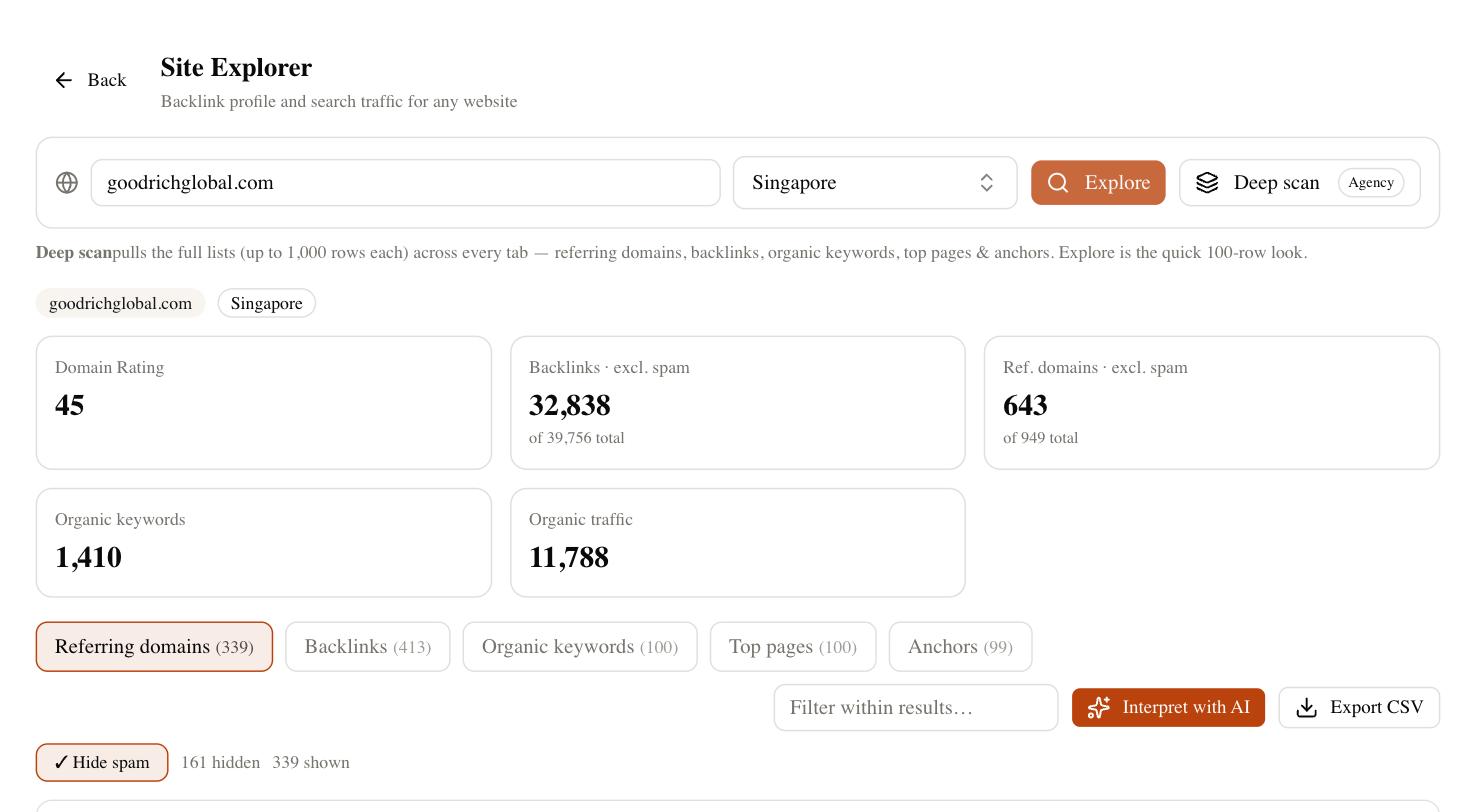
The honest caveat applies to both tools equally: third-party metrics are estimates, not measurements. Domain Rating, traffic projections, and keyword volumes will differ between any two providers, sometimes meaningfully, and neither Semrush nor SEO Rocket has a pipe into Google’s actual numbers. Treat cross-tool differences as directional. Where SEO Rocket concedes ground is raw backlink index size — Semrush crawls more of the web for links — so a pure link specialist will still see rows in Semrush that a leaner index doesn’t surface. For everyone else, the data is more than enough to make confident decisions.
Price and what you actually pay
Cost is usually the reason people start comparing in the first place. Semrush entry plans run roughly in the low-to-mid hundreds per month per seat, and the price climbs fast once you add users, extra projects, or the add-ons — like AI writing — that make the suite worth buying. Many teams end up paying for a lot of platform they never open, which is a poor fit if you only really do SEO and content.
SEO Rocket’s entry pricing sits at a fraction of a comparable Semrush plan, and because AI writing and AI-search tracking are included rather than metered add-ons, the all-in number is what you see. If you’re a consultant or agency, the built-in read-only client dashboards mean you hand a client a live report instead of exporting screenshots — replacing yet another subscription. The saving isn’t just the headline price; it’s the two or three tools you no longer need to run alongside it.
Which one should you choose
Match the tool to how you spend Tuesday, not to the longest feature page. Write down the three tasks you actually did in your SEO tool last week. If the list is some mix of checking rankings, studying a competitor, and producing content, you’re the person SEO Rocket was built for, and paying suite prices for a mid-tier workflow makes little sense. If instead your week was three hours deep in link audits and cross-channel campaign reporting, Semrush’s depth and breadth earn their cost.
Deciding between Semrush vs SEO Rocket isn’t about which tool is better in the abstract — it’s about which one covers the 80% you rely on without charging you for the 80% you don’t. For solo operators, consultants, and lean agencies who want AI-native SEO with real data behind it, SEO Rocket is the natural pick. For large marketing teams that need every channel in one platform and the deepest link index going, Semrush remains a strong, honest choice. Whichever you lean toward, run your own site and two competitors through it for a full ranking cycle before you commit; positions jitter a few spots day to day, and the tool that answers your real questions fastest is the right one for you.