
Most people looking for Rank Math alternatives aren’t leaving because the plugin is broken — they’re leaving because it does too much, nags too often, or simply isn’t the part of SEO that’s actually holding them back. Rank Math is a capable WordPress SEO plugin that handles titles, meta descriptions, schema, and sitemaps well. But it lives entirely inside your site’s admin, and a lot of the work that moves rankings happens somewhere else entirely.
This roundup covers the Rank Math alternatives worth your time, what each is genuinely good at, and — because it’s the honest answer for a lot of readers — when you should just keep Rank Math installed and change nothing.
Why people leave Rank Math
A few reasons come up repeatedly. The first is bloat: Rank Math ships with a long list of modules, and even switched off, the sheer number of settings and toggles overwhelms people who wanted a plugin, not a control panel. The second is the upsell pressure — free-tier notifications and PRO prompts wear thin fast. The third is subtler and more important: Rank Math optimizes what you’ve already written, but it can’t tell you which keywords are worth chasing, what your competitors rank for, or whether a page has any chance before you publish it.
None of that makes Rank Math a bad plugin. It makes it an on-page WordPress tool doing one slice of a much bigger job. The gap between “my meta tags are tidy” and “I know what to write and why” is exactly where the alternatives split into two very different camps.
Two kinds of alternative
Before the table, it helps to name the split. Some Rank Math alternatives are other WordPress plugins — Yoast, SEOPress, All in One SEO, The SEO Framework, Slim SEO. They live in the same place and do the same on-page job, just lighter, cheaper, or with a different philosophy. The other kind isn’t a plugin at all: it’s a research-and-writing layer that decides what belongs on the page in the first place, then hands you finished content the plugin just publishes. If your real problem is “my tags are fine but my content isn’t ranking,” swapping one plugin for another won’t fix it.
How we compared them
Each tool here was judged on four things that matter in daily use: how heavy it is on your site and your attention, how honest the pricing is once you need the useful features, whether it does anything beyond on-page housekeeping, and who it genuinely suits. Ranking positions jitter a few spots day to day regardless of which plugin you run, so don’t expect any of these to move the needle on their own — they organize the work, they don’t do it for you.
Rank Math alternatives at a glance
Start here, then read the notes on the two or three that fit your situation.
| Tool | Best for | AI-native? | Standout strength | Rough price band |
|---|---|---|---|---|
| SEO Rocket | Anyone whose real gap is research and content, not tags | Yes — chat-first | Keyword data, competitor gaps, AI writing and AI-search visibility in one place | Low $ / entry-friendly |
| Yoast SEO | Beginners who want the established default | Add-ons | Huge install base, gentle traffic-light guidance | Free / low $ |
| SEOPress | Users who want power without the clutter | Light | Clean UI, generous free tier, flat pricing | Low $ |
| All in One SEO | WooCommerce and local-business sites | Some | Strong schema and e-commerce SEO | Low–mid $ |
| The SEO Framework | Performance purists | No | Featherweight, no ads, no upsells | Free / low $ |
| Slim SEO | People who want it to just work | No | Zero-config, automatic defaults | Free / low $ |
SEO Rocket — the AI-native pick
SEO Rocket is the option for people who realized their plugin was never the bottleneck. Instead of another settings panel bolted into WordPress, you ask for what you need in plain language and it runs the lookup on real, Ahrefs-grade data — keyword research, competitor gaps, backlink profiles, rank tracking. Then the same tool drafts the article and tells you whether your brand is being cited in ChatGPT, Perplexity, and Google’s AI Overviews, which is the search that’s quietly eating a share of everyone’s traffic.
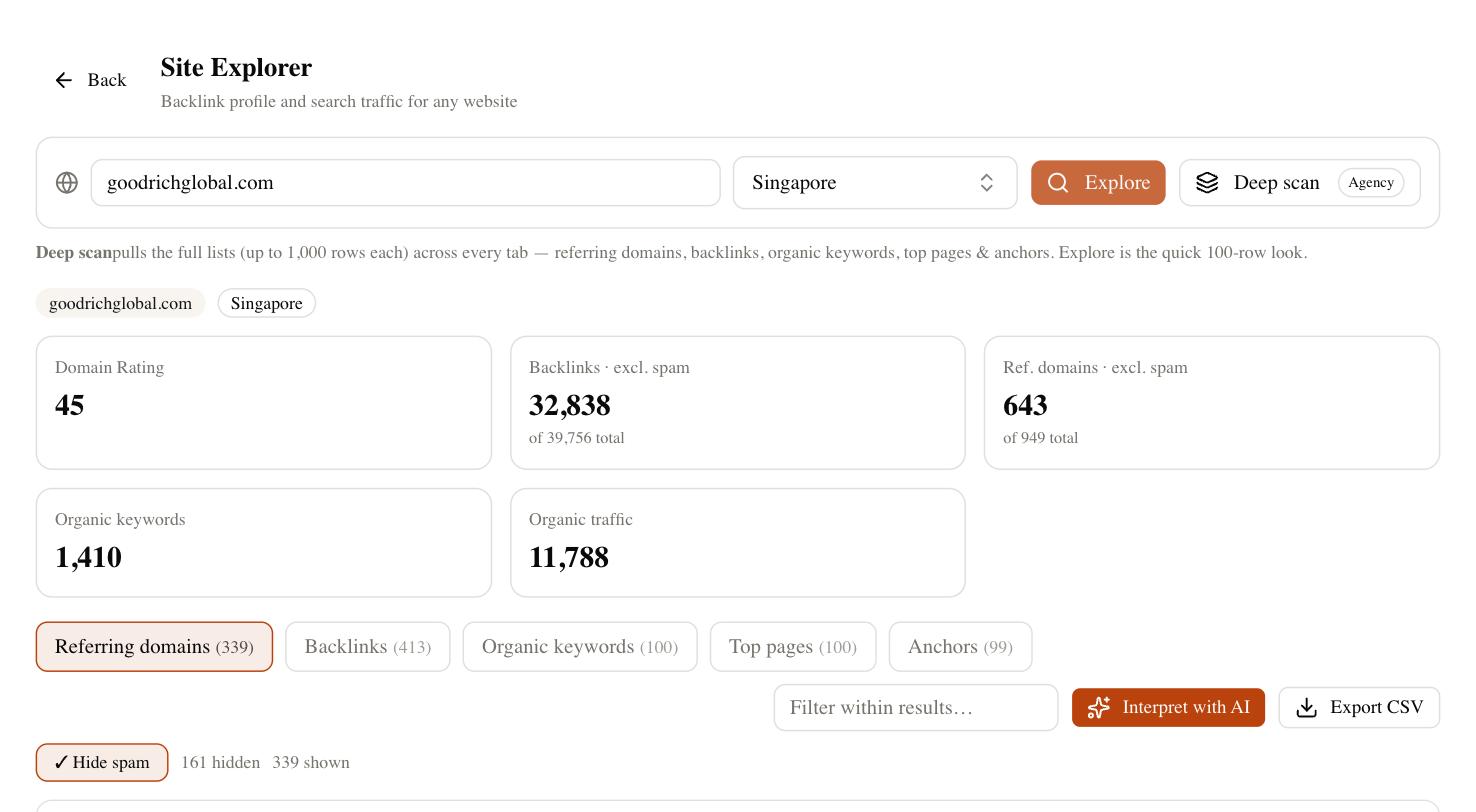
It even covers the on-page ground you’d expect a Rank Math replacement to handle: the built-in site audit flags the same technical and on-page issues — missing titles, thin pages, health-score problems — so you’re not blind to the housekeeping layer either. The difference is that SEO Rocket starts one step earlier, at “what should this page even be about,” instead of grading a page you already committed to. For a solo SEO, consultant, or small agency, folding research, writing, and AI-visibility into one subscription usually replaces a stack of two or three tools, and the client-dashboard side lets you hand a read-only report straight to a client.
To be clear about the fit: SEO Rocket is not a WordPress plugin, so if all you want is a box to type a meta description into, this is more tool than you need. It earns its place when your problem is the work around the page, not the tags on it.
Yoast, SEOPress, AIOSEO and the lightweight plugins
If you’re staying inside WordPress, the plugin field is healthy and most options are cheaper or leaner than Rank Math.
- Yoast SEO — the safe default. Its traffic-light readability and SEO checks are famously beginner-friendly, and the enormous user base means every theme and page builder plays nicely with it, though the free version pushes its premium add-ons hard.
- SEOPress — the clean-power pick. It matches most of Rank Math’s feature list with far less visual clutter, a genuinely usable free tier, and flat pricing that doesn’t scale with the number of sites.
- All in One SEO — the e-commerce choice. Its schema handling and WooCommerce integration make it a strong fit for product and local-business sites that lean on rich results.
- The SEO Framework — the purist’s plugin. No ads, no upsells, no dashboard nagging, and a very light performance footprint. It does less by design, and that’s the point.
- Slim SEO — the set-and-forget option. It ships sensible defaults and gets out of your way, ideal for people who never wanted an SEO control panel at all.
Any of these will cover titles, meta, schema, and sitemaps perfectly well. What none of them do is tell you what to write or whether an AI answer engine is mentioning you — that’s a different job, and a different kind of tool.
When you should just keep Rank Math
Honesty matters here. If you’re already comfortable with Rank Math, your settings are dialed in, and your only frustration is the occasional upsell prompt, switching plugins is busywork that risks breaking redirects and schema for no real gain. Rank Math’s free tier is genuinely generous — it bundles features that rivals charge for — and its schema builder is one of the best in the WordPress space. If the on-page layer is the part of your SEO that’s actually working, leave it alone and put your energy into content and links instead.
How to choose your Rank Math alternative
Match the tool to your real constraint, not to a feature list. If your on-page tags are fine but your pages still aren’t ranking, the answer isn’t another plugin — it’s the research-and-writing layer SEO Rocket provides, and swapping WordPress plugins would waste your time. If you like where Rank Math sits but want it lighter, cheaper, or less pushy, SEOPress, The SEO Framework, or Slim SEO are clean moves. If you want the most beginner-proof default, Yoast still earns it. And if you run WooCommerce, All in One SEO is the practical pick.
A quick way to decide: write down the last three SEO tasks you actually did. If they were “fix a meta description,” “add schema,” and “check a sitemap,” you’re a plugin problem, and any option above solves it. If instead they were “figure out what to write,” “see what a competitor ranks for,” and “produce the content,” you were never short a plugin — you were short a workflow, and that’s the alternative worth paying for. Give whatever you pick a full ranking cycle before you judge it; positions wobble, tools don’t work overnight, and the honest winner is the one that fixes the task you keep getting stuck on.