
Most people reading a rank math review already have Yoast installed and are wondering whether the switch is worth an afternoon of migration. The short answer is that Rank Math is a genuinely strong WordPress SEO plugin that gives away more in its free tier than most rivals charge for — but it is still a plugin, which means it solves on-page mechanics and nothing beyond them.
This rank math review is written for someone who wants the honest version: what the tool actually does well, where it quietly frustrates people, roughly what it costs, and who should skip it. No affiliate cheerleading, no invented statistics — just how it behaves once it is running on a real site.
What Rank Math actually is
Rank Math is an on-page SEO plugin for WordPress. It lives inside your site and helps with the things that happen at the page level: title tags and meta descriptions, XML sitemaps, schema markup, internal-link suggestions, redirects, and a content-analysis score that grades each post against a target keyword. It sits in the same category as Yoast SEO and All in One SEO, and the three compete on roughly the same surface.
What sets it apart is scope. Rank Math ships as a set of modules you toggle on and off — schema, a 404 monitor, redirections, Google Search Console and Analytics connections, local SEO, WooCommerce fields — and a lot of that is available without paying. That breadth is the reason it spread so fast among WordPress users who were used to hitting a paywall the moment they wanted more than a title and a snippet.
What Rank Math does well
The free tier is the headline. You get unlimited keyword tracking per post, schema types that competitors gate behind premium, automatic sitemaps, redirect management, and Search Console data pulled into your dashboard — all without a license. For a small business running one WordPress site, that alone covers most of what on-page SEO requires.
Setup is the other genuine strength. The onboarding wizard walks you through connecting Search Console, choosing a schema default, and importing settings from Yoast or All in One SEO without losing your existing metadata. The import works cleanly in most cases, which matters because a broken migration is the fastest way to tank a site’s rankings for a week.
The per-post analysis is more granular than Yoast’s. It scores your content across dozens of checks — keyword in the title, the first paragraph, subheadings, image alt text, content length — and gives you a running number to chase. Used lightly, that checklist is a useful reminder for writers who forget the basics.
Where Rank Math falls short
The score that helps beginners also misleads them. Chasing a green 100/100 pushes people toward keyword stuffing and mechanical writing, because the plugin rewards exact-match repetition that Google stopped caring about years ago. Treat the score as a checklist, not a target — a page can rank beautifully at 70 and read like spam at 100.
It is also a heavy plugin. Rank Math writes a fair amount of data to your WordPress database and adds admin-side weight, and on cheap shared hosting some users notice a slower dashboard. It is rarely a dealbreaker, but if your site already runs a dozen plugins, adding a feature-dense one is not free.
Support is the weaker spot. Free users rely on documentation and community forums, and paid support runs through a ticket system that can be slow at busy times. If you want someone on the other end quickly when a redirect loop breaks your site, that is worth knowing before you commit.
The deepest limitation is not a bug — it is the category. A plugin can only optimize the pages you have already written. It cannot tell you which keywords are worth targeting, what your competitors rank for that you do not, whether your backlink profile is healthy, or whether ChatGPT and Google’s AI Overviews ever mention your brand. Rank Math is the last mile of SEO, not the map.
Rank Math pros and cons at a glance
Here is the honest balance sheet, plus how the two obvious WordPress rivals compare on the points that usually decide the choice.
| Factor | Rank Math | Yoast SEO | All in One SEO |
|---|---|---|---|
| Free-tier depth | Very generous | Limited | Moderate |
| Schema / rich results | Extensive, mostly free | Basic free, more in premium | Solid, tiered |
| Ease of setup | Guided wizard, clean import | Simple, very familiar | Straightforward |
| Performance footprint | Heavier | Lighter | Moderate |
| Support responsiveness | Docs + tickets | Established, priced | Ticket-based |
| Rough price band (paid) | Low annual $ | Mid annual $$ | Low–mid annual $ |
What Rank Math costs
The free version is free and does more than many people ever outgrow. The paid tier is sold as an annual license and sits in the lower band of WordPress SEO pricing — cheaper per year than Yoast’s premium license, and competitive with All in One SEO. Exact numbers and plan names shift, so check the current page before you buy, but the shape has been consistent: you are paying tens of dollars a year, not hundreds, and a single license can cover multiple sites depending on the tier.
Paying unlocks things like extra schema types, keyword-rank tracking inside the dashboard, and the AI-assisted content features. Whether that is worth it depends entirely on whether you will use rank tracking and content tooling — because if you already run a dedicated SEO platform for those, you are paying twice.
Who Rank Math suits
If you run one or a handful of WordPress sites and you want strong on-page SEO without a subscription, Rank Math is one of the easiest recommendations to make. The free tier is legitimately good, the schema support is deeper than most, and the Yoast import means switching costs almost nothing. Bloggers, small business owners, and freelancers building client sites are the natural fit.
It suits you less if performance is tight, if you need fast hands-on support, or if you are already deep in the WordPress ecosystem with a plugin you know well — the marginal gain over a properly configured Yoast setup is real but not dramatic. And it does nothing for you at all if your site is not on WordPress, since the whole tool is WordPress-only.
Where an AI-native tool fits alongside it
Here is the honest boundary: Rank Math and a platform like SEO Rocket are not really competitors — they do different jobs, and most serious sites end up wanting both. Rank Math handles the on-page plumbing inside WordPress. SEO Rocket handles everything upstream of that: which keywords deserve a page, what competitors rank for that you are missing, whether your backlinks hold up, how your positions move week to week, and whether AI search surfaces are citing you at all.
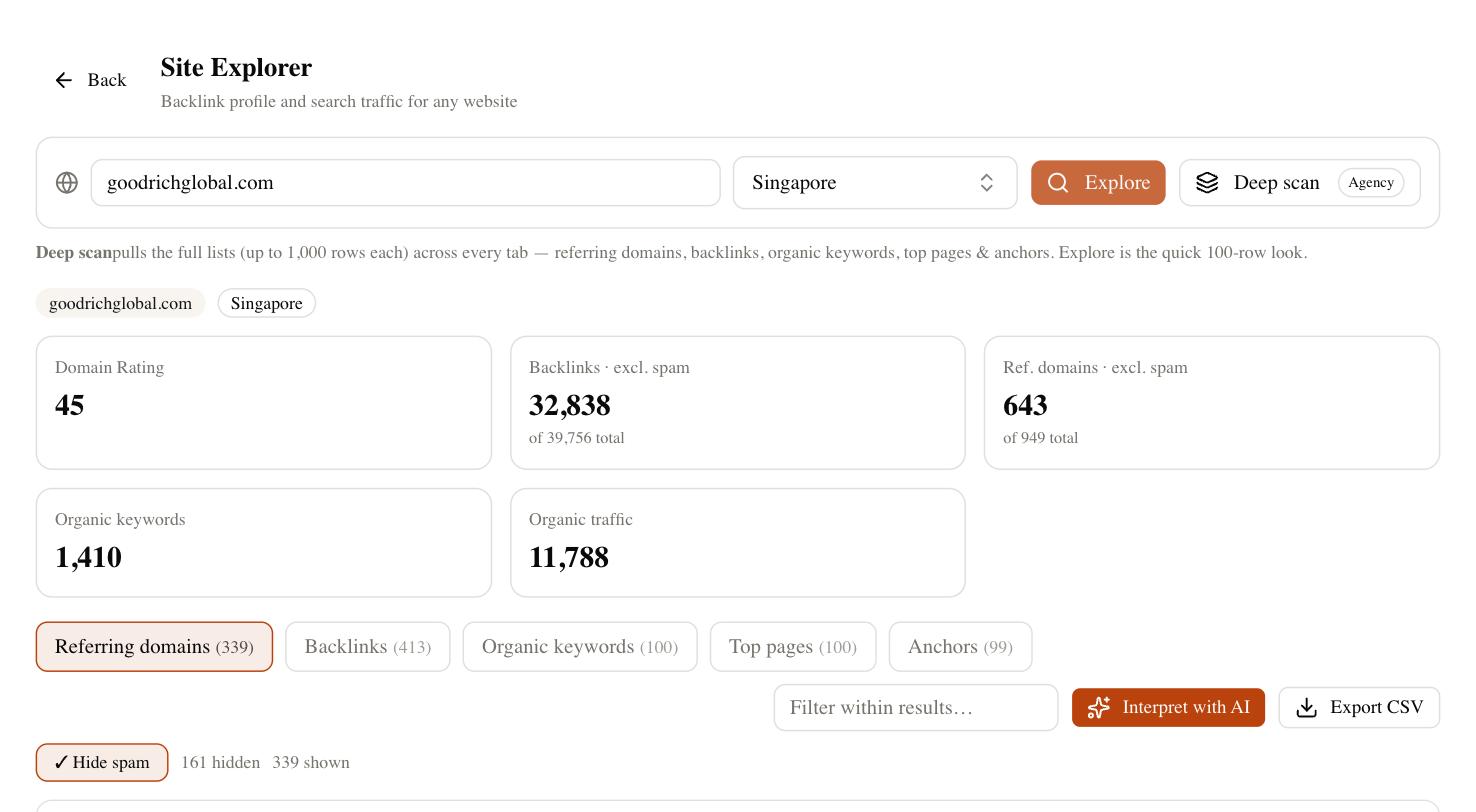
The practical workflow is to let SEO Rocket tell you what to write and why — pulling Ahrefs-grade keyword and competitor data through a plain-language chat, drafting the article, and tracking both classic rankings and AI-answer visibility — then use Rank Math to set the schema, title, and redirects when that content lands in WordPress. If you only ever plan to tidy up pages you have already decided to publish, a plugin is enough. If your real bottleneck is deciding what to publish and proving it worked, that is the layer a plugin cannot reach.
The verdict
Rank Math earns its reputation. It is a capable, unusually generous WordPress SEO plugin that most single-site owners can adopt for free and rarely regret. Its weaknesses — a heavier footprint, a gamified score that tempts overwriting, and support that can lag — are real but manageable, and none of them undercut the core value. If you are choosing between free WordPress SEO plugins, it belongs at the top of the shortlist.
Just keep the plugin in its lane. On-page hygiene is necessary and Rank Math does it well, but rankings are won upstream — in keyword strategy, competitive gaps, content, and now AI visibility. Install Rank Math for the last mile, and pair it with a tool that owns the strategy if you want the whole journey covered rather than just the finish line.