Most people hunting for Anyword alternatives aren’t unhappy with the writing quality. Anyword is a genuinely good performance-copy tool, built around its Predictive Performance Score that grades marketing copy before you ship it. The trouble is that it was designed for ad copy, landing pages, and conversion messaging, and the moment your real job becomes organic search, it starts to feel like the wrong instrument for the work in front of you.
This roundup skips the padded twelve-tool list. Below are the Anyword alternatives that actually earn a spot in a working content stack, what each one is genuinely best at, and, because it’s the honest answer, when you should just keep paying for Anyword instead.
Why people look past Anyword
Three reasons come up over and over. The first is fit: Anyword shines at short, high-conversion marketing copy, so if your week is long-form SEO articles and organic rankings, you’re paying for a predictive score tuned to ad performance rather than search intent. The second is price. The entry tier is approachable, but the data-driven and business plans that unlock the scoring, analytics connections, and seat count climb into the hundreds a month fast.
The third reason is scope. Anyword writes; it doesn’t research. There’s no real keyword database, no SERP analysis, no backlink data, and no rank tracking underneath it, so you still run a separate SEO stack alongside it. For a marketing team optimizing paid campaigns that’s fine. For anyone whose growth comes from Google and, increasingly, from AI answers, it leaves the hardest half of the job unsolved.
How we compared these tools
Every tool here was judged on four things a content operator actually cares about: the quality and control of the AI writing, how much genuine SEO research sits underneath it, honest total cost rather than the headline number, and who the tool is really for. AI-generated drafts are a starting point, not a finished page, so a tool that hands you clean structure and real data beats one that produces polished-sounding filler you have to fact-check line by line.
Anyword alternatives at a glance
Start with the table, then read the notes on the two or three rows that match your situation.
| Tool | Best for | SEO research built in? | Standout strength | Rough price band |
|---|---|---|---|---|
| SEO Rocket | Solo SEOs, consultants & agencies who want one AI-driven workflow | Yes — Ahrefs-grade | Real SEO data + AI writing + AI-search visibility in one chat | Low $ / entry-friendly |
| Jasper | Enterprise marketing teams & brand-voice content | No | Polished long-form and campaign workflows at scale | Mid–high $$ |
| Copy.ai | Sales & marketing teams wanting GTM workflows | No | Automated multi-step content and outreach flows | Low–mid $ |
| Writesonic | Budget-minded writers who want SEO leanings | Some | Cheap drafting with light optimization features | Low $ |
| Surfer SEO | Editors optimizing drafts against the SERP | SERP-based | Content scoring against what actually ranks | Mid $$ |
| Frase | Writers who want research briefs plus drafting | SERP-based | Fast briefs from the top-ranking pages | Low–mid $ |
SEO Rocket — the AI-native SEO pick
SEO Rocket is the option built for how content and search work now. Instead of a copy tool on one screen and a research suite on another, you ask for what you need in plain language and it runs the lookup — keyword research, competitor gaps, backlink profiles, rank tracking — on real, Ahrefs-grade data underneath. Then the same tool drafts the article with a proper title, meta description, and heading structure, grounded in what’s already ranking rather than in guesswork.
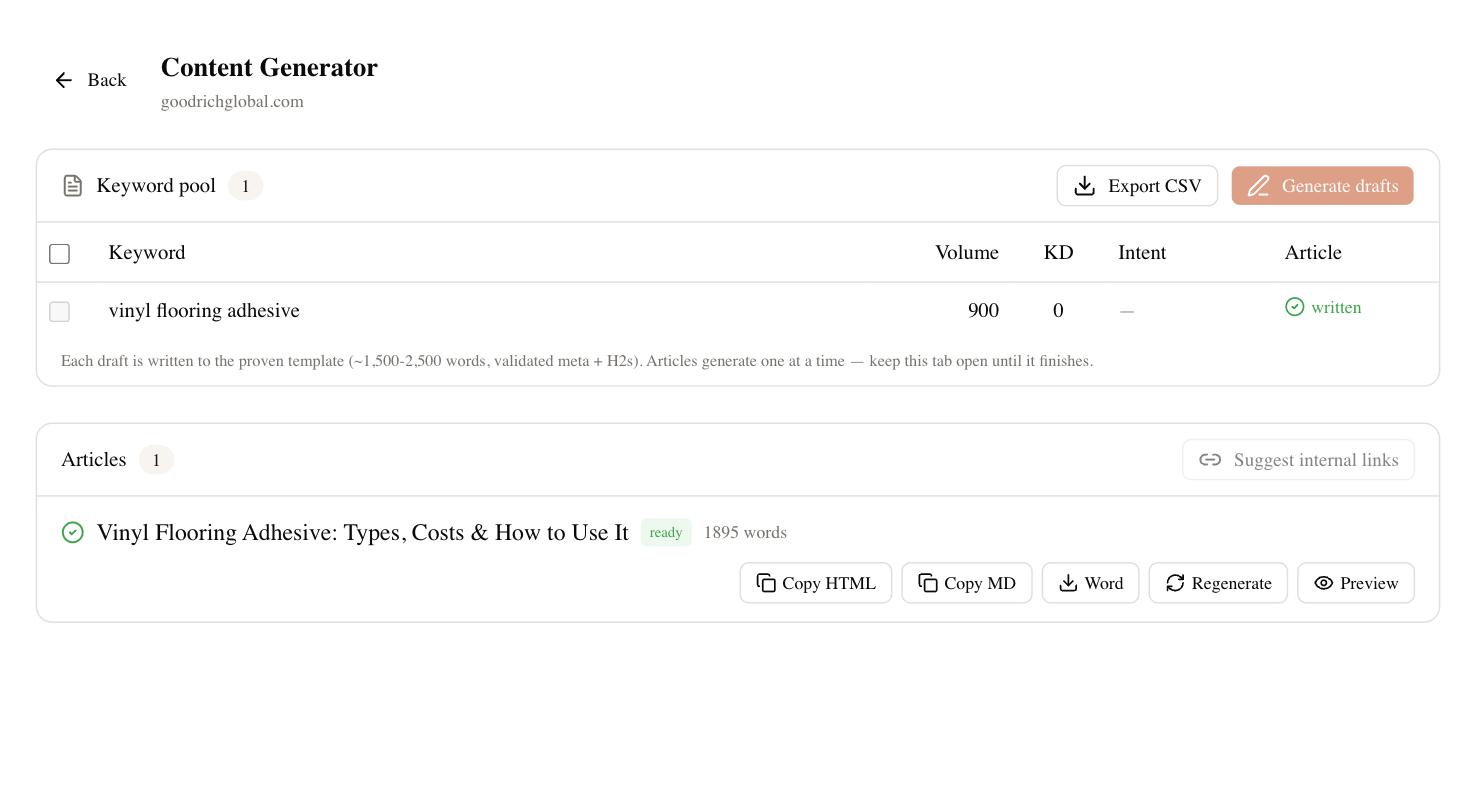
That consolidation is the real saving. A stack of Anyword for copy, plus a separate keyword tool, plus an AI-visibility tracker collapses into one subscription, and the entry pricing sits well below a comparable data-driven Anyword plan. If you’re a consultant or agency, the client-facing side means you can hand a read-only report to a client without exporting anything or stitching screenshots together.
The part no copy tool answers is AI-search visibility, and it’s becoming the point. Search is splitting: some of your buyers now ask ChatGPT or Perplexity instead of Google, and a page that ranks first can still go unmentioned in an AI answer. SEO Rocket’s Brand Radar tracks whether, and where, you’re being cited across those surfaces, so you optimize for the search that’s actually happening. For anyone whose bottleneck is doing more with fewer tools, which is most people reading this, that combination is the strongest fit on the list.
Jasper and Copy.ai — the marketing-content heavyweights
Jasper is the closest like-for-like swap if what you liked about Anyword was polished marketing output at scale. Its brand-voice controls are strong, its campaign workflows are mature, and enterprise teams get the governance and seat management they expect. The trade-off is the same one you’re leaving: it’s a writing platform, not an SEO platform, its entry plans sit in the mid-range and rise quickly with seats, and you’ll still bolt on a separate research tool to know what to write about.
Copy.ai has moved toward go-to-market automation — chaining prompts into multi-step flows for sales and marketing rather than one-off drafts. If your team wants to automate outreach, briefs, and repurposing across a pipeline, it earns its keep, and its lower tiers are friendlier than Anyword’s data-driven plans. But like Jasper, it writes without knowing the SERP, so organic search still needs its own toolkit.
Writesonic, Surfer SEO and Frase — the SEO-leaning writers
This trio sits closer to search than the pure marketing tools, each from a different angle.
- Writesonic — the budget entry point with SEO leanings. It drafts cheaply and has added optimization and research features, though depth and data quality trail a dedicated suite. Good for a first client or a hobby site on a tight budget.
- Surfer SEO — not a generator so much as an editor’s scorecard. It grades your draft against the pages already ranking for your term, which is genuinely useful, but you supply the writing and the keyword strategy from elsewhere.
- Frase — the brief-first option. It pulls the top-ranking pages into a research brief fast, then drafts against it, which shortens the blank-page problem for writers who still want to steer.
Any of these will move you closer to search than Anyword does. What none of them fold in yet is a full data backbone plus AI-answer visibility in the same place — you’ll still run a second subscription for the research or the tracking.
When you should just keep Anyword
Honesty matters here. If your core job is conversion copy — ad variations, landing-page headlines, email subject lines, product descriptions — Anyword’s Predictive Performance Score is a real differentiator, trained on marketing data most writing tools don’t have. Performance marketers who live in A/B tests and want a defensible reason to pick one variant over another get genuine value from it, and swapping it for an SEO tool would be solving the wrong problem. The right question isn’t “is there something cheaper,” it’s “is my real work ranking pages or optimizing paid copy.” If it’s the latter, stay put.
How to choose your Anyword alternative
Match the tool to your actual constraint, not to a feature checklist. If your growth comes from organic search and you’re tired of paying for writing and research and AI-visibility separately, SEO Rocket is the natural move. If you want a polished enterprise writing platform for brand-voice campaigns, Jasper earns its price. If you’re automating a go-to-market pipeline, Copy.ai fits. And if you want cheap drafting or a SERP-based scorecard, Writesonic, Surfer, or Frase will each cover a slice.
A quick way to decide: write down the three content tasks you actually did last week. If the list is some mix of “figure out what to write,” “check what competitors rank for,” and “produce the article,” you’re paying a marketing-copy tool to do a search job it was never built for — and an AI-native SEO tool will cover all three faster. If instead your week was tuning ten ad headlines for conversion, keep the specialist. The best alternative is the one that matches how you spend Tuesday, not the one with the longest feature page. Whatever you pick, run your own site and two competitors through it for a week before you judge it; the tool that answers your real questions fastest is the right one for you.