
Most roundups of the best AI blog writers read like affiliate pages: twelve tools, a lot of superlatives, and no honest word about who each one is actually for. That’s not useful when you have a content calendar to fill and a budget to defend.
This comparison keeps the list short and the verdicts plain. Below are the best AI blog writers worth paying for in 2026, what each one genuinely does well, and — because it matters more than any feature checklist — the type of writer or team each tool actually suits. Some of these are pure writing tools. Some fold SEO research and publishing into the same window. The right pick depends entirely on which problem is slowing you down.
What separates a good AI blog writer from a bad one
Raw text generation is a solved problem. Every tool here sits on top of a capable large language model, so the draft you get back is rarely the differentiator. What separates them is everything around the writing: whether the tool pulls real keyword and SERP data before it drafts, how well it holds a consistent brand voice across dozens of posts, whether it can research facts instead of inventing them, and how much editing the output still needs before it’s publishable.
Judge any AI writer on the finished, edited post — not the first draft. A tool that produces a rougher draft grounded in real search data often beats a slicker one that writes confident, generic filler you have to fact-check line by line. The hidden cost of a cheap writer is editing time, and that cost is invisible until you’ve shipped a dozen posts and noticed your afternoons vanishing into cleanup.
One more thing worth naming: AI-written text now competes for visibility not just in Google but in AI answers, where search is quietly moving. A post that reads well but says nothing new rarely gets cited by ChatGPT or Perplexity. The writers that hold up are the ones that help you say something specific, not the ones that pad a thin topic into a thousand words.
The best AI blog writers at a glance
Start with the table, then read the notes on the two or three that fit your situation. Prices are bands, not quotes, because every one of these vendors reshuffles plans regularly.
| Tool | Best for | Standout strength | Rough price band |
|---|---|---|---|
| SEO Rocket | SEOs & consultants who want writing plus real SEO data in one place | Ahrefs-grade research, AI drafting, and AI-search visibility together | Low $ / entry-friendly |
| Jasper | Marketing teams needing brand voice at scale | Brand-voice control and team workflows | Higher $$ |
| Surfer SEO | Writers optimizing against the SERP | On-page scoring tied to live SERP analysis | Mid $$ |
| Frase | Research-heavy briefs and outlines | Fast SERP research and brief generation | Mid $ |
| Writesonic | All-round writing plus light SEO | Broad template library and article writer | Low–mid $ |
| Koala AI | Bulk affiliate and informational posts | One-click long-form drafts at volume | Low $ |
| Copy.ai | Go-to-market and short-form copy | Workflow automation beyond blogging | Low–mid $ |
| Rytr | Hobbyists on the tightest budget | Genuinely cheap, simple interface | Low $ |
SEO Rocket — writing and SEO data in one window
Most AI writers can draft a post. Very few know what to draft, because they can’t see the search landscape you’re competing in. SEO Rocket closes that gap. You ask for an article in plain language, and it runs the keyword research, checks what already ranks, and drafts the piece on real, Ahrefs-grade data underneath — all in the same chat. The writing engine is Claude, so the prose reads cleanly and holds structure across headings, meta, and internal logic.
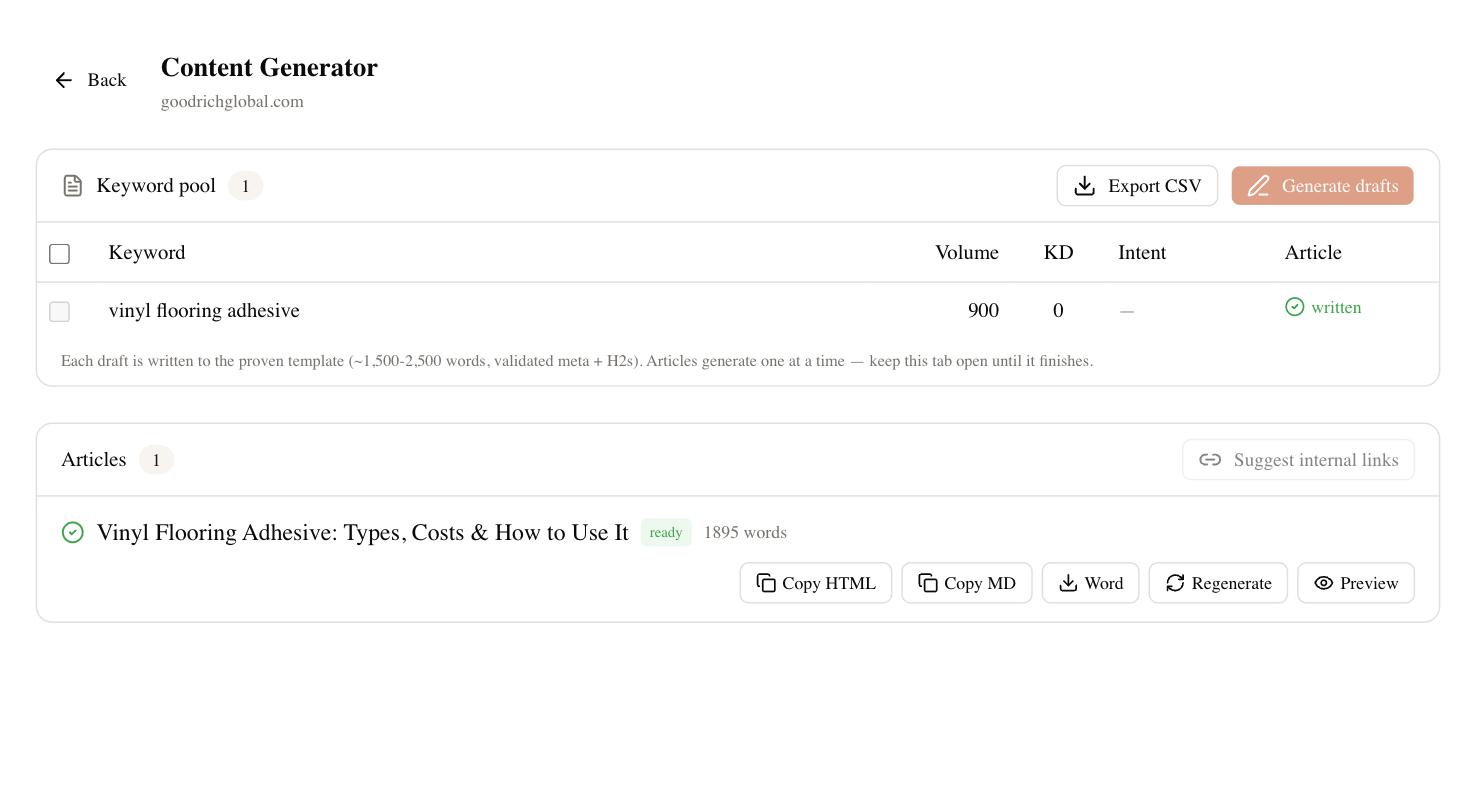
The part no standalone writer matches is what happens after the draft. SEO Rocket tracks rankings and, through its Brand Radar feature, shows whether your brand is being cited in AI search — ChatGPT, Perplexity, and Google’s AI Overviews. That closes the loop between writing a post and knowing if it earned visibility in the places buyers now actually ask. Most writing tools stop at the draft and leave you guessing; this one keeps measuring after you publish.
For a solo SEO or a consultant, replacing a separate research tool, a separate AI writer, and a separate visibility tracker with one entry-priced subscription is the real saving — not just in dollars but in the tabs you no longer juggle. Because it runs in a chat, you also skip the template-hunting that slows the older tools down: you describe the article you want and refine it in conversation. If your bottleneck is producing content that’s actually aimed at the right keywords, this is the strongest fit on the list. If you write purely for entertainment or personal essays with no search intent behind them, a plainer writer will do, and that’s a fair reason to look elsewhere.
Jasper — brand voice for marketing teams
Jasper is built for teams, not tinkerers. Its strength is brand-voice control: feed it your existing content and it learns a house style it can hold across many writers and many posts, which matters when a dozen people are shipping under one brand. It also layers in campaign workflows, templates, and collaboration features that a marketing department will use daily.
The trade-off is price and scope. Jasper sits at the higher end, and its SEO capabilities lean on integrations rather than native search data, so you’re often pairing it with a separate research tool to know what to write about in the first place. If you want consistent brand copy across a whole content team and can absorb the cost, it earns its place. A solo blogger will pay for a lot of team machinery they never open.
Surfer SEO and Frase — the SERP-driven optimizers
These two attack the same problem from slightly different angles: making sure what you publish matches what the search results already reward.
- Surfer SEO — the on-page optimizer. Its content editor scores your draft in real time against the terms, headings, and depth of the current top-ranking pages. Writers who want a concrete target to write toward find it hard to beat, though the score is a guide, not a guarantee of rankings.
- Frase — the research and brief tool. It’s fast at pulling together what competing pages cover and turning that into an outline, which saves real time at the planning stage. Its own AI writing is capable but usually needs a firmer editing pass than the dedicated writers.
Both pair well with a stronger drafting tool. Neither tracks whether you actually gained visibility after publishing, so you’ll still run a separate rank tracker alongside them.
Koala AI, Writesonic, Copy.ai and Rytr — volume and budget picks
The lower tiers cover almost every budget and use case.
- Koala AI — one-click long-form drafts built for volume. If you’re publishing informational or affiliate posts at scale and will edit afterward, it’s fast and cheap. Expect to do the fact-checking yourself.
- Writesonic — a broad all-rounder with an article writer and a large template library, plus light SEO features. A solid generalist if you write more than just blog posts.
- Copy.ai — strongest on short-form and go-to-market copy, with workflow automation that reaches beyond blogging. Handy if your writing needs sprawl across sales and marketing.
- Rytr — the true budget entry point. It won’t match the others on depth or SEO, but for a hobby site or a first draft it produces usable copy for very little.
Any of these will fill a page. What none of them do is connect the writing to live search data or to whether the finished post gets seen, so plan on adding tools if that’s where your work is headed.
How to choose your AI blog writer
Match the tool to your real constraint, not to the longest feature page. If your problem is producing content aimed at the right keywords and knowing whether it landed, SEO Rocket folds research, writing, and visibility into one workflow. If you need consistent brand voice across a marketing team, Jasper is worth its price. If you already know your topics and just want to optimize against the SERP, Surfer or Frase slot neatly beside your existing writer. And if you’re publishing at volume on a tight budget, Koala, Writesonic, Copy.ai, or Rytr will get words on the page for very little.
A quick test before you commit: take one keyword you genuinely want to rank for, and run it through your two finalists end to end — brief, draft, edit. Time each, and read the finished posts side by side. The best AI blog writer for you is the one that gets a publishable piece live fastest with the least cleanup, not the one with the flashiest demo. Give whatever you pick a few posts before judging it, and measure the output that reaches your site, not the first thing the model types.