Search for the best AI paraphrasing tools and you’ll get a dozen listicles that treat rewording an essay, polishing a work email, and rewriting a blog post as the same job. They aren’t. The best AI paraphrasing tools for a student dodging clunky phrasing are rarely the ones you’d reach for when you need a rewrite that still ranks on Google. So this roundup splits them by the job you’re actually doing, tells you what each one is genuinely good at, and points you at the cheaper or better-fit rival when that’s the honest answer.
Below are seven tools worth your time, what they stand out at, and roughly what they cost. Read the table first, then the two or three notes that match your situation.
Paraphrasing isn’t one job
A paraphraser does one of three things depending on who’s using it. Academics and students want to reword source material without changing the meaning and without tripping originality checks. Professionals want to shift tone — make a blunt message polite, or a rambling paragraph tight. Marketers and site owners want to rewrite content that has to compete in search, which means the reword has to keep intent, keywords, and structure intact, not just swap synonyms.
Most tools lean hard toward one of those three. That’s why “which is best” has no single answer — it depends entirely on whether you’re rewriting for a professor, a colleague, or a search engine.
How we compared them
Each tool here was judged on four practical things: the quality of the rewrite (does it read like a human wrote it, or like a thesaurus exploded), how much control you get over tone and length, honest total cost rather than the headline free tier, and who it genuinely fits. Free paraphrasers were held to a lower bar on polish but a higher one on speed and access, because that’s the whole point of using them.
One thing no paraphraser fully solves is detection. Both AI-detection and originality checkers keep moving, and no rewriter can promise to slip past them forever. Treat that as a reason to rewrite for genuine clarity rather than to disguise copied text, and you’ll get more out of every tool below.
Best AI paraphrasing tools at a glance
Here’s the shortlist. The price bands are rough tiers, not current quotes — check each site before you buy, since plans move around.
| Tool | Best for | Standout strength | Rough price band |
|---|---|---|---|
| SEO Rocket | Rewriting content that has to rank in search | Rewrites tied to real keyword data plus AI-search visibility, in one chat | Low $ / entry-friendly |
| QuillBot | Students and academic rewording | Multiple rewrite modes with a built-in summarizer and grammar checker | Free tier / low $ |
| Wordtune | Professionals polishing tone | Natural tone rewrites and “spices” that add examples or counterpoints | Free tier / low $ |
| Grammarly | All-round correctness with rewrite on top | Grammar, clarity, and generative rewrite in one place everywhere you type | Free tier / mid $ |
| Jasper | Marketing teams rewriting at scale | Brand voice controls and templates for campaigns | Higher $$ |
| Rytr | Tight budgets and quick drafts | Cheap AI writing with a usable paraphrase mode | Very low $ |
| Free paraphrasers | One-off rewrites, no account | Instant, no-login rewriting for short passages | Free / low $ |
SEO Rocket — for rewrites that need to rank
SEO Rocket isn’t a paraphraser in the QuillBot sense, and it would be dishonest to pretend otherwise. It’s a chat-first SEO tool that writes and rewrites content with Claude on top of real, Ahrefs-grade keyword and competitor data. The reason it belongs on this list is that a huge share of paraphrasing is done for one purpose — reworking a page so it reads better and still performs in search — and that’s a job the standalone paraphrasers weren’t built for.
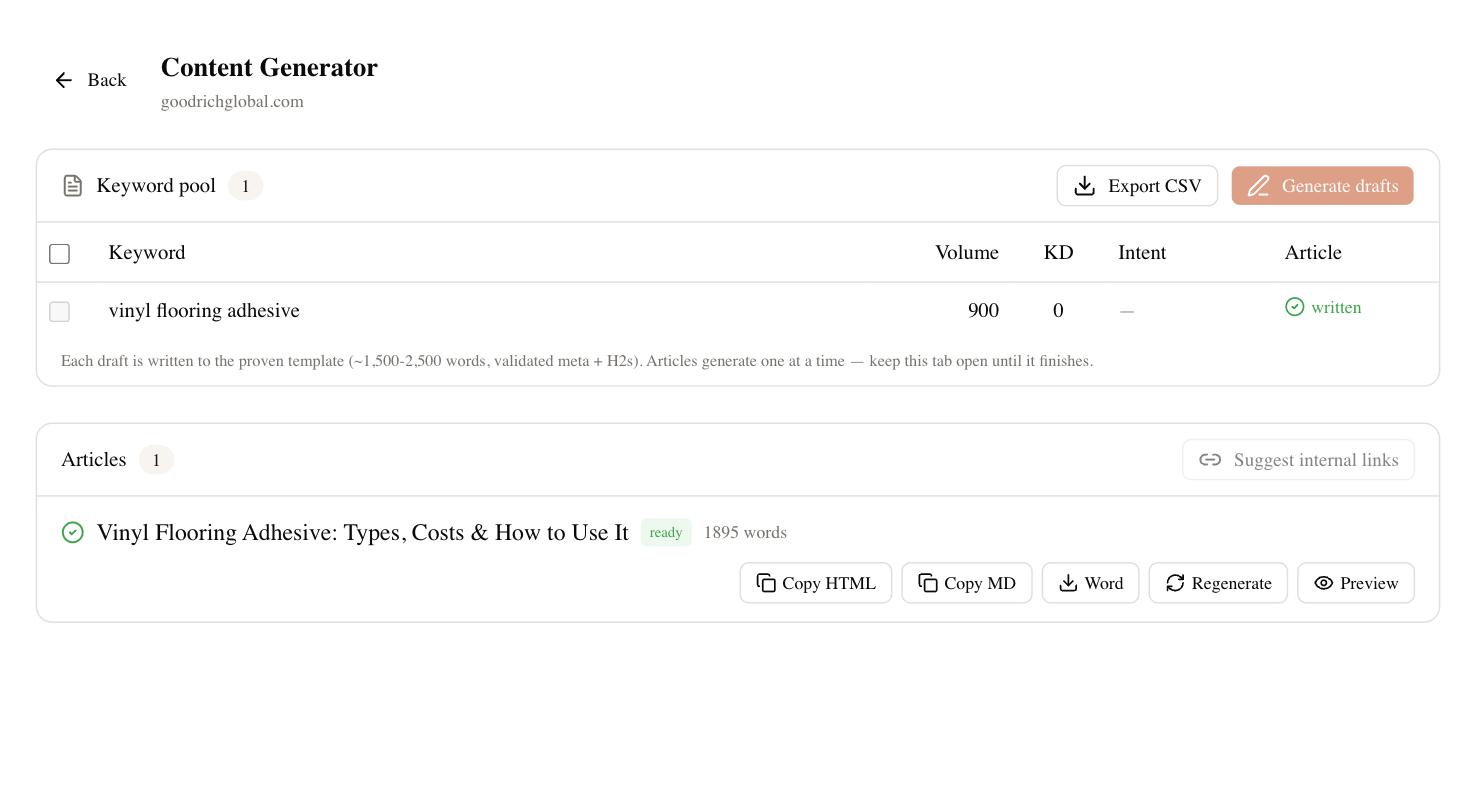
The difference shows up in what the rewrite is aware of. When you ask SEO Rocket to rewrite a section, it can see what you’re trying to rank for, what the page-one competitors cover, and where your draft is thin — so the reword keeps your target terms and heading structure instead of quietly synonym-swapping them into something that no longer matches intent. It then tracks whether that page shows up not just on Google but in AI answers from ChatGPT, Perplexity, and Google’s AI Overviews. If your paraphrasing is really “help me publish content that competes,” this covers the writing and the measurement in one subscription, at entry pricing well below a stack of separate tools. If you just need to reword a paragraph for class, it’s overkill — one of the tools below fits better.
QuillBot and Wordtune — the paraphrasing specialists
These two are what most people mean when they say paraphraser, and both are excellent at it.
QuillBot is the default for students and academics. It offers several rewrite modes — standard, fluency, formal, and shorten among them — and bundles a summarizer, grammar checker, and citation help, so it doubles as a lightweight writing suite. Its free tier is genuinely usable for short passages, and the paid tier unlocks longer text and the more aggressive modes. If your job is rewording source material cleanly without changing meaning, it’s the safe pick.
Wordtune leans toward professionals. Instead of modes, it hands you several natural-sounding rewrites of a sentence and lets you nudge tone from casual to formal or make a line shorter or longer. Its “spices” can drop in an example, statistic, or counterargument to flesh out a thin sentence. It reads a little more human than most rewriters, which makes it a favorite for emails, reports, and anything client-facing. There’s a free tier, with a low monthly band for heavier use.
Grammarly, Jasper and Rytr — rewrite inside a bigger tool
Sometimes paraphrasing isn’t the main event — it’s one feature you want alongside everything else.
- Grammarly — the all-rounder. It’s primarily a grammar and clarity checker, but its generative rewrite and tone controls handle everyday paraphrasing well, and it works nearly everywhere you type. If you want one tool that fixes mistakes and rewords awkward lines, it earns its mid-tier price.
- Jasper — the team play. Built for marketing content, it offers brand-voice controls and campaign templates, so a team rewriting at volume gets consistency across writers. It’s the priciest option here and overkill for a single user, but real value for a content team.
- Rytr — the budget entry. A cheap AI writer with a workable paraphrase mode. It won’t match the specialists on polish, but for quick drafts on a tight budget it does the job for very little.
Free paraphrasers — for a quick, one-off reword
There’s a whole tier of free, no-login rewriters — tools like Paraphraser.io and similar utilities — that exist for a single moment: you have a sentence or two, you want it reworded now, and you don’t want to sign up for anything. They’re ad-supported and the output can be uneven, but for short passages they’re fast and free. Just don’t trust them with anything long or important; the polish drops off quickly, and pasting sensitive text into an anonymous free tool is a habit worth breaking. A large language model you already pay for, such as ChatGPT or Claude, will usually rewrite better than these utilities if you give it clear instructions, so reach for the free ad-supported ones only when you want zero setup.
How to choose the best AI paraphrasing tool
Match the tool to the job, not to a feature list. If you’re rewording for school or research, QuillBot is the clean, honest pick. If you’re polishing professional writing and tone matters most, Wordtune reads best. If you want grammar and rewrite in one everyday tool, Grammarly covers it. Marketing teams rewriting at scale get real value from Jasper, and a tight budget is well served by Rytr or a free utility.
But if your reason for paraphrasing is that the content has to earn traffic — you’re reworking a page so it ranks, keeps its keywords, and shows up in AI answers — a general rewriter will quietly work against you by breaking the very structure search rewards. That’s the gap SEO Rocket fills, and it’s the one job the pure paraphrasers can’t. A quick test: write down why you’re rewriting the text. If the answer is “so a person reads it better,” pick a specialist above. If the answer is “so it performs in search,” you want a tool that understands search, not just synonyms.