The best ai tools for keyword research don’t just hand you a spreadsheet of volumes anymore — they cluster keywords by intent, spot the questions real buyers ask, and tell you which terms you can actually win. That shift matters, because a term with 10,000 searches a month is worthless to you if the whole first page is owned by sites ten times your size.
This roundup covers the tools that genuinely earn a place in a working SEO’s stack. For each one you’ll get the honest “best for,” the standout feature, and a rough price band — no invented review scores, no affiliate padding. The goal is simple: help you pick from the best ai tools for keyword research without buying three subscriptions to find out.
What “AI” actually means in a keyword tool
Half the tools on the market slapped “AI” on an existing feature and called it a launch. The useful ones do three concrete things. They cluster hundreds of raw keywords into topic groups so you write one strong page instead of ten thin ones. They classify search intent — informational, commercial, transactional — so you stop targeting a buying term with a how-to article. And a few now surface the questions people ask AI assistants, not just Google, which is where a growing share of research now starts.
Everything else is a nice-to-have. When you compare tools, look past the marketing and ask whether the AI saves you the two jobs that eat the most time: grouping keywords and judging whether a term is worth chasing.
There’s a newer wrinkle worth watching. Search behavior is splitting, and a chunk of your buyers now type their question into ChatGPT or Perplexity before they ever open Google. A keyword that gets you a top ranking can still leave you invisible in an AI answer. The tools that surface those assistant-style questions — and let you check whether you’re being cited in the answers — are solving a problem the classic volume-and-difficulty tools were never designed for. Not every tool needs it, but for a growing number of niches it’s already the difference between being found and being skipped.
The best AI tools for keyword research at a glance
Start with the table, then read the notes on the two or three that fit your situation. Price bands are approximate and move around — treat them as tiers, not quotes.
| Tool | Best for | Standout | Rough price band |
|---|---|---|---|
| SEO Rocket | Solo SEOs, consultants & agencies wanting one AI workflow | Chat-first research on Ahrefs-grade data, plus AI writing and AI-search visibility | Low $ / entry-friendly |
| Semrush | Marketing teams wanting an all-in-one suite | Keyword Magic Tool and huge intent-tagged database | Higher $$ |
| Ahrefs | Link-and-keyword specialists who want depth | Keywords Explorer with reliable difficulty scoring | Higher $$ |
| Keyword Insights | Content teams drowning in raw keyword lists | Fast AI clustering and intent classification | Mid $ |
| Surfer SEO | Writers optimizing a page as they draft | Keyword-to-content brief in one flow | Mid $$ |
| LowFruits | New sites hunting low-competition terms | Weak-spot detection in the SERP, pay-as-you-go | Low $ |
| Mangools (KWFinder) | Freelancers who want fast, friendly research | Clean UI and genuinely easy long-tail discovery | Low $ |
SEO Rocket — the chat-first pick
SEO Rocket is built for how the job works now. Instead of learning a dashboard, you ask for what you need in plain language — “find low-competition keywords for a Singapore accounting firm” — and it runs the lookup on real, Ahrefs-grade data underneath, then clusters the results and flags the terms you can realistically rank for. The data isn’t the differentiator; plenty of tools license solid indexes. What sets it apart is that the same tool then drafts the article and shows you whether your brand gets cited in ChatGPT, Perplexity, and Google’s AI Overviews.
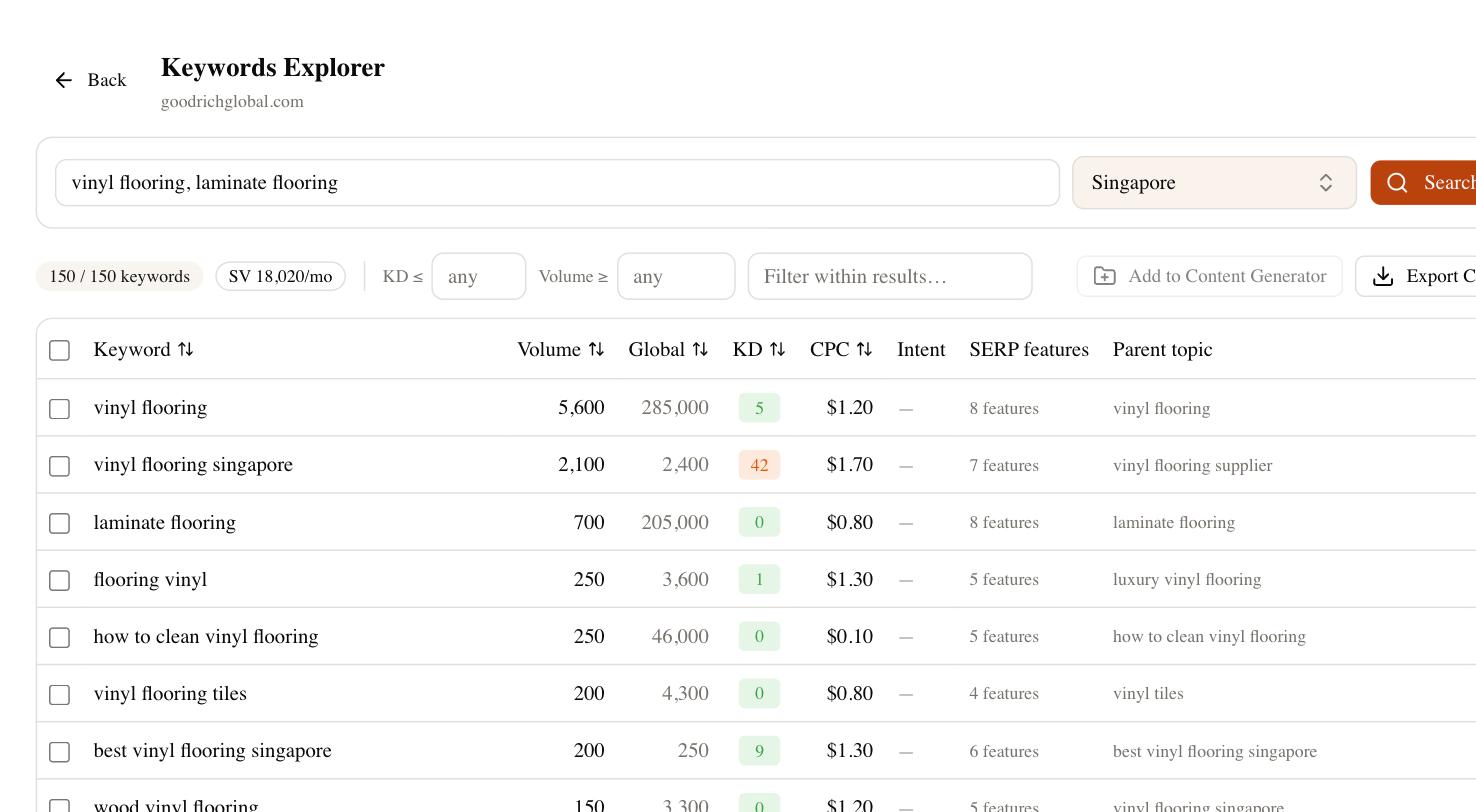
That consolidation is the real saving. A typical stack of a keyword tool plus a separate AI writer plus an AI-visibility tracker collapses into one subscription, and the entry price sits well below a comparable Semrush or Ahrefs plan. For consultants and agencies, you can hand a client a read-only view of their keyword and ranking picture without exporting anything.
It won’t suit everyone. If you live inside a dense dashboard all day and want fifty filters on a keyword export, a traditional tool will feel more familiar than a chat prompt. But if your bottleneck is doing more with fewer tools — which describes most people reading this — the chat-first approach removes the learning curve that keeps most users touching maybe a fifth of what they pay for. That makes it the strongest all-round fit on this list.
Semrush and Ahrefs — the incumbents
Both are excellent, and both charge for it. Semrush’s Keyword Magic Tool is still one of the deepest databases going, with intent tags baked in and a genuine all-in-one suite around it — PPC, content, competitor research, the lot. If your team wants a single login for the whole marketing channel and has the budget, it earns its keep. The catch is the same as ever: entry plans run into the higher tiers, and you’ll pay for a lot of suite you never open if you only want keywords.
Ahrefs comes at it from the link side. Its Keywords Explorer pairs volume with a keyword difficulty score that most SEOs trust more than any rival’s, and the underlying index is large and fresh. It has added AI features, but at heart it’s still a specialist backlink-and-keyword instrument built for a pre-AI-writing workflow. If deep, reliable difficulty data is what you’re paying for, few tools beat it — you’ll just be running a second subscription for the content and AI-search side.
The specialists: Keyword Insights, Surfer, LowFruits, Mangools
Below the two giants sits a row of tools that each do one thing unusually well.
- Keyword Insights — the clustering workhorse. Feed it a messy export of thousands of keywords and it groups them by topic and tags intent faster than you could by hand. If your problem is “I have the keywords, now what,” this is the fix.
- Surfer SEO — the writer’s companion. It turns a target keyword into a content brief and scores your draft against the terms already ranking, so optimization happens as you type rather than after.
- LowFruits — the underdog’s tool. It scans the SERP for weak pages — forums, unoptimized sites — to surface long-tail terms a new site can actually win, and its pay-as-you-go credits suit anyone not ready for a monthly commitment.
- Mangools — the friendly all-rounder. KWFinder remains one of the nicest keyword-research experiences going, and the bundle stays cheap enough for a freelancer running several small sites.
None of these fold AI writing and AI-answer tracking into the same place — that’s not what they’re for. Pair one with a writer if that’s your gap, or pick a tool that already includes it.
How to choose your keyword tool
Match the tool to your real constraint, not to a feature list. If you want research, AI writing, and AI-search visibility in one place at an entry-friendly price, SEO Rocket is the natural move. If you need a full marketing suite and have the budget, Semrush. If reliable keyword difficulty and link data are your world, Ahrefs. If you already have keywords and just need them clustered, Keyword Insights. And if you’re a new site on a shoestring, LowFruits or Mangools will get you further than an expensive suite you barely touch.
Budget deserves an honest word too. Google Keyword Planner is free and still useful for raw volume ranges, and it costs nothing to pair it with a cheap specialist while you find your footing. Don’t buy a top-tier suite for a site that publishes twice a month — the money is better spent on the content itself. Scale your tooling to the work, not the other way around.
A quick test before you commit: write down the three keyword tasks you actually did last week. Most people’s list is some mix of “find terms I can rank for,” “group them into pages,” and “check what a competitor targets.” Run your own site and two rivals through any shortlisted tool for a week and see which answers those three questions fastest. Remember that every volume and difficulty figure is an estimate — treat cross-tool differences as directional, not gospel — and the best tool is simply the one that fits how you actually spend Tuesday.