A year ago, “does ChatGPT mention my brand” was a curiosity. Now it’s a line item, and the best generative engine optimization tools are the ones that answer it with data instead of vibes. Generative engine optimization — GEO — is the practice of getting your brand cited inside AI answers on ChatGPT, Perplexity, Gemini, Copilot, and Google’s AI Overviews, the same way traditional SEO gets you ranked on the blue links.
The problem is that the category is barely two years old, every tool claims to do everything, and the pricing ranges from thirty dollars a month to five figures a year. This roundup cuts through it. Below are the best generative engine optimization tools worth your money in 2026, what each one is genuinely best at, and where an honest recommendation points somewhere other than us.
What generative engine optimization actually measures
Before you buy anything, know what you’re paying to see. A real GEO tool tracks three things: whether your brand gets mentioned when someone asks an AI a buying-intent question, whether you get cited with a link, and how your “share of voice” compares to competitors across those AI surfaces. The good ones also tell you which sources the models pull from — because a huge share of AI citations come from third-party pages like Reddit, review sites, and editorial coverage, not your own domain.
That last point matters. Ranking first on Google no longer guarantees you show up in the AI answer sitting above those results. GEO tools exist to close that gap, and the weaker ones stop at a vanity dashboard while the stronger ones tell you what to fix. Watch for one more thing as you shop: how many engines a tool actually queries, and how often. A monitor that checks ChatGPT once a week gives you a very different picture than one sampling seven engines daily, and the difference shows up in your bill.
How we compared them
Each tool here was judged on four things a working marketer cares about: how many AI engines it actually tracks, whether it just monitors or also helps you act, honest total cost, and who it genuinely fits. We’re not quoting exact plans — pricing in this space changes monthly — so treat the bands as directional. And we tested these as an operator would, on real brands, not from a feature page.
Best generative engine optimization tools at a glance
Start with the table, then read the notes on the two or three that match your budget and team size.
| Tool | Best for | Standout strength | Rough price band |
|---|---|---|---|
| SEO Rocket | Solo SEOs, consultants & small agencies wanting one workflow | Ahrefs-grade SEO data, AI writing & AI-visibility (Brand Radar) in one chat | Low $ / entry-friendly |
| Profound | Enterprise & mid-market marketing teams | Deepest answer-engine analytics, bot-crawl tracking & prompt-volume data | High $$$ / custom |
| Otterly.ai | SMBs & freelancers on a budget | Simple mention & citation tracking across seven AI engines | Low $ |
| Peec AI | Teams & agencies wanting clean benchmarking | Share-of-voice competitor comparison, multi-country tracking | Mid $ |
| Writesonic | Content teams who want to track and fix in one place | Agents that rewrite pages to earn citations, plus outreach | Mid $$ |
| Semrush (AI Toolkit) | Teams already living inside Semrush | AI-visibility bolted onto a full SEO & marketing suite | Higher $$ |
SEO Rocket — the all-in-one pick
SEO Rocket is built for the reality that GEO isn’t a standalone job — it’s one more thing on an already full plate. Instead of a separate login, you ask in plain language and it runs the work: keyword research and competitor gaps on real, Ahrefs-grade data, rank tracking, AI content drafts, and Brand Radar, which shows whether you’re being cited across ChatGPT, Perplexity, and Google’s AI Overviews. The pitch isn’t that any single piece beats a specialist; it’s that you stop paying for and switching between three tools.
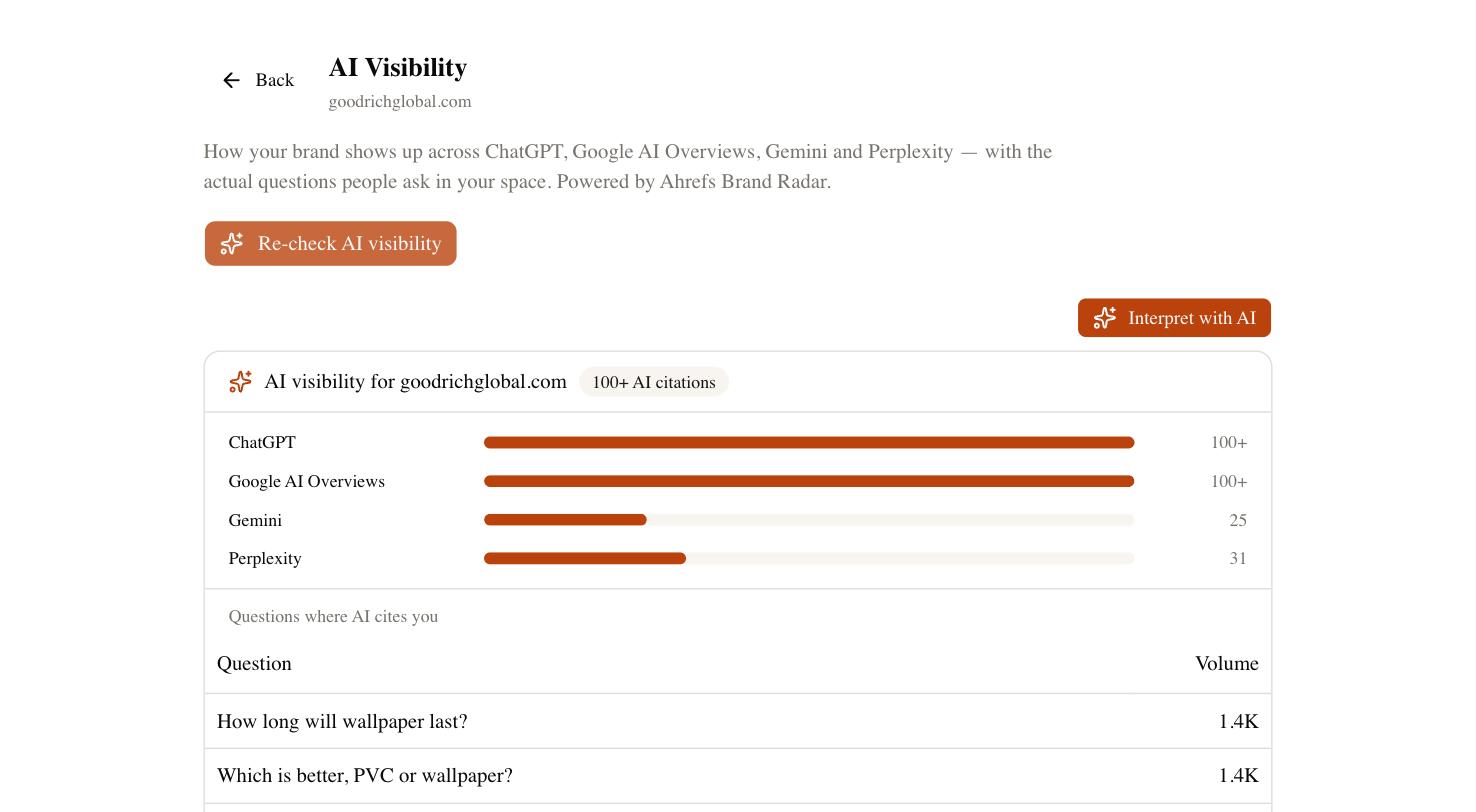
For a consultant or a small agency, that consolidation is the whole point. A typical stack of a backlink tool, an AI writer, and an AI-visibility tracker collapses into one entry-friendly subscription, and because it’s chat-first there’s no dashboard to learn. If your bottleneck is doing more with fewer tools, this is the strongest fit on the list. If you need forensic, enterprise-grade analytics on millions of AI prompts and nothing else, a dedicated platform will go deeper — read on.
Profound — the enterprise GEO platform
Profound is the serious end of the market. It tracks how AI systems represent your brand in conversations, monitors how bots like GPTBot and PerplexityBot crawl your site, and analyzes prompt volumes across millions of real queries so you can align content with actual AI demand. It also runs autonomous agents for AEO tasks and FAQ generation. This is a platform for enterprise and mid-market teams — AEO specialists, demand gen, PR — with the budget and the headcount to use it.
Pricing isn’t public and lands in the demo-and-custom-quote range, which tells you the target buyer. If you’re a large brand where AI visibility is a board-level metric, Profound earns its keep. If you’re a team of one or five, it’s more platform than you’ll use.
Otterly.ai and Peec AI — the focused trackers
Between the all-in-one and the enterprise suite sit two excellent monitors that do one job well.
- Otterly.ai — the budget on-ramp. It tracks brand mentions and citations across seven AI engines, surfaces the prompts people ask in your niche, and scores your pages for AI-readiness. Entry plans sit in the low tens of dollars a month, which makes it the easy first buy for a freelancer or a small business that just wants to see the numbers.
- Peec AI — the benchmarking specialist. Its share-of-voice view against named competitors is one of the cleanest in the category, and multi-country tracking plus CSV, Looker Studio, and API exports make it a natural fit for agencies reporting to clients. Pricing sits in the mid band, quoted in euros.
Neither writes content or fixes your pages — they tell you where you stand and where the gaps are. If monitoring is all you need and you’ll act on the data yourself, either is a smart, affordable choice.
Writesonic and Semrush — execution and the suite play
Two more options round out the list for different needs. Writesonic has pivoted hard into GEO: it tracks visibility across ten-plus AI platforms, then uses agents to rewrite pages with FAQ blocks and self-contained passages, and even drafts outreach to earn third-party citations. It measures lift at day 14 and 28, so you can see whether the fixes worked. It sits in a mid price band and suits content teams that want tracking and doing in the same tool.
Semrush, meanwhile, has folded AI-visibility into its AI Toolkit. It won’t be the deepest GEO instrument you can buy, but if your team already runs its keyword research, backlinks, and audits inside Semrush, adding AI tracking to an existing login beats onboarding a new vendor. Expect the higher pricing that comes with a full suite — you’re paying for breadth, not GEO depth.
How to choose the right GEO tool
Match the tool to your constraint, not to the longest feature list. If your problem is tool-sprawl and you want SEO data, AI writing, and AI-search tracking in one place, SEO Rocket is the natural move. If AI visibility is an enterprise metric with a budget to match, Profound goes deepest. If you just want to watch the numbers cheaply, Otterly or Peec AI do it well, and if you want to fix pages as you track them, Writesonic covers both. Already on Semrush? Start with its toolkit before adding anything.
One more piece of honest advice: don’t buy a tool to fix a problem you haven’t confirmed you have. Most of these platforms offer a free report or trial, so run yours before you commit. If the AI engines already cite you fairly across your buying-intent prompts, a cheap monitor to keep an eye on it is plenty; if you’re invisible, that’s when the tracking-plus-fixing tools start paying for themselves.
Whatever you pick, give it a few weeks before you judge it. AI answers are noisier than search rankings — the same prompt can cite you today and skip you tomorrow — so you’re looking for a trend, not a single reading. Run your own brand and two competitors through a shortlist for a month, and buy the one that answers your real question fastest: when a buyer asks an AI about your category, do you show up?