
This Byword review is written for anyone deciding whether a bulk AI article writer earns a place in their SEO stack. Byword has picked up a genuine following among programmatic-SEO operators and niche-site owners, and this Byword review covers what it does well, where it quietly falls short, and the kind of person it actually suits.
Byword positions itself plainly: an AI article writer for SEO at scale. You feed it titles or keywords, it produces long-form drafts, and it will push them straight to your site if you let it. That focus is the whole story here — it is a content engine, not a research suite, and judging it as anything else is unfair to both sides.
What Byword actually is
At its core, Byword turns a list into a pile of articles. You can write one piece at a time, but almost nobody buys it for that. The draw is bulk mode: upload a CSV of titles, or a spreadsheet of keywords and variables, and generate dozens or hundreds of drafts in a single run. For programmatic plays — location pages, comparison pages, long-tail informational content — that throughput is the point.
The output is competent AI long-form: a sensible heading structure, an intro, body sections, a short conclusion. It handles multiple languages, can insert images, and connects to common platforms so publishing is one click rather than a copy-paste marathon. It is fast, and the drafts read better than the auto-generated junk of a few years ago.
What Byword does well
Speed and volume are the honest strengths. If your bottleneck is producing 200 supporting pages for a topical cluster, Byword removes that bottleneck in an afternoon. The bulk workflow is well thought out — you are not babysitting a chat window for each article, and the CSV-to-published-post pipeline is smoother than stitching a general writing tool to a separate publishing plugin.
The publishing integrations matter more than they sound. Auto-posting to WordPress, Webflow, and similar platforms, with images and basic internal links added on the way out, saves the tedious last mile that usually eats an hour per batch. For someone running several sites, that operational polish is a real time-saver and a fair reason the tool has fans.
Where Byword falls short
The first limit is scope. Byword writes; it does not tell you what to write. There is no backlink index, no rank tracking, no serious keyword database of its own — you bring the strategy and the keyword list, and it fills them in. That is fine if you already have a research tool, but it means Byword is one instrument in a stack, not the stack.
The second limit is the risk that comes with scale. Mass-produced AI content sits directly in the path of Google’s scaled-content-abuse and site-reputation policies. Byword is not doing anything against the rules by generating drafts, but publishing hundreds of thin, unedited pages is a well-documented way to get a site flattened in a core update. The tool gives you the throttle; it does not give you the judgment to know when to ease off.
Third, the drafts still need a human. They are good for AI, but they lean generic, occasionally pad, and rarely bring the specific numbers, first-hand detail, or point of view that make content actually rank and convert now. Ship them raw at volume and you are betting your domain on Google not noticing.
Byword at a glance
Here is the honest pros-and-cons view before you weigh the price.
| Pros | Cons |
|---|---|
| Genuine bulk generation — hundreds of drafts per run | No keyword, backlink, or rank-tracking data of its own |
| Smooth CSV-to-published-post pipeline | Bulk output invites scaled-content and quality risk |
| One-click publishing to WordPress, Webflow and more | Drafts still need real editing to compete |
| Multilingual, with images and basic internal links | Writes content but not strategy — you supply both |
| Fast, purpose-built for programmatic SEO | Priced per volume; costs climb as output grows |
Rough price band and value
Byword sits in the mid content-tool bracket — entry plans land roughly in the low-hundreds-a-month range, with tiers scaling by how many articles you generate. That is reasonable for the throughput if you genuinely publish at volume, and expensive if you were hoping it would replace a full SEO subscription. It will not; it does one job.
Judge the value by output, not by the headline number. If you are producing a few articles a week, a general-purpose writer or a broader SEO platform with writing built in is better economics. If you are standing up a 500-page programmatic site, Byword’s per-article cost is where it starts to make sense — provided you have an editing plan to go with it.
Who Byword is for
Byword suits programmatic-SEO builders, niche and affiliate site owners, and small agencies that already own their keyword research and just need a fast, reliable draft-and-publish engine. If that is you, and you have the discipline to edit and to not carpet-bomb your domain, it is a legitimately useful tool that does what it claims.
It is a poor fit if you want one place to research, write, track rankings, and see whether AI search engines cite you. It is also wrong for anyone hoping a tool will supply the SEO judgment — Byword assumes you already have it, and hands you a very fast trigger.
The AI-native alternative
The gap in a writer-only tool is that content lives apart from data and measurement. SEO Rocket takes the other approach: it is chat-first, so you ask for keyword research, competitor gaps, backlinks, and rank tracking in plain language on Ahrefs-grade data, and the same tool drafts the article with Claude — then shows whether you are being cited in ChatGPT, Perplexity, and AI Overviews through its Brand Radar view.
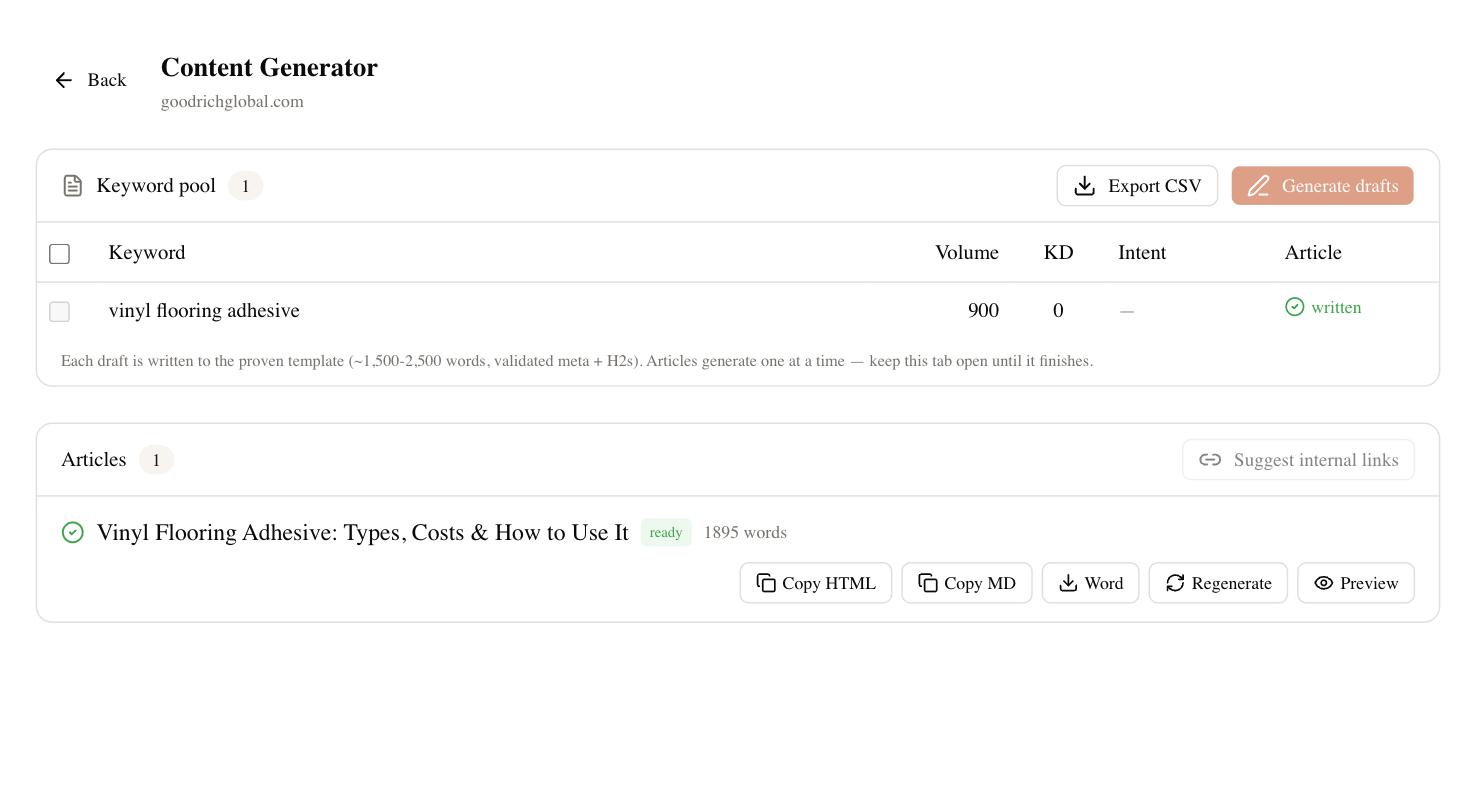
The practical difference is that the writing is informed by the data, in one workflow, instead of pasted keywords going into a separate engine. For a solo SEO or a lean agency that wants strategy, drafting, and AI-search visibility connected rather than bolted together, that consolidation is the stronger fit. If your only need is raw bulk output and you already run a research stack, Byword remains the more specialized pick — the honest choice depends on whether your bottleneck is volume or the whole workflow.
The verdict
Byword is a good tool being honest about what it is: a fast, focused bulk article writer for people running SEO at scale. It earns its keep for programmatic builders who already have keywords in hand and the discipline to edit before publishing. It is not a full SEO platform, it will not decide your strategy, and used carelessly at volume it can put a site at real risk in a core update. Buy it for the job it does — throughput — and pair it with your own research and a human editor. Ask it to be your whole SEO operation and it will disappoint, because it never claimed to be one.