
If you’re weighing Claude vs ChatGPT for SEO, start with the uncomfortable truth: neither one is an SEO tool. Both are general-purpose AI assistants that happen to be very good at the writing and thinking parts of the job, and neither knows your real keyword volumes, your rankings, or your backlink profile unless you feed that data in. The question of Claude vs ChatGPT for SEO is really a question about which assistant fits which part of your workflow — so let’s compare them on the dimensions that actually change your output.
This is a fair fight. Claude, from Anthropic, and ChatGPT, from OpenAI, are the two most capable chat models most SEOs will ever touch. They overlap heavily, they cost about the same at the consumer tier, and the honest verdict is that the winner depends on the task in front of you. Here’s where each one pulls ahead.
What each tool actually is
Claude is a conversational AI built around long-context reasoning and natural writing. It handles very large documents in a single prompt, keeps a consistent voice across a long draft, and tends to produce prose that reads less obviously “AI.” ChatGPT is the broader platform: a family of models wrapped in a bigger ecosystem — image generation, data analysis, web browsing, and custom GPTs you or others can build for specific jobs, including SEO-flavored ones.
Both offer a free tier and a paid consumer plan in the roughly $20-a-month band, with higher power-user and team tiers stacked above that. For SEO work you’ll want a paid plan on either — the free models are capable but rate-limited and usually a generation behind. The practical difference isn’t the price, which is close to identical; it’s what each platform wraps around the model and how the raw output reads once you paste it into a CMS.
Claude vs ChatGPT for SEO at a glance
Read the table, then check the segment verdicts below for the two or three rows that matter to your week.
| Dimension | Claude | ChatGPT |
|---|---|---|
| Long-form writing feel | More natural, editor-ready prose | Capable, sometimes more formulaic |
| Context window | Very large — full drafts and briefs at once | Large, varies by model |
| Research & browsing | Web search available | Broad browsing, plus a deep-research mode |
| Ecosystem | Focused: chat, projects, artifacts | Wide: custom GPTs, images, data analysis |
| Structured / bulk output | Strong at clean, on-brief structure | Strong, especially with data files |
| Real SEO data (volume, SERP, links) | None built in | None built in |
| Consumer price band | ~$20/mo tier | ~$20/mo tier |
Writing quality: Claude takes it
For drafting articles, briefs, and meta copy, Claude usually needs less editing. It holds a brand voice across 2,000 words without drifting into the stock “in today’s fast-paced world” register, and it follows a detailed outline closely instead of padding. If your bottleneck is turning a keyword brief into a publish-ready first draft, Claude is the one I reach for. That’s not a knock on ChatGPT — it writes well — but Claude’s default prose tends to survive a human edit with fewer red pens.
The catch applies to both: neither model can be trusted on facts, statistics, or citations. They will produce a confident, wrong number as happily as a right one. Anything a reader could fact-check — data points, quotes, study results — you verify yourself before it goes near a live page. This matters more for SEO than for most writing, because a single fabricated stat is exactly the kind of thing that erodes the E-E-A-T signals you’re trying to build, and it’s your name on the byline, not the model’s.
Research and ecosystem: ChatGPT pulls ahead
When the task is exploration rather than final prose, ChatGPT’s breadth wins. Its browsing and deep-research modes are genuinely useful for scoping a topic, and custom GPTs let you package a repeatable workflow — a brief generator, a schema builder, an internal-link planner — that teammates can reuse. The data-analysis feature also means you can drop a CSV of your own keyword export in and have it clustered or summarized on the spot.
If your work leans toward ideation, competitive scanning, and building small reusable tools around your process, ChatGPT is the more flexible home base. Many SEOs happily keep both open and switch by task — Claude for the draft, ChatGPT for the research and the odd image. There’s no rule that says you have to pick one, and at consumer pricing running both costs less than a single seat on most dedicated SEO suites.
The gap neither one closes
Here’s what the whole Claude vs ChatGPT debate misses for SEO specifically: both tools are blind to the data that decides whether your work ranks. Ask either for search volume, keyword difficulty, or who links to a competitor and you’ll get an estimate that sounds authoritative and is effectively made up. They don’t have a live index. They can’t tell you your current position, they can’t see the real SERP, and they can’t show you whether ChatGPT itself is citing your brand in its answers.
So the realistic setup is a stack: one of these assistants for writing, a separate SEO platform for the data, and increasingly a third tool to track AI-search visibility. That works — it’s just three subscriptions, three logins, and a lot of copy-pasting between windows.
SEO Rocket — the AI-native option
SEO Rocket collapses that stack. It’s a chat-first SEO tool that uses Claude for the writing you’d otherwise do in a raw chat window, but wires it to real, Ahrefs-grade data underneath — genuine keyword volumes, competitor gaps, backlink profiles, and rank tracking — so the draft is grounded in numbers instead of guesses. You ask in plain language, the same way you’d prompt ChatGPT, and it runs the actual lookup before it writes.
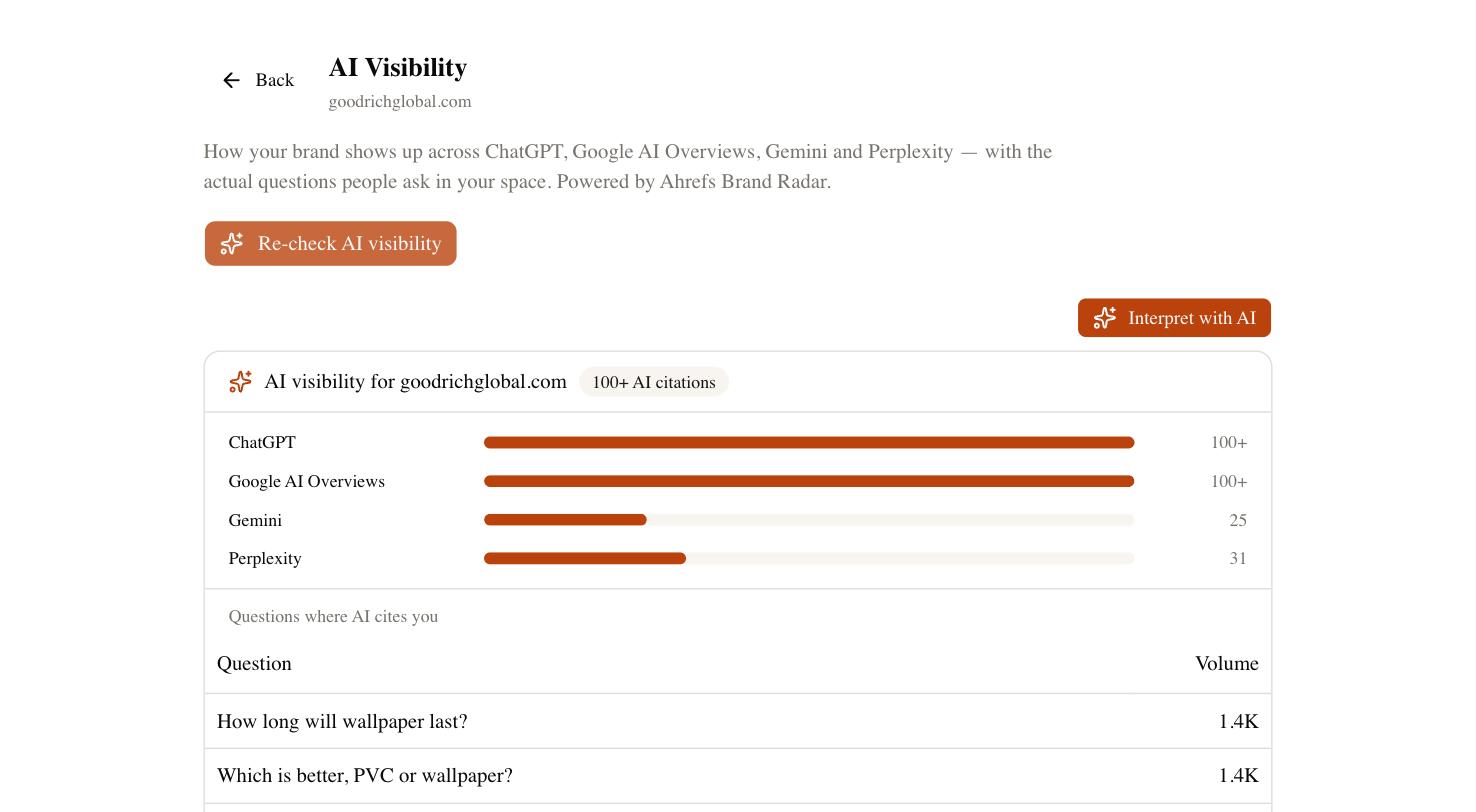
It also answers the question neither general assistant can: is anyone’s AI actually mentioning you? Brand Radar tracks whether your brand shows up in ChatGPT, Perplexity, and Google’s AI Overviews, so you’re optimizing for the search that’s happening now, not just the ten blue links. For a solo SEO or an agency, folding writing, real data, and AI-visibility into one workflow at an entry-friendly price usually beats renting three tools that don’t talk to each other.
So which should you use?
If you only take one general assistant, pick by your dominant task. Choose Claude when drafting and editing long-form content is most of your day and you want the cleanest first draft. Choose ChatGPT when research, ideation, image generation, and building repeatable custom workflows matter more, or when you’re already living in its ecosystem. Plenty of people run both — they’re cheap enough at the consumer tier that the switching cost is a browser tab, not a budget line.
But be clear-eyed about what you’re buying: a brilliant writer with no idea whether the page will rank. If your real goal is content that performs — grounded in live keyword and SERP data, tracked for position, and monitored for AI-search citations — a purpose-built tool like SEO Rocket does the job a raw chat window structurally can’t. Use the assistant that fits your writing style; use a real SEO platform for the parts that decide whether the writing was worth doing.