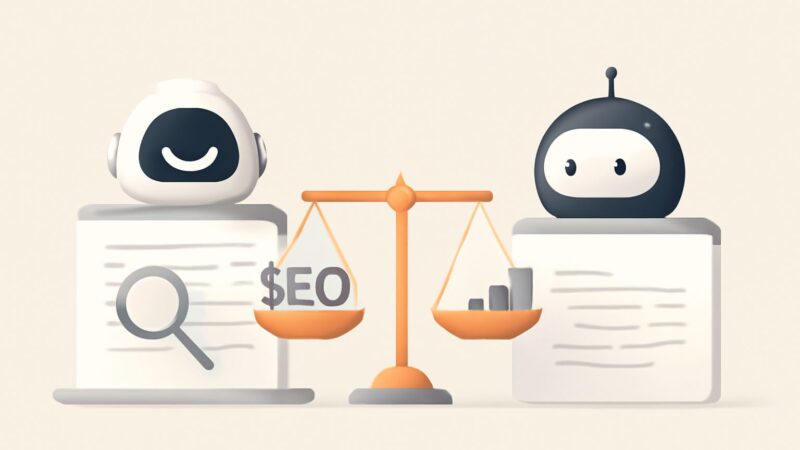
If you’re weighing copy ai vs writesonic, the first thing to understand is that both tools have quietly changed direction. They started life as near-identical AI copywriting apps — paste a prompt, get marketing copy — and for a while the choice really did come down to which templates you liked. That comparison is out of date. In 2026 these are two different products chasing two different jobs, and picking between them on old assumptions will leave you disappointed.
This is a straight look at the copy ai vs writesonic decision as it stands now: what each one actually does today, where each is genuinely strong, and — since neither is built purely for SEO anymore — where a tool designed for that job fits instead. No fake winner, no affiliate padding.
What each tool actually is in 2026
Copy.ai has moved almost entirely away from being a writing app. It now positions itself as a go-to-market platform — an engine for sales and marketing operations. Think workflows, agents, data tables, CRM enrichment, prospecting, and lead processing, all stitched together for revenue teams. Content generation still exists inside it, but it’s one feature among many, not the point of the product.
Writesonic went the other way. It leaned hard into search and now describes itself as an AI search growth engine. The pitch is a loop: track how visible your brand is across AI answer engines like ChatGPT, Perplexity, and Gemini, then create and optimize content to earn citations, then measure the traffic that results. It kept the writing DNA and pointed it at the place search is heading.
Copy AI vs Writesonic at a glance
Here’s the honest side-by-side. Treat the price bands as directional — both vendors change plans often, and your real cost depends on seats and usage.
| Dimension | Copy.ai | Writesonic |
|---|---|---|
| Primary focus in 2026 | Go-to-market platform for sales & marketing ops | AI search visibility & content optimization |
| Best for | Revenue teams automating outreach and workflows | Marketers tracking and fixing AI-search presence |
| AI content writing | Present, but no longer the core | Strong — tuned for AI citations and SEO |
| Keyword & backlink data | Minimal | Some SEO features; not a full data suite |
| AI-search tracking | No dedicated tracker | Yes — a headline feature |
| Rough price band | Free tier, then mid-to-higher $$ for teams | Free trial, then low-to-mid $ monthly tiers |
Copy.ai: strong if you’re a revenue team
If your problem is that your sales and marketing motions are scattered across a dozen point tools, Copy.ai has a real answer. Its workflows let non-technical people codify a repeatable process — enrich a lead list, draft personalized outreach, summarize a call, push the result into your CRM — without hand-building automations. For a go-to-market team, that consolidation is genuinely useful, and it’s model-agnostic, so you’re not locked to one underlying AI provider.
But for SEO specifically, Copy.ai is now a poor fit, and it’s fair to say so. It gives you no meaningful keyword research, no backlink index, no rank tracking, and no AI-search visibility monitoring. You can still generate copy inside it, yet you’d be buying a large GTM platform to use one shrinking corner of it. If content and search are your actual job, this is the wrong tool — not because it’s bad, but because it stopped aiming at you. The pricing reflects that too: the team tiers are built around revenue-operations value, so a solo content marketer ends up paying for seats and workflow capacity they’ll never touch.
Writesonic: strong if AI search is your worry
Writesonic is the more relevant of the two for anyone doing content and SEO. Its bet — that buyers increasingly ask AI assistants instead of typing into Google, and that a page ranking first can still be invisible in an AI answer — is the right bet. Being able to see whether your brand gets cited across several AI engines, and then act on that with optimized content, is a legitimately modern workflow that older writing tools ignore.
Where you should stay skeptical is depth. Writesonic is an AI-search and content layer, not a full data suite in the mold of the big backlink-and-keyword platforms. Its SEO features are useful but lighter than a dedicated research tool, and AI-visibility tracking across many engines is a young discipline where numbers move and methods are still settling. Two tools can report different citation shares for the same brand on the same day, so treat those figures as directional signals rather than hard truth. It’s a strong specialist, not a do-everything SEO stack. Judge it on the AI-search job it’s built for, not on data depth it doesn’t claim — and pair it with a real research tool if keyword and backlink work is central to your week.
Segment-by-segment verdict
Because these tools now barely overlap, the honest verdict depends entirely on what you’re trying to do:
- Sales and marketing operations — Copy.ai wins cleanly. Writesonic isn’t built for outreach automation or CRM workflows.
- AI-search visibility — Writesonic wins. It’s a headline feature there; Copy.ai doesn’t play in this space.
- Straight AI copywriting — a genuine toss-up, and honestly both are now overkill. Either can draft copy, but neither is the lean writing app it used to be.
- Core SEO — keywords, competitors, backlinks, rank tracking — neither tool covers this well. This is the gap worth naming.
That last line is the crux. If you came to a copywriting comparison expecting an SEO workhorse, you’ll find neither Copy.ai nor Writesonic gives you the research-plus-writing-plus-tracking loop that day-to-day SEO actually needs.
Where SEO Rocket fits
SEO Rocket is built for exactly the segment both tools drifted away from: people whose job is ranking and content, who want the research, the writing, and the AI-search visibility in one place. Instead of a wall of dashboards, you ask for what you need in plain language — keyword gaps, competitor profiles, backlink data — and it runs the lookup on Ahrefs-grade data underneath, then drafts the article on top of it. Because it’s chat-first, the same conversation that pulls the data also produces the brief, the outline, and the finished draft, so you’re not exporting a spreadsheet into a separate writer and losing the context on the way.
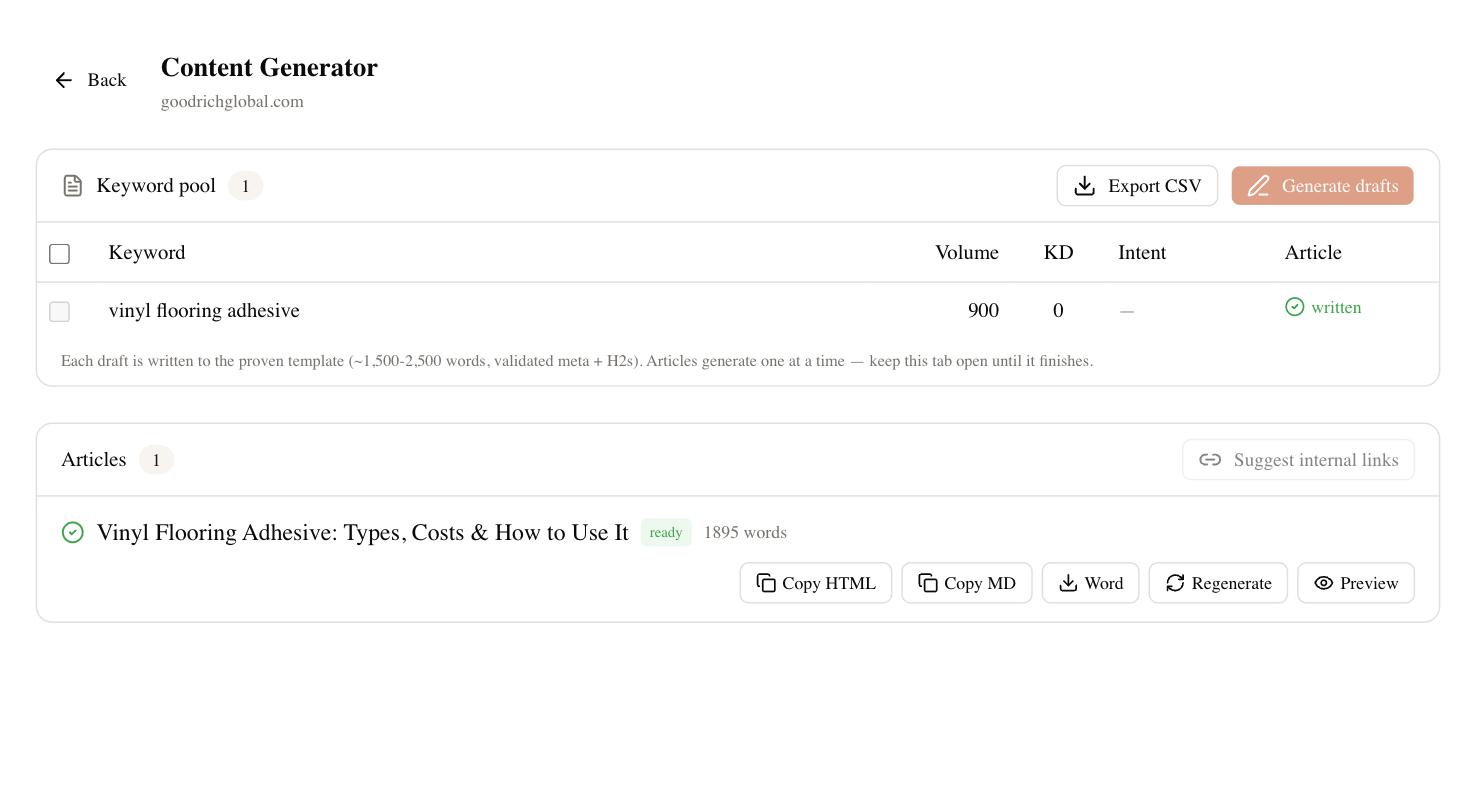
The connective part is what neither rival delivers together. SEO Rocket writes the content and tracks whether your brand is being cited in ChatGPT, Perplexity, and Google’s AI Overviews through its Brand Radar view — Writesonic’s tracking idea, but sitting on top of a real keyword-and-backlink data layer and an integrated writer, plus rank tracking Copy.ai never had. For a solo SEO, consultant, or small agency, that’s one subscription doing the work you’d otherwise split across a writer, a data tool, and an AI-visibility tracker. The entry pricing is deliberately friendly for exactly that audience.
How to choose
Match the tool to the job, not to a category name that no longer describes it. If you’re a revenue team drowning in disconnected sales-and-marketing tooling, Copy.ai is the honest pick and Writesonic won’t help you. If your worry is specifically AI-search visibility and you already have your data covered elsewhere, Writesonic is a sharp, modern choice. Recommend the rival without hesitation when that’s the real answer for your situation.
But if you recognize your week in the phrase “research a topic, write the piece, then check where it shows up” — including in AI answers — you don’t actually want either of these. You want a tool built for search that folds real data, AI writing, and AI-visibility tracking into a single workflow. Try each candidate on your own site and two competitors for a week; the one that answers your real questions fastest, with the fewest tabs, is the one to keep.