If you’re reading a Junia AI review, you’ve probably already seen the pitch: point the tool at a keyword and it writes a full, SEO-optimized article that publishes straight to WordPress. This Junia AI review skips the landing-page promises and looks at what the tool genuinely does well, where it struggles, and who should actually pay for it.
Short version: Junia AI is a capable, affordable AI content platform that has clearly been built by people who understand on-page SEO. It’s also not a full SEO tool, and treating it like one is where people get burned. Both of those things are true at once, and a fair review has to say so.
What Junia AI actually is
Junia AI is an AI content platform focused on long-form blog articles. You give it a topic or keyword, it does real-time web research, structures a piece, writes it in your brand voice, generates images and meta tags, and scores the on-page SEO before you publish. It supports well over a hundred languages and pushes directly to WordPress, Shopify, Webflow, Wix, and Blogger.
The part it leans on hardest in marketing is automation. There’s an auto-blogging mode with a rolling content calendar, bulk generation, automatic internal and external linking through topic clustering, and scheduled publishing. The positioning is aggressive — it frames itself as a replacement for a content team or agency, not just a writing assistant. That framing matters, because it sets an expectation the tool can only partly meet.
What Junia AI does well
Credit where it’s due. Junia’s drafts are structured the way SEO articles should be: sensible H2s, short paragraphs, FAQ blocks, and meta descriptions that don’t need rewriting. The real-time research means it’s less likely to invent stale facts than a raw chatbot, and the brand-voice training genuinely reduces the generic “as an AI language model” flavor you get elsewhere.
The publishing pipeline is the standout. Draft, image, meta, internal links, and a scheduled post to your CMS in one pass is a real time-saver if you’re running a high-volume blog. For a solo founder or a small team that needs to go from zero to a few dozen indexed articles quickly, that end-to-end flow is the whole value, and it delivers on it.
Where Junia AI falls short
Now the honest part. Junia scores your content against on-page heuristics — keyword coverage, structure, readability. That is not the same as knowing whether a keyword is winnable. It has no real backlink index, no keyword-difficulty data drawn from a live crawl, and no rank tracking. So it can hand you a beautifully optimized article targeting a term you have no realistic chance of ranking for, and nothing in the product will warn you.
The second issue is the one every AI content tool shares: volume is a trap. Auto-publishing 68 articles a month feels productive, but Google has spent two years tightening the screws on unhelpful, mass-produced content. Thin AI articles at scale can suppress a whole domain, not just the weak pages. Junia’s output is above average, but it still needs a human to fact-check claims, add genuine experience, and decide what not to publish. Used as a fully hands-off content faucet, it’s a liability.
Finally, the credit model. Plans are metered by article count and words, and heavy months mean buying extra word credits or waiting for the reset. That’s fine — it’s just worth knowing the headline price isn’t the ceiling.
Junia AI vs a data-backed workflow
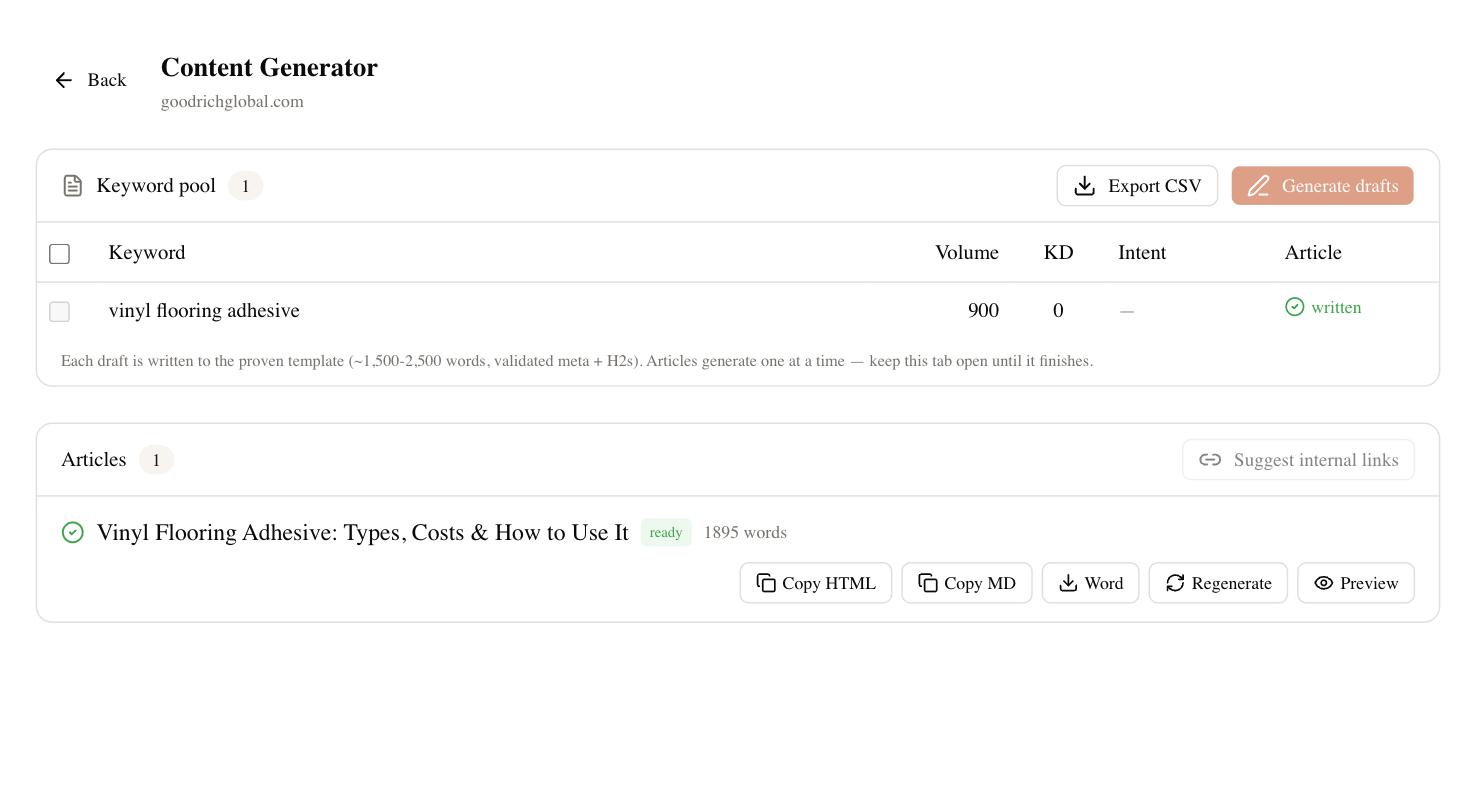
The clearest way to place Junia is against a tool that pairs writing with real SEO data. Junia is a content engine; something like SEO Rocket is an AI-native SEO platform where the writing sits on top of Ahrefs-grade data, rank tracking, and AI-search visibility. Here’s the honest split.
| Capability | Junia AI | SEO Rocket |
|---|---|---|
| AI long-form writing | Yes — strong, structured drafts | Yes — Claude-based, data-informed |
| Auto-publish to CMS | Yes — many platforms, scheduling | Export-focused |
| Real keyword difficulty & volume | No — on-page scoring only | Yes — Ahrefs-grade data |
| Backlink data | No | Yes |
| Rank tracking | No | Yes |
| AI-search visibility (ChatGPT, Perplexity) | Optimizes for it, doesn’t measure it | Yes — Brand Radar tracking |
| Best at | Fast, high-volume content publishing | Deciding what to write, then writing it |
| Rough price band | Low $ — entry-friendly | Low $ — entry-friendly |
The point isn’t that one wins. It’s that they solve different halves of the problem. Junia is excellent at producing content. It’s not built to tell you whether that content targets the right thing.
What it costs
Junia sits at the affordable end of the market. Entry pricing lands in the low tens of dollars a month for a modest article allowance, and the higher tier — still cheap by SEO-tool standards — unlocks bulk generation, auto-blogging, unlimited sites, and API access. Yearly plans carry the usual steep discount, and extra words are a small pay-as-you-go add-on. Treat those numbers as a band, not a quote; AI-tool pricing changes often, so check the current page before you commit.
Against a content agency, it’s a rounding error. Against other AI writers, it’s competitive rather than cheapest. The value question isn’t the price — it’s whether cheap content you still have to edit and fact-check is cheaper than fewer, better pieces aimed at winnable keywords.
Who Junia AI is for
Junia is a good fit if you already know your keyword strategy and your bottleneck is production. Solo founders, affiliate and niche-site owners, and small agencies pushing volume for clients will get real mileage from the publishing pipeline. If you have a list of terms you know you can rank for and you just need drafts out the door with images and meta attached, this is a sensible, low-cost buy.
It’s the wrong tool if your problem is deciding what to write. If you don’t yet know which keywords are realistic, whether a competitor already owns the topic, or whether your site is even being cited in AI answers, an AI writer alone will happily help you produce the wrong thing efficiently. That’s the gap a data-backed platform fills — and where SEO Rocket folds the research, the writing, and AI-search tracking into one workflow instead of leaving you to guess.
The honest verdict
Junia AI is one of the better AI SEO writers, and the price makes it easy to try. The drafts are clean, the CMS automation is genuinely useful, and for high-volume publishing it earns its keep. Just don’t mistake a fast writer for a complete SEO strategy. Pair it with real keyword and competitor data, keep a human in the loop on facts and quality, and never treat auto-publish as fire-and-forget.
Here’s the test I’d run: take three keywords you’re planning to target and check whether you can actually rank for them before you generate a single word. If your current stack can’t answer that, the missing piece isn’t a better writer — it’s the data underneath it. Get that half right, and a tool like Junia becomes a real asset instead of an expensive way to publish content nobody finds.