If you are weighing Sitebulb vs SEO Rocket, the first thing to say plainly is that these two tools were built to solve different halves of the same job. Sitebulb vs SEO Rocket is not a straight feature-for-feature fight where one wins on points — Sitebulb is a specialist technical crawler with genuinely excellent auditing depth, and SEO Rocket is an AI-native workflow that covers research, writing, and AI-search visibility in one chat window. Pick the wrong frame and you will end up disappointed by whichever one you buy.
This comparison leads with Sitebulb on purpose, because it is the stronger tool at the thing it was designed for, and pretending otherwise would waste your time. What follows is where Sitebulb genuinely wins, where SEO Rocket makes its case, and which one fits the way you actually work.
What Sitebulb does better
Sitebulb is a purpose-built site crawler, and technical auditing is its whole reason to exist. Point it at a domain and it renders a full crawl with a level of detail most all-in-one tools never reach: crawl maps that show your site’s link architecture visually, a hint system that explains not just what is wrong but why it matters and how to fix it, and prioritization that separates the critical issues from the cosmetic ones. For a technical SEO doing a deep audit, that depth is the product.
It also handles the awkward parts of crawling well. JavaScript rendering, log-file-style crawl comparison between audits, internal link scoring, and granular control over how the crawler behaves are all mature here. If your work is diagnosing why a large or complicated site is not being indexed properly, Sitebulb gives you more raw technical signal than a generalist platform will, and it presents that signal in a way that helps you build a prioritized fix list. Honest verdict: for pure technical crawl auditing, Sitebulb is the stronger tool, and I would not try to argue you out of it.
Where SEO Rocket is a different animal
SEO Rocket is not trying to out-crawl Sitebulb. It is built around a different bottleneck — the fact that most SEOs and agencies now juggle four or five tools to get through a week. Instead of a desktop crawler, it gives you a chat-first interface: you ask for keyword research, a competitor content gap, a backlink profile, or rank tracking in plain language, and it runs the lookup on real, Ahrefs-grade data underneath. That covers a set of jobs Sitebulb was never designed to do at all.
The two products barely overlap on features. Sitebulb does not do keyword research, backlink analysis, or rank tracking as a core function, and it does not write content or track AI-search visibility. SEO Rocket does all of those, but its site audit is a health check rather than a forensic crawl. So the real question in Sitebulb vs SEO Rocket is not “which is better” — it is “which half of the job is your bottleneck.” Once you frame it that way, the choice usually makes itself.
Sitebulb vs SEO Rocket at a glance
Here is the honest side-by-side. Read it as a map of where each tool concentrates, not a scoreboard.
| Capability | Sitebulb | SEO Rocket |
|---|---|---|
| Technical crawl audit | Deep — crawl maps, hints, prioritization | Health-check level |
| Keyword research | No | Yes — Ahrefs-grade |
| Backlink analysis | No | Yes |
| Rank tracking | No | Yes |
| Competitor content gap | No | Yes |
| AI content writing | No | Yes — built in |
| AI-search visibility | No | Yes — Brand Radar |
| Interface | Desktop / cloud crawler | Chat-first |
| Client dashboards | Reporting exports | Read-only client dashboards |
| Rough price band | Mid $$ | Low $ / entry-friendly |
SEO Rocket’s AI-native case
The argument for SEO Rocket comes down to consolidation and where search is heading. On the consolidation side, a common stack is a crawler for audits, a separate keyword-and-backlink tool, an AI writer, and something to check whether ChatGPT ever cites you. SEO Rocket folds the research, writing, and visibility layers into one subscription, and because it is chat-first there is almost no learning curve — you type what you want instead of hunting through menus. For a solo consultant or a small agency, that is the difference between a Tuesday spent switching tabs and a Tuesday spent doing the work.
The part no traditional crawler answers is AI-search visibility. Search is splitting — some of your buyers now ask ChatGPT, Perplexity, or Google’s AI Overviews instead of typing a query and scrolling. A page that ranks first can still be invisible in an AI answer. SEO Rocket’s Brand Radar tracks whether and where you are being cited across those surfaces, so you are optimizing for the search that is actually happening. Sitebulb, brilliant as it is at crawling, has nothing in this lane because it was never meant to.
The site audit question
This is the honest tension in the comparison. SEO Rocket does run a site audit — it surfaces a health score and flags the on-page and technical issues that matter for most sites — but it is not a forensic crawler in Sitebulb’s league. If you are auditing a straightforward business site, a set of client sites, or your own portfolio, SEO Rocket’s audit will catch the issues that actually move rankings and hand you a fix list without exporting anything.
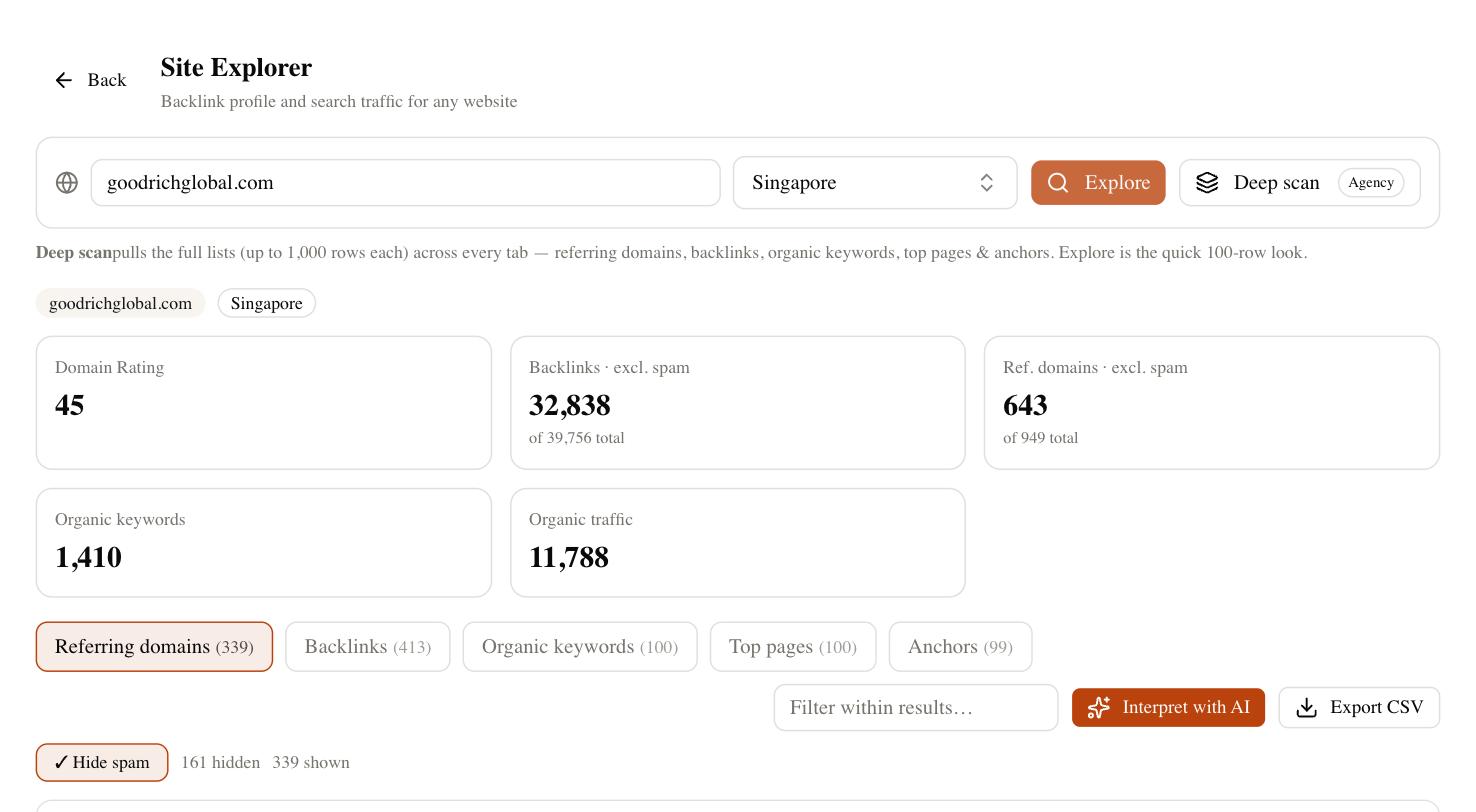
Where it stops short is the deep end. If you need to compare two crawls after a migration, trace a rendering problem on a million-URL site, or produce a 40-page technical audit for an enterprise dev team, Sitebulb’s dedicated crawler goes further than SEO Rocket’s health check. That is not a knock on SEO Rocket — it is a different depth of tool for a different depth of problem, and buying the wrong one for your situation is the most common mistake here.
Pricing and who each suits
On cost, the two sit in different bands. Sitebulb runs in a mid monthly range, priced as the specialist auditing tool it is. SEO Rocket is entry-friendly at the low end, which reflects that it is replacing a stack rather than adding one more line item to it. Neither is expensive by enterprise standards, and price alone should not decide this — the fit does.
Buy Sitebulb if technical auditing is the core of your work: you are a technical SEO, you run deep crawls regularly, and the crawl maps and hint system are the value. Buy SEO Rocket if your week is keyword research, competitor analysis, content production, and proving AI-search visibility to clients, and you want it in one chat-driven place. Plenty of agencies will honestly want both — Sitebulb for the heavy technical audits, SEO Rocket for everything else — and there is no shame in running the two side by side.
How to choose between them
Write down the three things you actually did in an SEO tool last week. If the list is dominated by crawl audits, indexation debugging, and technical fix lists for developers, Sitebulb is the tool that matches how you spend your time, and the crawl depth will earn its price. If instead your week was researching keywords, checking what competitors rank for, drafting content, and reporting to clients, that is squarely SEO Rocket’s workflow, and a specialist crawler would leave most of your job uncovered.
Whichever you lean toward, try it on your own real work before deciding, and give it a full cycle — a crawler proves itself on one deep audit, an AI workflow proves itself across a week of mixed tasks. The Sitebulb vs SEO Rocket decision is genuinely a fork in the road, not a ranking, so match the tool to your actual bottleneck and the right answer will be obvious.