Most people who ask about crawl depth are counting the wrong thing. They open a URL like /shop/mens/shoes/running/product-482, count four slashes, and conclude the page is “four levels deep.” That’s URL path depth, and Google barely cares about it. Click depth means something else entirely: the number of clicks it takes to reach a page from your homepage along the shortest available link path. A product with a short URL can be twelve clicks deep, and a page with a long, ugly URL can be one click from home. That distinction is the whole game, because the click distance — not the slug — is what quietly decides which of your pages Google crawls often, indexes at all, and treats as important.
What Click Depth Actually Measures
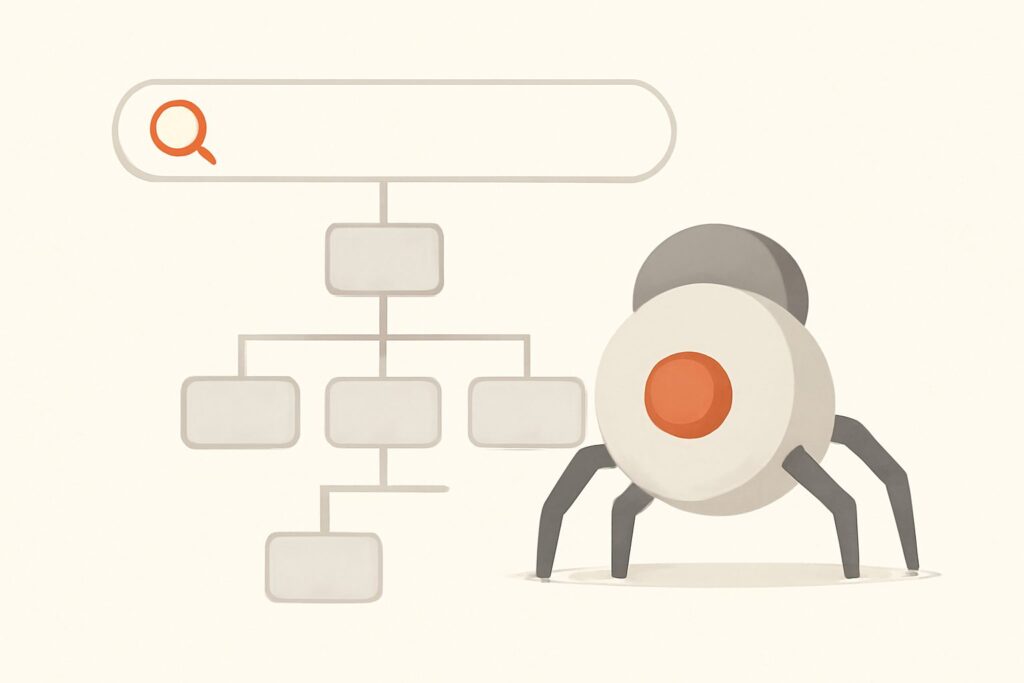
Crawl depth is the shortest click path from a starting point — almost always the homepage — to a given URL. Home is depth 0. Anything linked directly from the homepage is depth 1. A page you can only reach by clicking home → category → subcategory → product is depth 3. The key word is shortest: if a page is reachable in two clicks via one route and eight via another, its click depth is two. Googlebot discovers URLs by following links, so the shallowest path is the one that matters for how quickly and how often the page gets found.
This is why click depth is a better label than the folder count in the address bar. Search engines build a link graph, not a file tree. A crawler starts at known URLs and walks outward link by link, and each hop outward is a level of depth. Your directory structure is just a naming convention layered on top; the link graph is the territory.
Why Click Depth Is Not the Same as URL Depth
Google has been explicit over the years that the number of slashes in a URL is not a direct ranking factor. A flat-looking URL buried behind ten pagination clicks is still a deep page. A “deep-looking” URL linked from your main navigation is shallow. So when you audit click depth, ignore the address bar and trace the actual links a visitor — or a bot — would have to follow. The two numbers routinely disagree, and the click-path number is the one correlated with crawl frequency and indexing.
The practical failure mode is a site that looks tidy in its URL scheme but hides its money pages behind filters, “load more” buttons, or deep pagination. On paper the architecture is three tidy folders. In reality half the catalog is nine clicks from home and gets crawled once a quarter, if at all.
The Mechanism: Why Deep Pages Lose
Three separate forces punish depth, and they compound.
- Later discovery. A crawler finds shallow pages first because they sit closer to the URLs it already knows. A page eight hops out may not be reached for days or weeks after it’s published — or until a sitemap nudges it.
- Lower crawl frequency. Googlebot allocates attention roughly in line with perceived importance. Deep pages read as less important, so they get re-crawled less often, and updates to them take longer to register.
- Diluted internal link equity. Internal PageRank flows through links and splits at every hop. A page reachable only through a long chain of low-authority intermediate pages inherits very little of the homepage’s strength, so it competes from a weaker position even if the content is excellent.
Note that these are crawling and importance effects, not a “depth penalty.” Google doesn’t dock you for depth directly. Deep pages underperform because they’re discovered late, crawled rarely, and starved of link equity — three mechanisms, one symptom.
The Three-Click Rule Is a Heuristic, Not a Law
You’ll hear “keep every important page within three clicks of the homepage.” Treat it as a rule of thumb, not a Google directive — there is no magic threshold where a page falls off a cliff. What’s true is directional: the closer an important page sits to the homepage, the more crawl attention and internal equity it tends to get. Three clicks is a useful target for pages you genuinely want to rank. For a 200,000-URL catalog, hitting three clicks for every product is unrealistic, and that’s fine — the point is to make sure your priority pages are shallow, not to obsess over the depth of a discontinued SKU.
How Pagination and Faceted Navigation Bury Pages
The most common way sites accidentally create deep pages is pagination. If a category lists 24 products per page and a product only lives on paginated page 15, then reaching it costs home → category → next → next … fourteen times. That product is 16+ clicks deep purely because of how the listing paginates, regardless of how short its URL is.
Faceted navigation is worse. Filter combinations (color + size + brand + price) generate near-infinite URLs, and the pages you actually care about can end up reachable only through long filter chains. Left unchecked this becomes a spider trap — crawlers waste budget wandering filter permutations while the real product pages stay deep and under-crawled. The fix isn’t to delete pagination; it’s to add shallow routes: link key products from hub pages, surface best-sellers in navigation, and keep the crawlable filter set tight.
Why XML Sitemaps Don’t Fix Click Depth
Here’s the caveat most guides skip. Submitting a deep URL in your XML sitemap helps Google discover it — the sitemap is a flat list, so every URL in it is effectively one hop from a source Googlebot checks. But discovery is not importance. A page that’s eight clicks deep in your link graph and also in your sitemap will get found, yet it still inherits almost no internal link equity and still reads as low-priority. The sitemap solves the “Google never found it” problem; it does nothing for the “Google found it and decided it doesn’t matter” problem. If a page is worth ranking, it needs real internal links pulling it shallower — the sitemap is a supplement, not a substitute.
Crawl Depth vs Crawl Budget vs Orphan Pages
These siblings get conflated constantly, so separate them cleanly. Crawl depth is click distance from home. Crawl budget is the total number of URLs Googlebot is willing to fetch on your site in a given window — mostly a concern for very large sites. Orphan pages are the extreme case of depth: pages with no internal links pointing to them at all, so their click depth is effectively infinite and they’re reachable only via a sitemap or an external link. Deep pages are hard to crawl; orphan pages are nearly impossible to crawl through your own site. Reducing depth and eliminating orphans are the same project pointed at different ends of the same spectrum.
How to Measure Your Click Depth
You measure it by crawling your own site the way a bot would — starting at the homepage and recording the shortest click path to every URL. A desktop crawler like Screaming Frog will produce a crawl-depth column if you run it, wait for it, and read the export yourself. That works, but it’s a manual, point-in-time snapshot: you re-run it whenever you remember, and the picture is stale the moment you ship a template change.
SEO Rocket takes the same signal off your plate. Its real-crawler site audit walks your link graph automatically and continuously, flagging pages that have drifted too deep, orphan pages with no internal links, and the pagination and redirect chains that push depth up — each finding paired with the fix. Cross-reference that against Google Search Console: if the Page Indexing report shows deep URLs stuck in “Discovered – currently not indexed” or “Crawled – currently not indexed,” depth and weak internal linking are usually the reason Google looked and shrugged. For the very largest sites, server log-file analysis remains the ground truth on what Googlebot actually fetches and how often — a dedicated log tool still earns its place there. Think of the continuous audit as the always-on layer and logs as the deep forensic pass.
How to Flatten a Deep Site
Reducing crawl depth is an internal-linking exercise, not a URL-renaming one. The moves that work:
- Build hub pages. Curated category and topic hubs that link directly to your priority pages pull them one or two clicks from home, bypassing deep pagination entirely.
- Add breadcrumbs. They create consistent, crawlable shortcut links up the hierarchy and reinforce the shortest path for both users and bots.
- Contextual internal links. Link from strong, shallow pages to the deep pages you want to promote. A link from a high-traffic guide to a buried product does more than any sitemap entry.
- Fix pagination. Ensure paginated pages are crawlable and, where it fits, surface top items on the first page so they don’t hide on page 15. Google deprecated
rel="next"/"prev"years ago, so don’t rely on those tags — good internal links and clean paginated URLs are what carry the load now. - Prune the dead weight. Every low-value deep page you keep still consumes crawl attention. Consolidate or remove them so the crawler spends its passes on pages that matter.
SEO Rocket’s competitor gap and internal-link findings help you decide which deep pages deserve promotion — the ones targeting keywords a rival ranks for and you don’t — so you’re pulling the right pages shallow rather than flattening everything indiscriminately. Then rank tracking and the client dashboard show whether the crawl attention translated into movement, because a shallower page that still doesn’t rank is telling you the problem was never depth.
Frequently Asked Questions
What is a good crawl depth for SEO?
Aim to keep pages you actively want to rank within about three clicks of the homepage. It’s a guideline, not a hard limit — there’s no cliff at four clicks. On large sites it’s normal for low-priority URLs to sit deeper; what matters is that your money pages stay shallow enough to earn regular crawls and a fair share of internal link equity.
Does click depth affect rankings directly?
Not directly. Google doesn’t apply a depth penalty. Deep pages tend to rank worse because they’re discovered later, crawled less often, and receive less internal PageRank — three indirect mechanisms. Fix those by flattening the click path and the ranking headwind eases.
Is click depth the same as URL depth?
No. URL depth is the number of folders in the address (/a/b/c/); click depth is the number of clicks from the homepage along the shortest link path. They frequently disagree, and only click depth is meaningfully tied to how Google crawls and prioritizes a page.
Can an XML sitemap reduce click depth?
It can help Google discover a deep page, but it doesn’t reduce the page’s actual click depth or give it internal link equity. Treat the sitemap as a discovery aid; to genuinely make a page shallower and more important, add internal links from shallow, authoritative pages.