
Most people hunting for RankIQ alternatives aren’t disappointed by the tool — they’ve simply outgrown it. RankIQ is a genuinely useful content optimizer built for bloggers: hand-picked keyword libraries by niche, a content grade that tells you which phrases to add, and a title optimizer. It does that one job well. The trouble starts when your work stops being pure blogging and starts needing rank tracking, backlink data, or content for niches its libraries don’t cover.
This roundup skips the padded lists of a dozen affiliate links. Below are the RankIQ alternatives that actually earn their keep, what each is genuinely best at, and — because it’s the honest answer for some readers — when you should just keep RankIQ.
Why people look past RankIQ
Three reasons come up repeatedly. First, scope: RankIQ optimizes content and picks keywords, but it doesn’t track your rankings, show your backlink profile, or audit your site. You end up buying a second and third tool for the rest of the job. Second, the keyword libraries. They’re curated and low-competition, which is the whole appeal, but everyone on RankIQ is fishing the same pond — popular phrases get crowded fast, and the niche coverage is strongest for food, lifestyle, and other classic blog verticals.
Third, it’s an optimizer, not a writer. RankIQ tells you what to include and grades the draft, but the actual writing is still on you (or a bundled model you switch over to). None of this makes RankIQ bad — it makes it a specialist blogging tool in a job that increasingly wants one connected workflow. That gap is where the alternatives compete.
How we compared them
Each tool here was judged on four things a working content marketer actually cares about: the depth and freshness of the data underneath, honest total cost rather than the headline number, whether AI writing and AI-search visibility are built in or bolted on, and who the tool genuinely serves. Content scores and traffic estimates are directional signals, not gospel — treat differences between tools as approximate, and never chase a grade at the expense of a readable page.
RankIQ alternatives at a glance
Start with the table, then read the notes on the two or three rows that fit your situation.
| Tool | Best for | AI-native? | Standout strength | Rough price band |
|---|---|---|---|---|
| SEO Rocket | Solo SEOs, consultants & agencies wanting one workflow | Yes — chat-first | Ahrefs-grade data + AI writing + AI-search visibility in one place | Low $ / entry-friendly |
| Surfer SEO | Content teams optimizing at volume | Add-ons | Deep on-page SERP analysis and content editor | Mid $$ |
| Frase | Writers who want fast briefs | Yes | SERP research plus AI drafting in one flow | Low–mid $ |
| Clearscope | Editorial teams that value polish | Light | Clean, accurate content grading | High $$$ |
| Semrush | Marketing teams wanting a full suite | Add-ons | Breadth across SEO, PPC, and content | Higher $$ |
| NeuronWriter | Budget-minded bloggers & freelancers | Some | Affordable NLP-based content optimization | Low $ |
SEO Rocket — the AI-native pick
SEO Rocket is the option built for how content work runs now. Instead of jumping between an optimizer, a keyword tool, and a separate writer, you ask for what you need in plain language and it does the lookup — keyword research, competitor gaps, rank tracking — on real, Ahrefs-grade data underneath. The same tool then drafts the article to a proper heading structure, and shows whether your brand is being cited in ChatGPT, Perplexity, and Google’s AI Overviews.
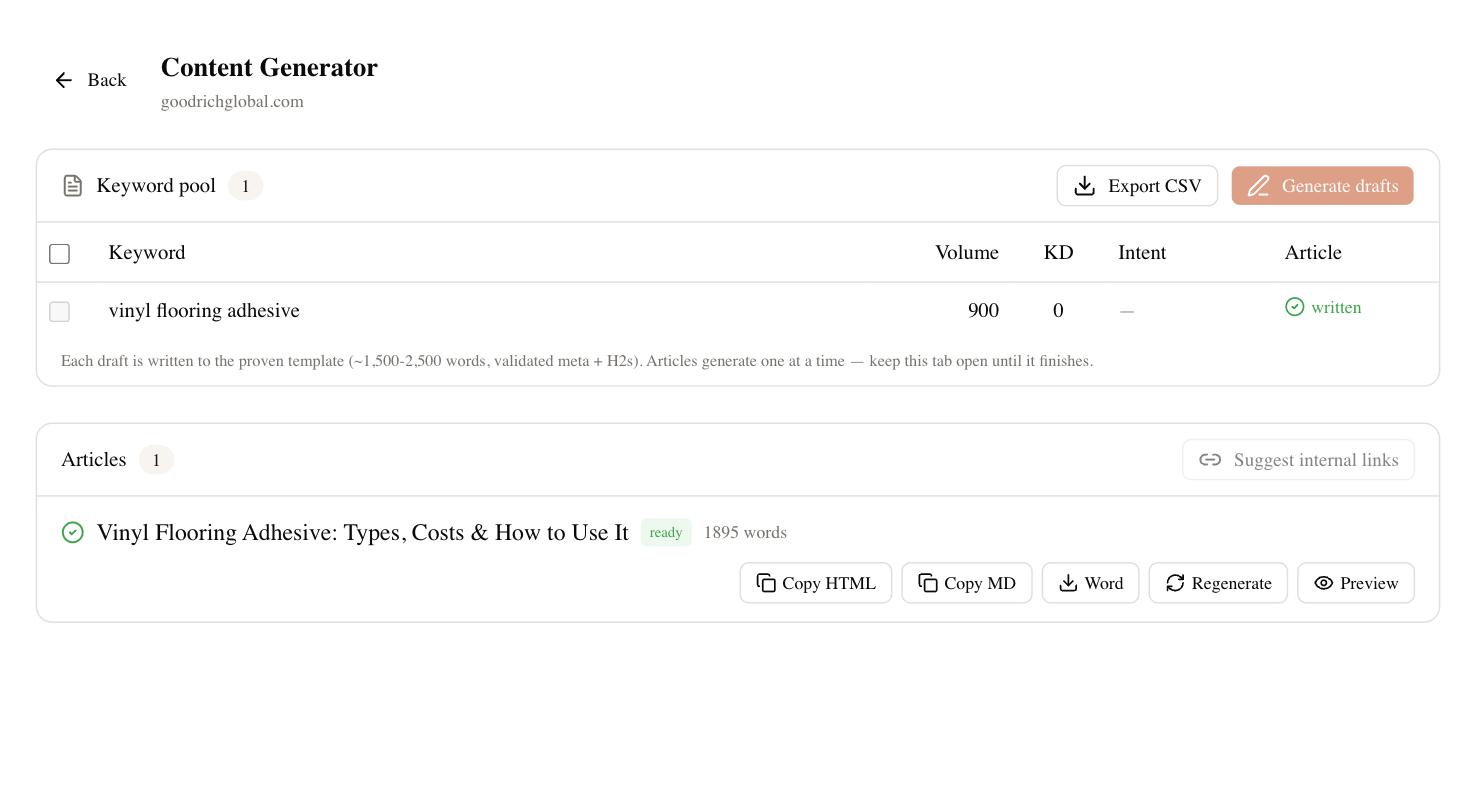
That consolidation is the real saving. Where RankIQ handles the optimize-and-grade step and leaves the rest to other subscriptions, SEO Rocket folds keyword research, drafting, and rank tracking into one login — and the entry pricing sits comfortably in the low band, not the enterprise tier. For a consultant or agency, the client-dashboard side means you can hand a read-only report straight to a client without exporting a thing.
The AI-visibility piece is the part no content optimizer answers. Search is splitting: some of your readers now ask ChatGPT or Perplexity instead of Google, and a post that ranks first can still be invisible in an AI answer. SEO Rocket tracks whether and where you’re being cited across those surfaces, so you’re writing for the search that’s actually happening. If your bottleneck is doing more with fewer tools — which describes most people reading this — it’s the strongest fit on the list.
Surfer SEO, Frase and Clearscope
These three are the closest like-for-like swaps if you mostly want a better content optimizer than RankIQ.
- Surfer SEO — the power user’s optimizer. Its content editor scores drafts against live SERP data in real time and goes deeper on structure, word count, and term coverage than RankIQ’s grade. It expects you to bring your own keyword strategy, and the price sits a notch above entry level.
- Frase — the fastest path from query to draft. It builds a research brief from the top results and drafts alongside it, which suits writers who want to move quickly. The optimization is lighter than Surfer’s, but the workflow is smooth and the price is friendly.
- Clearscope — the premium editorial choice. Its grading is clean, accurate, and trusted by in-house content teams, and it integrates neatly with Google Docs. The catch is cost: it sits firmly in the high band and is priced for teams, not solo bloggers.
Any of the three will beat RankIQ on pure optimization depth. What none of them do is track your rankings or tell you whether an AI engine is citing you — that’s still a separate tool.
Semrush and NeuronWriter
Semrush is the opposite end of the spectrum from RankIQ: a full marketing suite covering keyword research, backlinks, technical audits, PPC, and a content toolkit. If you want everything under one login and have the budget, it’s a real all-in-one. The trade-offs are the familiar ones — it’s expensive once you add the features worth buying, and the breadth means a steeper learning curve than a focused blogging tool.
NeuronWriter goes the other way. It’s a low-cost, NLP-driven content optimizer that competes directly with RankIQ on price, offering SERP analysis and term recommendations for a fraction of a suite subscription. It won’t match Semrush on data or SEO Rocket on AI-search tracking, but for a solo blogger who just wants a cheaper optimizer, it’s a sensible swap.
When you should just keep RankIQ
Honesty matters here. If you’re a blogger in one of RankIQ’s well-covered niches, your whole job is writing posts that rank, and you already have rank tracking handled elsewhere, RankIQ’s curated keyword libraries are a genuine shortcut. Picking a proven low-competition phrase and grading your draft against the top pages is exactly what it’s built for, and it does it simply. If that’s your entire week and the price fits, there’s no reason to switch for the sake of it. The right question isn’t “is there something bigger,” it’s “do I actually need the extra scope.”
How to choose your RankIQ alternative
Match the tool to your real constraint, not to a feature page. If tool-sprawl is the problem and you want keyword research, AI writing, and AI-search tracking in one place, SEO Rocket is the natural move. If you only want a deeper optimizer, Surfer, Frase, or Clearscope will out-grade RankIQ. If you want the whole marketing suite, Semrush earns its price, and if you just want a cheaper optimizer, NeuronWriter does the job.
A quick way to decide: write down the three tasks you actually did last week. If they were all “pick a keyword, write a post, check the grade,” RankIQ or a lean optimizer covers you. If even one was “see where I rank” or “find out why a competitor outranks me,” you’ve outgrown a pure content tool — and an AI-native platform will cover all three faster and cheaper. Whatever you pick, run your own site and two competitors through it for a full ranking cycle before you judge it; positions jitter a few spots day to day, and the tool that answers your real questions fastest is the right alternative for you.