This Rytr review is for the person weighing a cheap AI writing tool and wondering whether it is enough for real work. Rytr is one of the original affordable AI writers, and this honest Rytr review covers what it genuinely does well, where it quietly falls short, and who should actually pay for it. No affiliate spin, no invented numbers.
Short version: Rytr is a competent, low-cost copy generator that punches above its price for short-form snippets. It is not an SEO platform, and treating it like one is where people get burned. Below is the detail, and where a different kind of tool fits better.
What Rytr actually is
Rytr launched as one of the first budget-friendly AI copywriters, and it has stayed true to that lane. You pick a use case from a library of roughly 40 templates — blog idea, email, product description, ad copy, social caption, meta title — choose a tone and a language, feed it a short brief, and it drafts a few variations. It supports dozens of languages and a wide spread of tones, ships a Chrome extension so you can write inside other apps, and includes a built-in plagiarism check and a tone-matching feature that mirrors a writing sample you paste in.
That is the whole product, and there is nothing wrong with that. Rytr does one job — turning a short prompt into passable copy — and it does it fast. The trouble only starts when you expect it to be a research tool, a keyword tool, or a long-form SEO engine, because it was never built to be any of those.
Where Rytr does well
Speed and price are the honest strengths. For a social caption, a cold-email opener, a batch of product descriptions, or ten ad variations, Rytr gets you from blank page to usable draft in under a minute. The template library removes the “what do I even type” problem that stops a lot of people using raw chatbots, and the tone controls are genuinely useful when you want the same idea in a punchy voice versus a formal one.
The free tier is a real strength too. You can test the output quality on your own briefs before spending anything, which is more than a lot of competitors offer. If your writing need is high-volume and short-form — a solo store owner refreshing listings, a freelancer knocking out captions — Rytr covers it cheaply and without a learning curve.
Where Rytr falls short
The weaknesses are just as honest. Long-form output is where Rytr thins out fast: paragraphs get repetitive, claims get vague, and a 1,500-word article stitched together section by section reads like it was stitched together section by section. You will edit heavily. That is fine for a human writer using it as a drafting aid, and frustrating for anyone hoping to publish straight out of the tool.
The bigger gap for SEO people is that Rytr has no data underneath it. There is no keyword research, no search-volume data, no SERP analysis, no competitor gap view, and no rank tracking. It can generate a meta title, but it cannot tell you which keyword to target or whether the title has any chance of ranking. The AI is not grounded in anything about your market — it writes from the prompt and its training, not from live search data. For casual copy that does not matter. For content meant to earn traffic, it means Rytr is only doing the last 20% of the job.
Rytr pros and cons versus an SEO-native tool
Here is a fair side-by-side on the dimensions that actually decide the buy. The comparison is against SEO Rocket, an AI-native SEO tool, because that is the honest contrast — one is a copy generator, the other is a research-plus-writing workflow.
| Capability | Rytr | SEO Rocket |
|---|---|---|
| Short-form copy speed | Excellent | Good |
| Template variety | ~40 use cases | SEO-focused workflows |
| Keyword & SERP data | None | Ahrefs-grade, built in |
| Long-form SEO articles | Weak, needs heavy edits | Core strength |
| Rank tracking | No | Yes |
| AI-search visibility | No | Yes, tracks AI answers |
| Rough price band | Budget, incl. free tier | Low, entry-friendly |
Neither column is “better” in the abstract. If your job is copy snippets, the left column wins on price and simplicity. If your job is ranking content, the right column is doing work the left one cannot.
Rytr pricing, roughly
Rytr sits firmly in the budget band. There is a free plan with a modest monthly character allowance, which is enough to trial it properly. Paid plans are cheap by AI-tool standards — roughly the price of a couple of coffees to somewhere in the low-to-mid twenties a month for the top personal tier, depending on features like custom tones and the plagiarism checker. Prices and plan names shift, so treat that as a band, not a quote, and check the current page before you buy.
For what it charges, Rytr is fair value. Nobody should feel oversold. The question is never really “is it cheap enough” — it almost always is — but “is short-form copy generation the thing I actually need to pay for.”
Rytr versus an AI-native SEO alternative
If your real goal is search traffic, the honest recommendation is a tool that starts from data, not from a prompt box. SEO Rocket is built for that job: you ask for what you need in plain language, it runs real keyword research, competitor gaps, backlink data, and rank tracking on Ahrefs-grade data, and then it drafts the article on top of that research using Claude. Same chat, one subscription.
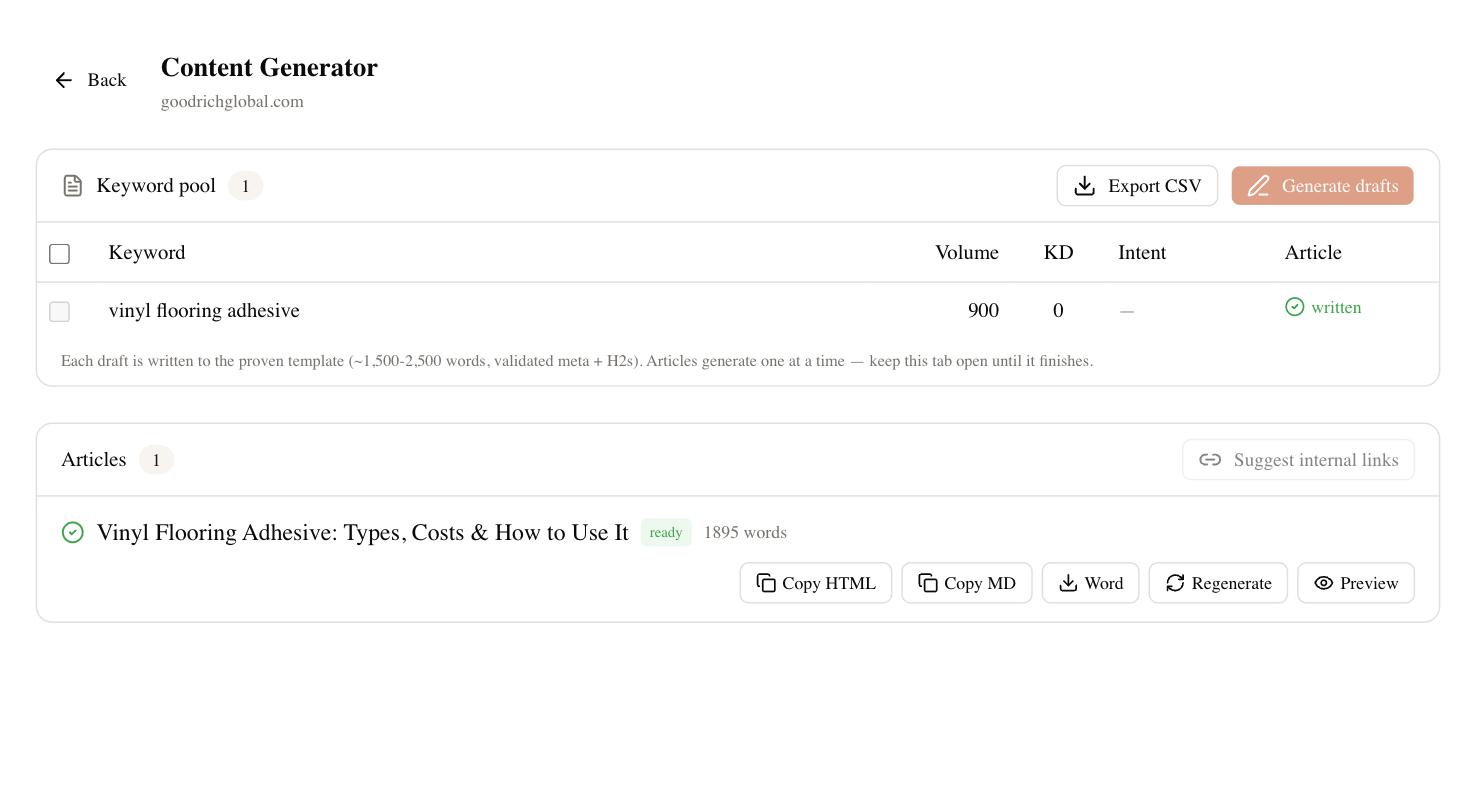
The difference shows up in the output. Rytr writes what sounds plausible; an SEO-native tool writes what is aimed at a keyword you can actually win, with a title and heading structure informed by what already ranks. SEO Rocket also tracks something Rytr does not touch at all — whether your brand gets cited in AI answers from ChatGPT, Perplexity, and Google’s AI Overviews — which increasingly decides whether people find you. If your bottleneck is producing content that ranks and gets seen, that end-to-end workflow is the stronger fit, and it lands in a similar budget-friendly band.
Who should use Rytr
Rytr is the right call for a specific person: someone who writes a lot of short copy, wants it fast, and does not want to think about SEO data. Solopreneurs, e-commerce sellers, social media managers, and freelancers producing captions, emails, and product blurbs will get real value for very little money, and the free tier lets you confirm that before committing.
Rytr is the wrong call if you are trying to rank in Google or show up in AI answers. It has no keyword data, no SERP awareness, no rank tracking, and its long-form output needs a heavy edit to be publishable — so as an SEO engine it leaves most of the work undone. For that job, a tool that pairs real search data with AI writing, like SEO Rocket, does more of it in one place. Buy Rytr for what it is: a fast, cheap, honest short-form copy assistant. Just do not ask it to be your SEO strategy.