The most useful ai overviews statistics aren’t the scary headlines — they’re the ones you can act on. Below are the numbers worth knowing about Google’s AI Overviews, each pulled from a named study, so you can plan around what the data says rather than what a LinkedIn post claims. These ai overviews statistics come from Pew Research, Ahrefs, Semrush, BrightEdge, and Google’s own disclosures, and where the studies disagree, this guide says so plainly.
AI Overviews are the AI-generated summaries that now sit at the top of many Google results pages, pushing the traditional blue links down. They matter to you because they change two things at once: how often a searcher sees your listing, and whether they bother to click it.
How often AI Overviews actually appear
Prevalence is where most reporting goes wrong, because every tracker uses a different keyword set, country, and device mix. Semrush, studying more than 10 million search terms, found AI Overviews appeared for 6.49% of queries in January 2025, climbing to 24.61% by July before settling around 15.69% by November 2025. Pew Research, analyzing 68,879 real searches from 900 U.S. adults, put it at roughly one in five — about 18% — of searches in March 2025.
So the honest answer is a range, not a single figure: somewhere between 15% and 25% of everyday searches in 2025, depending on how you measure, with individual trackers reporting higher on broad or mobile query sets. Treat any precise-sounding prevalence number with suspicion unless it names its methodology.
What AI Overviews do to your clicks
This is the part that changes budgets. The Pew Research study found that when an AI summary appeared, users clicked a traditional search-result link on just 8% of visits — versus 15% when no summary was present. That’s close to half the click-through, wiped out by a box most searchers didn’t ask for.
Ahrefs’ own data is blunter still. An April 2025 study measured a 34.5% drop in click-through rate for the top-ranking result when an AI Overview was present. A follow-up using 300,000 keywords from Ahrefs Keywords Explorer, published in December 2025, found the reduction had deepened to 58% for the number-one position. The direction is unmistakable: as AI Overviews expand, the click penalty grows.
The searchers who don’t click often don’t go anywhere at all. Pew found that 26% of visits to a results page with an AI summary ended the browsing session entirely, compared with 16% of pages without one. And links inside the summary itself rescue almost nothing — only 1% of visits produced a click on a cited source.
Which searches trigger an AI Overview
Not every query is equally exposed, and the pattern is clear enough to plan around. The Pew data shows AI Overviews are driven by how a person phrases their search:
- Short queries are mostly safe. Only 8% of one-to-two-word searches produced an AI summary.
- Long queries almost always trigger one. 53% of searches with 10 or more words returned an AI Overview.
- Questions are the biggest trigger. 60% of searches phrased as a full question produced a summary.
The takeaway for your keyword strategy: informational, question-shaped, long-tail terms are the most exposed to AI Overviews, while shorter navigational and commercial terms are far less affected — for now.
Where AI Overviews pull their sources
If your page is going to lose the click, the next best thing is to be the cited source inside the box. Here the studies genuinely conflict, and it’s worth seeing both sides.
| Study | Finding on source–ranking overlap |
|---|---|
| BrightEdge | Overlap between AI Overview citations and organic rankings grew from 32% to 54% over 16 months; only about 16.7% of citations came from the top 10, with most growth from pages ranking 21–100. |
| Ahrefs | A large majority — roughly three-quarters — of URLs cited in AI Overviews also rank in Google’s organic top 10, keeping traditional ranking authority central. |
| Pew Research | AI summaries are source-hungry: 88% cited three or more sources, and the median summary ran about 67 words. |
Reconcile them like this: ranking well still helps a lot — the top 10 is heavily represented — but it is no longer a guarantee, and a meaningful share of citations now comes from pages ranking well below the first page. In other words, strong content that ranks on page two or three can still earn an AI citation it would never earn a click for.
The scale of AI search adoption
The behavior shift is not niche. Google has said its AI Mode surpassed 1 billion monthly active users, and that AI Overviews now reach roughly 2 billion monthly users worldwide, per figures reported by Search Engine Journal. Google also describes AI Mode queries as running two to three times longer than a traditional search, which lines up neatly with the Pew finding that long, conversational queries are exactly the ones that trigger AI answers.
Put those together and the trend is a one-way street: more searches, phrased more conversationally, are being answered on the results page itself. The question isn’t whether AI search affects you, but which of your keywords it touches first.
What this means for your SEO
Don’t panic-optimize off a single scary percentage. Do these five things instead, in order:
- Segment your keywords by exposure. Long, question-shaped, informational terms are where AI Overviews hit hardest (60% of questions trigger one, per Pew). Commercial and navigational terms are far safer. Know which of your traffic sits in the danger zone.
- Protect the money terms. Bottom-of-funnel and branded queries still send clicks. Make sure your rankings there are unshakeable before you worry about informational losses.
- Write to be cited, not just ranked. Since AI Overviews favor sources that rank — and pull from beyond the top 10 — clear, well-structured, directly-answering content is your ticket into the box even when it costs you the click.
- Measure AI visibility, not just positions. Rank tracking alone can’t tell you whether ChatGPT, Perplexity, or Google’s AI Overviews cite your brand. That’s a separate signal you now have to watch.
- Rebuild your traffic forecasts. With top-position click-through down 34.5%–58% on AI Overview queries (Ahrefs), your old CTR-by-position model overstates traffic. Update it.
This is exactly the gap SEO Rocket is built for. Its rank tracking shows where you sit on the traditional results, while its AI-visibility tracking shows whether — and where — you’re actually being cited across ChatGPT, Google AI Overviews, and Perplexity. You optimize for the search that’s happening now, not the one that happened in 2019.
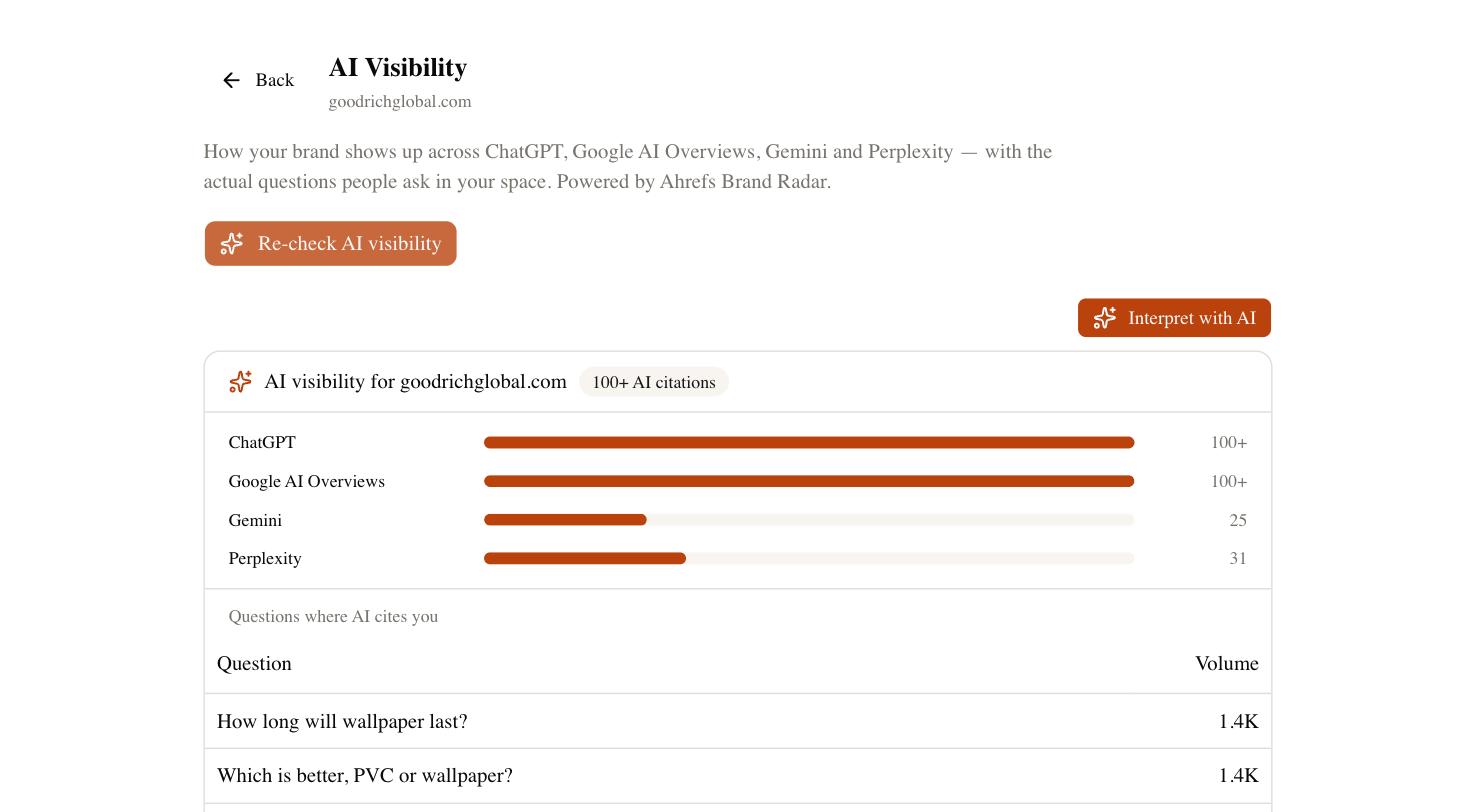
The practical move is to run your own site and two competitors through both views for a full ranking cycle. You’ll quickly see which terms you’re losing clicks on, which ones still convert, and whether the AI boxes eating your impressions are at least citing you by name. That’s a plan you can act on — which is more than any single statistic gives you.
Sources
- Pew Research Center — Google users are less likely to click links when an AI summary appears (July 2025)
- Ahrefs — AI Overviews reduce clicks (2025 studies)
- Semrush AI Overviews study (via SellersCommerce) — AI Overview prevalence across 10M+ keywords (2025)
- BrightEdge — Citation and organic-ranking overlap after 16 months of AI Overviews
- Search Engine Journal — Google’s first AI Mode usage figures after one year