Most roundups of ai search statistics mix real research with numbers someone invented for a slide. This one doesn’t. Every figure below comes from a named source you can check — Pew Research, Ahrefs, Similarweb, Google, OpenAI, Gartner — because the whole point of ai search statistics is that they hold up when a client asks “where did that come from?”
Here is what the credible data says about how people search now, how often AI answers show up, and what that does to the clicks your pages used to get.
How big AI search actually is
The headline numbers are genuinely large, and they come from the platforms themselves. OpenAI said ChatGPT passed 800 million weekly active users by the end of 2025, roughly double the 400 million it reported in February 2025. OpenAI has also described users sending more than 2.5 billion messages a day.
Google’s surfaces are bigger still. Google has said its AI Overviews reach around 2 billion users a month, and that AI Mode — its full conversational search experience — hit about 75 million users by December 2025. Perplexity, the AI-native search engine, reported passing 30 million monthly active users during 2025.
| Platform | Scale reported | Source |
|---|---|---|
| ChatGPT | 800M+ weekly active users (end of 2025) | OpenAI |
| Google AI Overviews | ~2 billion users per month | |
| Google AI Mode | ~75 million users (Dec 2025) | |
| Perplexity | 30 million+ monthly active users | Perplexity |
One prediction is worth flagging because you’ll see it cited everywhere. In 2024, Gartner forecast that traditional search engine volume would fall 25% by 2026 as AI chatbots absorbed queries. Treat that one carefully: as several analysts at Search Engine Journal and Search Engine Land pointed out, the deadline has arrived and Google still commands well over 90% of the search market. Search is shifting, not collapsing.
How often AI answers show up in Google
You don’t need people to leave Google for AI to change your traffic — you just need Google to answer inside the results page. Pew Research found that 58% of users ran at least one Google search that produced an AI-generated summary during March 2025 alone. That is the more useful exposure number, because it’s measured from real browsing behavior rather than a survey.
Coverage keeps climbing and it varies a lot by query type. Informational, question-shaped searches trigger an AI Overview far more often than transactional ones, so a blog-heavy site feels this before an ecommerce category page does. The direction is consistent across every tracker: more of your queries now get an AI answer stapled to the top than a year ago.
What AI answers do to your clicks
This is the part that shows up in your analytics, and the research is unusually consistent. Pew Research tracked 68,879 real Google searches and found that when an AI summary appeared, users clicked a traditional search result in just 8% of visits — versus 15% when no summary was present, nearly half the click rate. Clicks on the source links inside the AI summary were rarer still, happening in only 1% of visits.
Ahrefs saw the same pattern at scale. In its analysis of roughly 300,000 keywords, Ahrefs found the click-through rate for the number-one organic position was about 34.5% lower when an AI Overview was present. Ranking first no longer guarantees the click it used to.
Pew also measured what happens after the click. People were more likely to end their browsing session entirely after a search with an AI summary — 26% abandoned, compared with 16% on searches with only traditional results. The AI answer isn’t just intercepting the click; for a chunk of users it ends the journey.
- Traditional result clicked, AI summary present: 8% of visits (Pew Research, 2025)
- Traditional result clicked, no summary: 15% of visits (Pew Research, 2025)
- Link inside the AI summary clicked: 1% of visits (Pew Research, 2025)
- Position-one CTR drop when an AI Overview shows: ~34.5% (Ahrefs, 2025)
None of this is brand new behavior — it’s an acceleration of an old one. SparkToro’s analysis of US Google traffic found that roughly 58.5% of searches already ended without any click to an external site before AI Overviews were widespread. AI answers pour fuel on a zero-click fire that was already burning.
Where AI is sending traffic instead
The flip side of lost search clicks is a new, smaller referral channel. Similarweb estimated that AI platforms sent more than 1.13 billion referral visits to websites in June 2025, up about 357% year over year. That growth rate is real and worth chasing, but keep it in proportion: it’s a fraction of what Google organic still delivers.
The channel is also concentrated. Similarweb’s data shows ChatGPT drives the large majority of all AI referral traffic — on the order of 87% — with Perplexity and Google’s Gemini splitting most of the rest. In practice, “getting cited by AI” mostly means getting cited by ChatGPT today, with the others worth watching as they grow.
How buyers use AI to research and shop
The behavior change is furthest along in shopping, where AI is becoming a research layer that sits before your product page. Capital One Shopping’s research found that roughly 49% of consumers used AI for shopping at some point in 2025, and that 56% of US consumers planned to use AI chatbots to compare prices and find deals.
The generational split matters for where this goes next. Younger buyers lean on AI assistants far more heavily for product research than the average shopper, which means the customers you’re trying to win in five years are already forming buying opinions inside a chatbot — often before they ever type your brand into Google. If the AI’s answer doesn’t mention you, you’re not in the consideration set.
What this means for your SEO
Read together, these ai search statistics point to one shift: ranking and being seen are no longer the same thing. You can hold position one and still lose a third of your clicks to an AI Overview (Ahrefs), while a competitor you don’t track gets named inside the ChatGPT answer your buyer actually read. Two scoreboards now, not one.
So the practical to-do list is short. First, keep doing the fundamentals — the pages AI models cite are the same well-structured, genuinely useful pages that earn links and rankings, so classic SEO is the price of entry, not a dead end. Second, write for extraction: clear answers near the top, real specifics, structured data, and content that directly answers the question a user would ask a chatbot. Third — and this is the new one — actually measure whether you’re being cited across AI surfaces, because you can’t improve a number you never see.
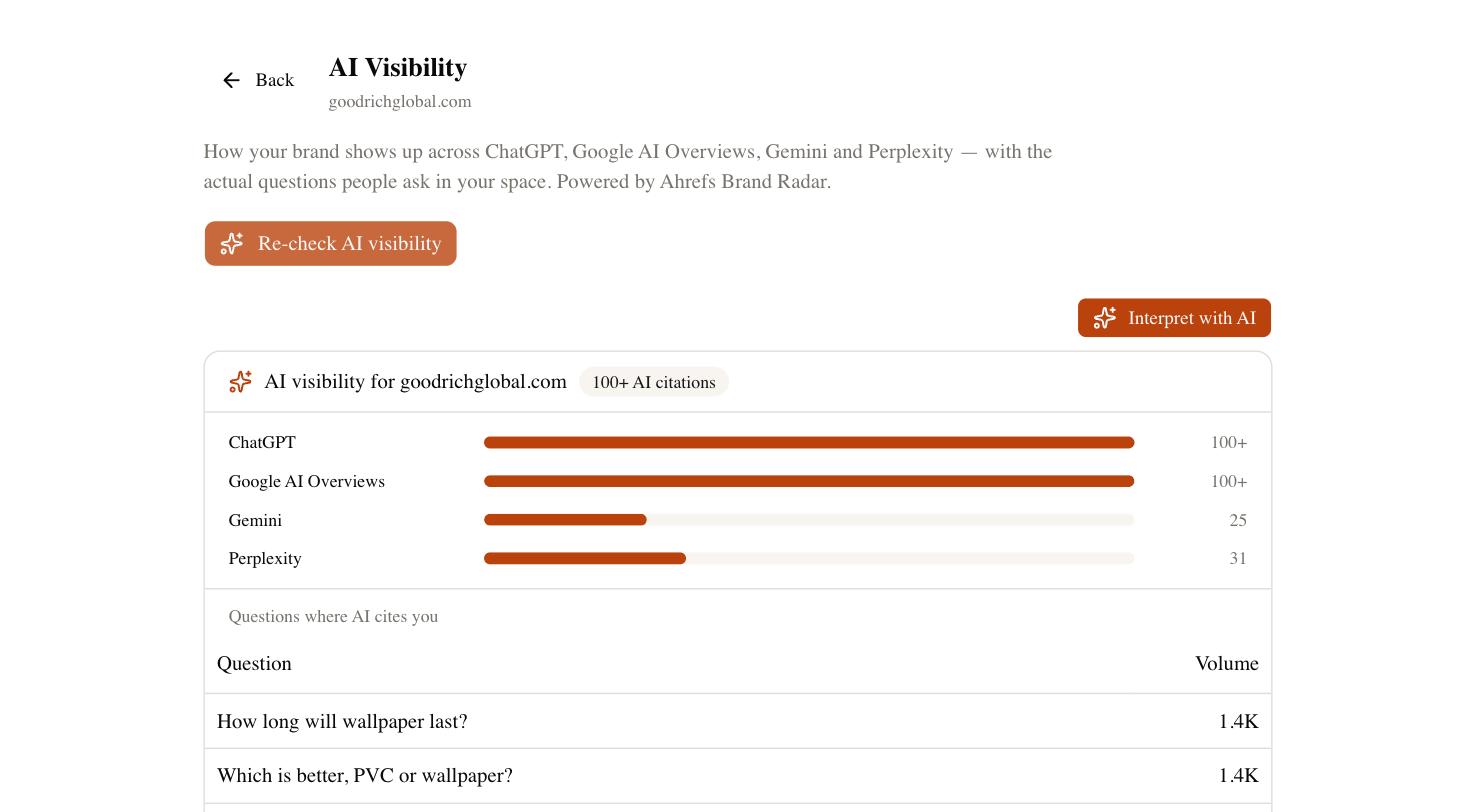
That last part is where SEO Rocket fits. It tracks your normal rankings and keywords on real data, and it also watches whether — and where — your brand gets cited across ChatGPT, Google AI Overviews, and Perplexity, in one place. Instead of guessing at the second scoreboard, you can see it, benchmark against competitors, and fix the gaps. Optimize for the search that’s actually happening, and measure both sides of it.
Sources
- Pew Research Center — Google users click less when an AI summary appears (2025)
- Ahrefs — How AI Overviews affect click-through rates
- Similarweb — Generative AI and AI search referral statistics
- Gartner — Search engine volume to drop 25% by 2026 (2024)
- SparkToro — 2024 Zero-Click Search Study
- Backlinko — ChatGPT / OpenAI usage statistics
- Capital One Shopping — AI shopping statistics (2026)
- Search Engine Journal — Skepticism on the 25% search-drop prediction